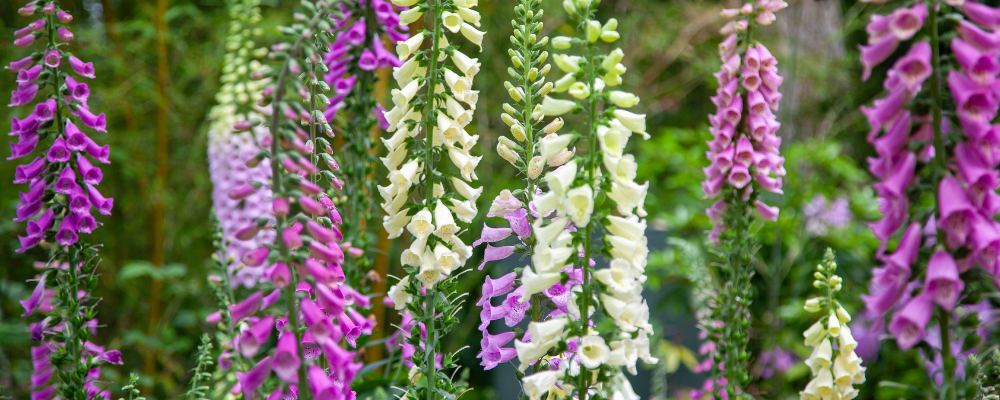
Purple foxglove lines its bells along a tall stem, like a series of suspended gloves. Its Latin name comes from the finger, its common names invoke fairies, goblins, and the Virgin, and its medical history leads to William Withering. Beneath this profusion of names remains a plant capable of stopping the heart.
In British and Irish traditions, the flower becomes a thimble, fairy glove, Virgin’s finger, or witch’s bell. The silhouette explains these images better than any modern correspondence: each corolla seems to await a small invisible hand.
The 18th century opens another chapter when Withering studied foxglove for dropsy. His work paved the way for the medical use of cardiac glycosides, whose margin between therapeutic effect and toxicity remains narrow. The whole plant must never be turned into a home remedy.
The Tall Spike with Purple Fingers
Digitalis purpurea L. belongs to the Plantaginaceae family. In its first year it forms a rosette of downy leaves; the following year it raises a flower spike bearing numerous tubular flowers, pink, purple, or white, marked with spots inside. The capsules then release a multitude of tiny seeds.
Kew gives the species a native range from Western and southwestern Europe to northern Morocco. The plant is cultivated as an ornamental and has become naturalized elsewhere. Kew, Digitalis purpurea.
All parts contain cardiac glycosides. The beauty of the flower spike does not make the flower a safe ritual accessory. Its imagery is enough to work with its names and figures.
Fingers, Gloves, and Thimbles
Botanist Leonhart Fuchs coined the name Digitalis in the 16th century from the Latin digitus, meaning finger, translating the idea of a thimble or finger stall. The German Fingerhut preserves this meaning. In French, names such as gantelée, Our Lady’s gloves, and the Virgin’s fingers Christianize the same form.
Folkard brings together Celtic and British names: in Ireland, Lusmore or fairy bonnet; in Wales, elves’ gloves; elsewhere, witches’ bells. Richard Folkard, Plant Lore, Legends, and Lyrics, “Foxglove”.
Each name places an absent bearer within the flower. Magic is born from this question: what hand, head, or being could inhabit the corolla?
Lusmore and the invisible people
An Irish tale features Lusmore, a bent man who bears the local name for foxglove. Hearing the fairies sing, he completes their refrain and receives healing as a reward. He then wears a sprig of the plant on his cap, a visible mark of the encounter.
Other customs interpreted the inclination of the stalk as a sign of the passage or weight of invisible beings. This interpretation does not describe an extraordinary physical property: wind, rain, and growth bend the stem. The story transforms this movement into a trace of a presence.
The glove without a hand. Foxglove offers a form ready to be inhabited. Its narrative power comes from absence: the corolla suggests a being that the eye cannot grasp.
Withering, the heart, and measurement
In 1785, William Withering published An Account of the Foxglove. He studied the plant’s use against dropsy and observed its effects, failures, and toxicity. This text became a milestone in the history of pharmacology.
The transition from herb to medicine does not mean that the raw leaves are usable. Modern digoxin is derived mainly from Digitalis lanata and requires medical dosing. Cardiac glycosides have a narrow therapeutic window and can trigger arrhythmias. NCBI Bookshelf, cardiac glycoside toxicity.
Thus, for the grimoire, the heart and measurement form a second axis: the beat, the interval, and the boundary separating remedy from poison.
Counting the bells without touching them
Use a botanical plate to count the open flowers, buds, and capsules. Record three rhythms on a page: what begins, what sounds now, and what ends. The flower stalk becomes a measure of time without a physical plant.
Draw a corolla and leave the inside empty. Around it, note the historical names: fingerstall, Our Lady's glove, fairy cap, elves' glove. Observe how the same form takes on different identities depending on the language and place.
For work involving the heart, listen to your resting pulse for a few moments without trying to alter it. Then place the image of foxglove in a closed book. The closure recalls the boundary between contemplation and medicine.
Historical correspondences
| Reference point | Correspondence |
|---|---|
| Botanical name | Digitalis purpurea L. |
| Name origin | The Latin digitus, meaning finger, adopted by Fuchs in the 16th century |
| Ritual names | Our Lady's gloves, Virgin's fingers, fairy cap, elves' gloves |
| Historical attribution | Venus, in Robert Turner as cited by Folkard |
| Magical domains | Invisible presence, rhythm, measurement, voice, and passage |
| Safe support | Botanical plate, drawing, and observing rhythm |