





















































































































Beneath its blue helmet, aconite carries a reputation born at the edge of the Underworld. Ovid has it emerge from Cerberus’s foam when Hercules brings the infernal dog into the light. Herbals later united this origin with two ominous names, monkshood and wolfsbane, which speak both to the flower’s form and to the true history of a poison.
Aconite is not a protective herb to be used like any other. In Greek texts and botanical compilations, it belongs to Hecate and Medea, to poisoned arrows, and to boundaries that no one crosses without consequence. Its magical significance comes from this power of rupture, not from an invitation to touch the plant or mix it into a preparation.
This profile focuses on Aconitum napellus L., a European species. Other aconites have been used as hunting poisons or medicinal materials after specialized treatments. These histories do not make any household preparation safe: aconitine can affect the heart and nervous system with extreme speed.
The Blue Mountain Helmet
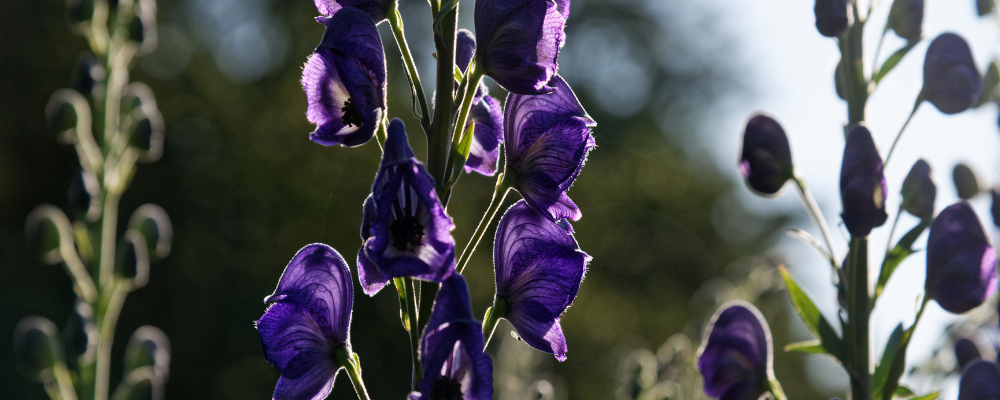
Aconitum napellus L. belongs to the Ranunculaceae family. This tuberous perennial bears deeply divided, palmate leaves and a flower stalk with blue or violet flowers. The upper sepal forms a hood, which gave rise to the names monkshood and friar’s hood. The thickened root concentrates a major share of the danger, but the entire plant is toxic.
Kew places its native range in Western and Central Europe. The genus Aconitum includes many species, with histories and compositions that do not overlap. Kew, Aconitum napellus.
The flower offers a striking image: a face hidden beneath a helmet. In a grimoire, this silhouette speaks of defense, secrecy, and prohibition. The living plant should be kept at a distance; study should rely on a botanical photograph, a digitized herbarium sheet, or a drawing.
Cerberus and the Infernal Birth
In the Metamorphoses, Ovid recounts how Hercules drags Cerberus out of Pluto’s realm. Blinded by the daylight, the multi-headed dog foams with rage. Wherever this foam falls, aconite takes root. Medea later draws on this poison when she seeks to eliminate Theseus.
The story gives the plant a magical geography: the opening between the world of the dead and that of the living. Aconite grows at the point of contact, like the material trace of a guardian torn from its gate. Ovid, Metamorphoses, Book 7.
Hecate appears in later commentaries as the instigator of this plant’s birth. She governs crossroads and nocturnal passages; Aconite thus becomes its dangerous mark. The story calls for no action involving the plant. It is enough to place the image of the helmet before a boundary one chooses not to cross.
Wolf’s Bane, Arrows, and Political Power
The name wolf’s bane preserves a hunting practice: bait or weapons were treated with poisons extracted from aconite species. Folkard recalls the use of poisoned arrowheads in antiquity and in Asia, while distinguishing European monkshood from Aconitum ferox, cited for northern India.
This story places Aconite within the magic of weapons and the power of death. It also explains its presence beside Medea in literature: the sorceress masters a substance feared by kings as much as by hunters. Richard Folkard, Plant Lore, Legends, and Lyrics, “Monk’s Hood”.
The Boundary Beneath the Helmet. Aconite does not offer familiar protection. Its image warns that certain boundaries must remain closed and that power may reside in the refusal to act.
The Mystery of the Name Aconite
Authors connected the word aconitum with the bare rocks where the plant was said to have appeared, and then with the power of a poison capable, in Ovid’s verse, of making its way through stone. These etymologies belong more to the literary imagination than to linguistic certainty.
The stone, the helmet, and the hellhound nevertheless form a coherent whole. The stone closes, the helmet covers, Cerberus guards. The plant becomes the emblem of a stern boundary. In a historical magical practice, it lends itself to meditation on prohibition, punishment, and the responsibility attached to knowledge.
This reading sets aside the modern image of an herb to burn to “drive away negativity.” The sources speak of poison, a guardian, and a boundary. Their power lies in the narrative, iconography, and name.
Working with the guardian’s image
Choose a botanical reproduction of Aconite or draw its helmet-shaped flower. Place the image in front of a closed box containing a text, a memento, or a commitment requiring a clear boundary. Write the boundary set below it: “my consent ends here,” “this secret remains closed,” or “I do not cross this boundary.”
For a reading devoted to Hecate or Medea, keep the image beside the book, without a real plant. Note the words related to doors, dogs, rocks, and poison. This collection reveals the symbolic network without reproducing a dangerous act.
A flower can also be made from blue paper and then placed facing a miniature door. The rite ends when the door is closed and the monkshood is placed in front of it. No specimen, extract, or plant residue enters the space.
Historical correspondences
| Marker | Correspondence |
|---|---|
| Botanical name | Aconitum napellus L. |
| Figures | Hecate, Medea, Hercules, and Cerberus |
| Symbolic places | Infernal gate, rock, boundary, battlefield |
| Historical names | Monkshood, wolfsbane, wolf’s-bane |
| Magical domains | Forbidden, protection, rupture, secrecy, responsibility |
| Safe medium | Botanical image, drawing, text, and miniature door |