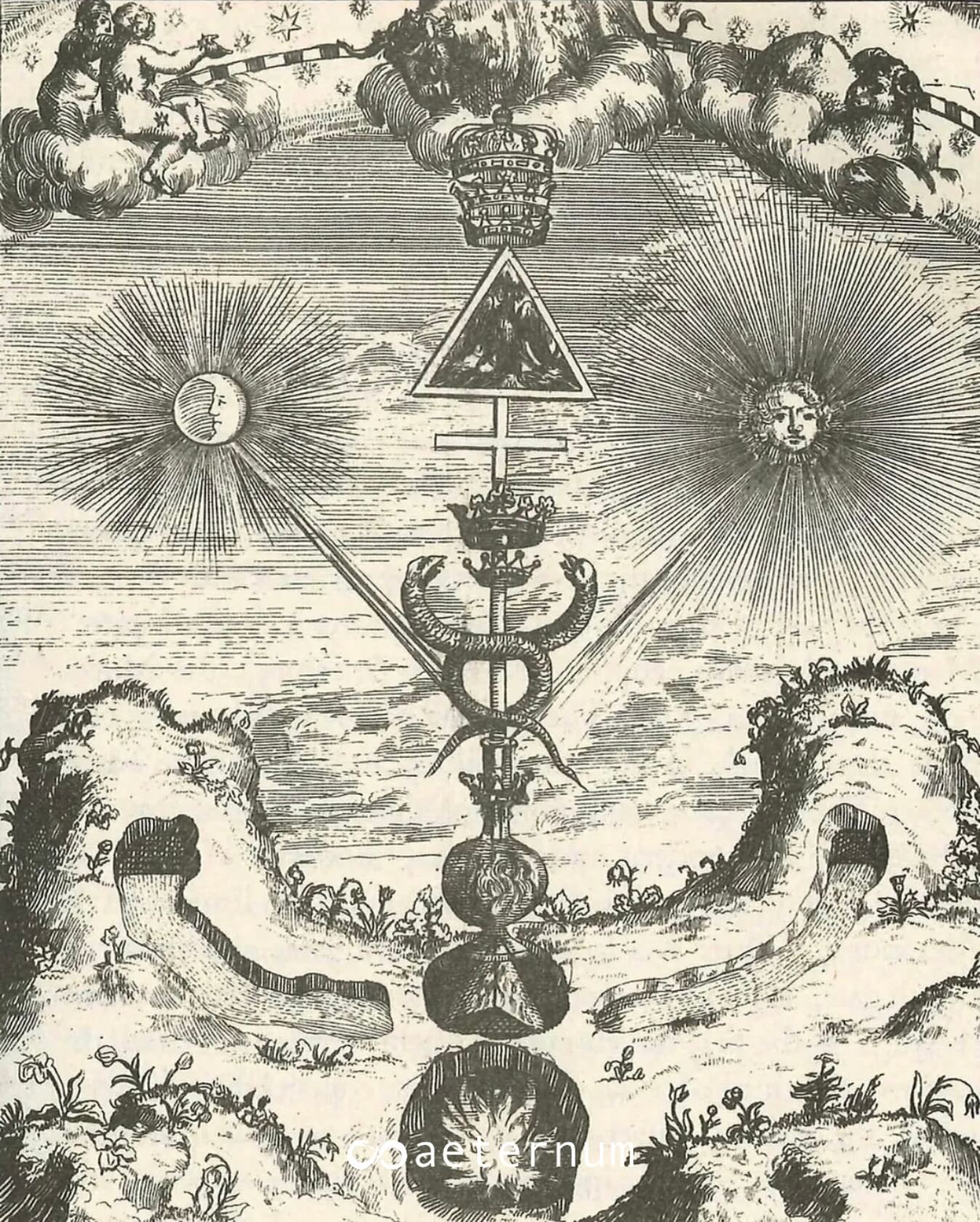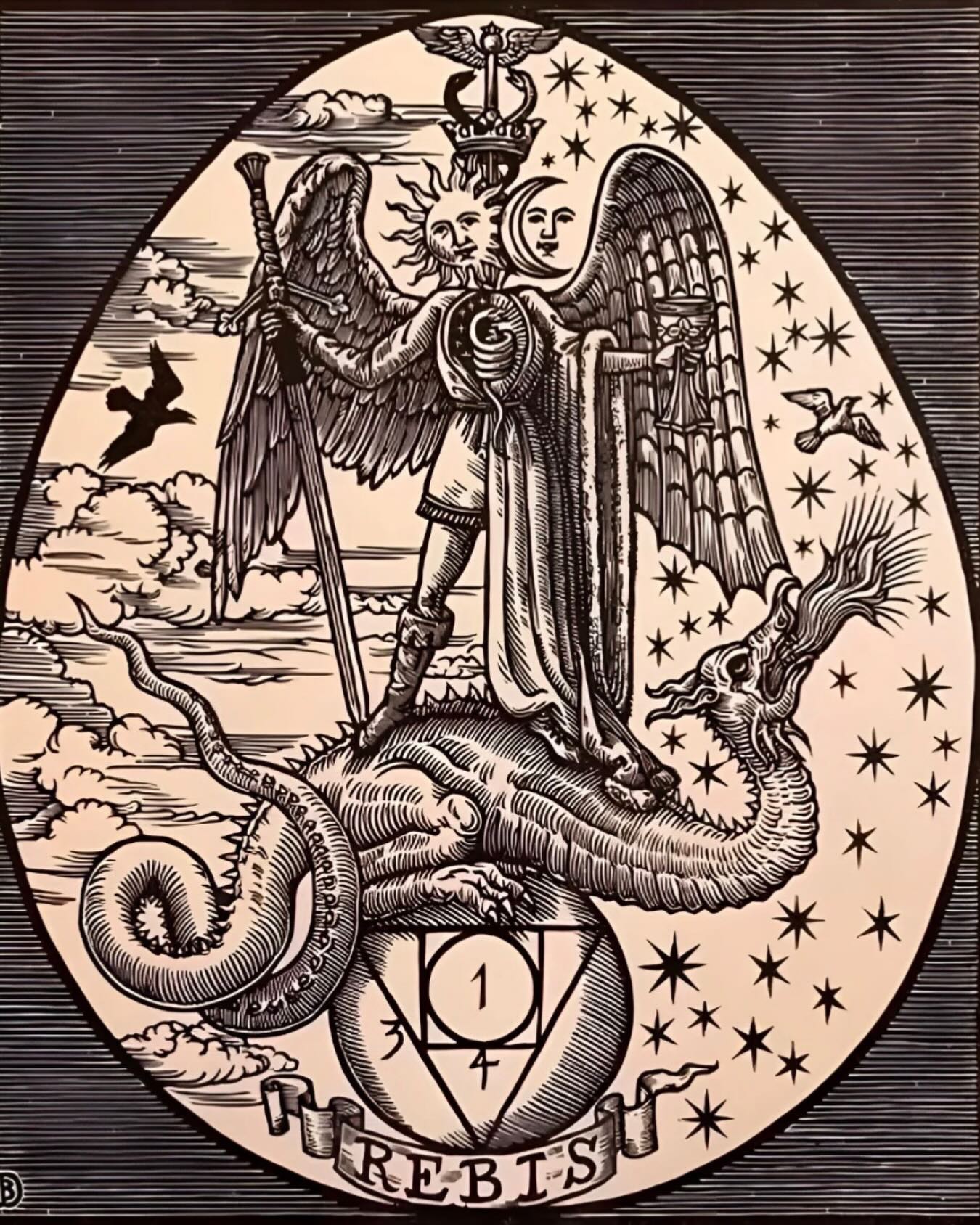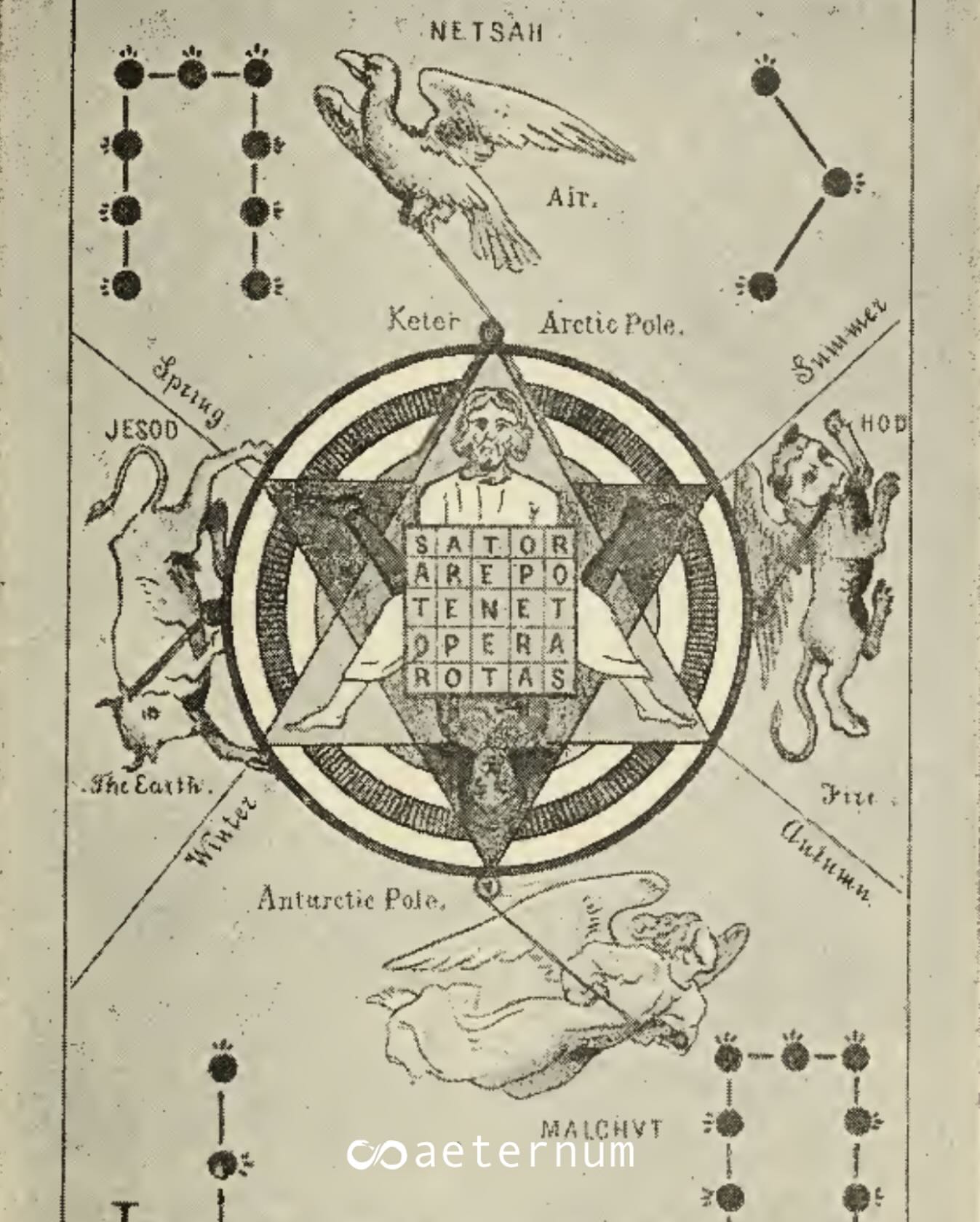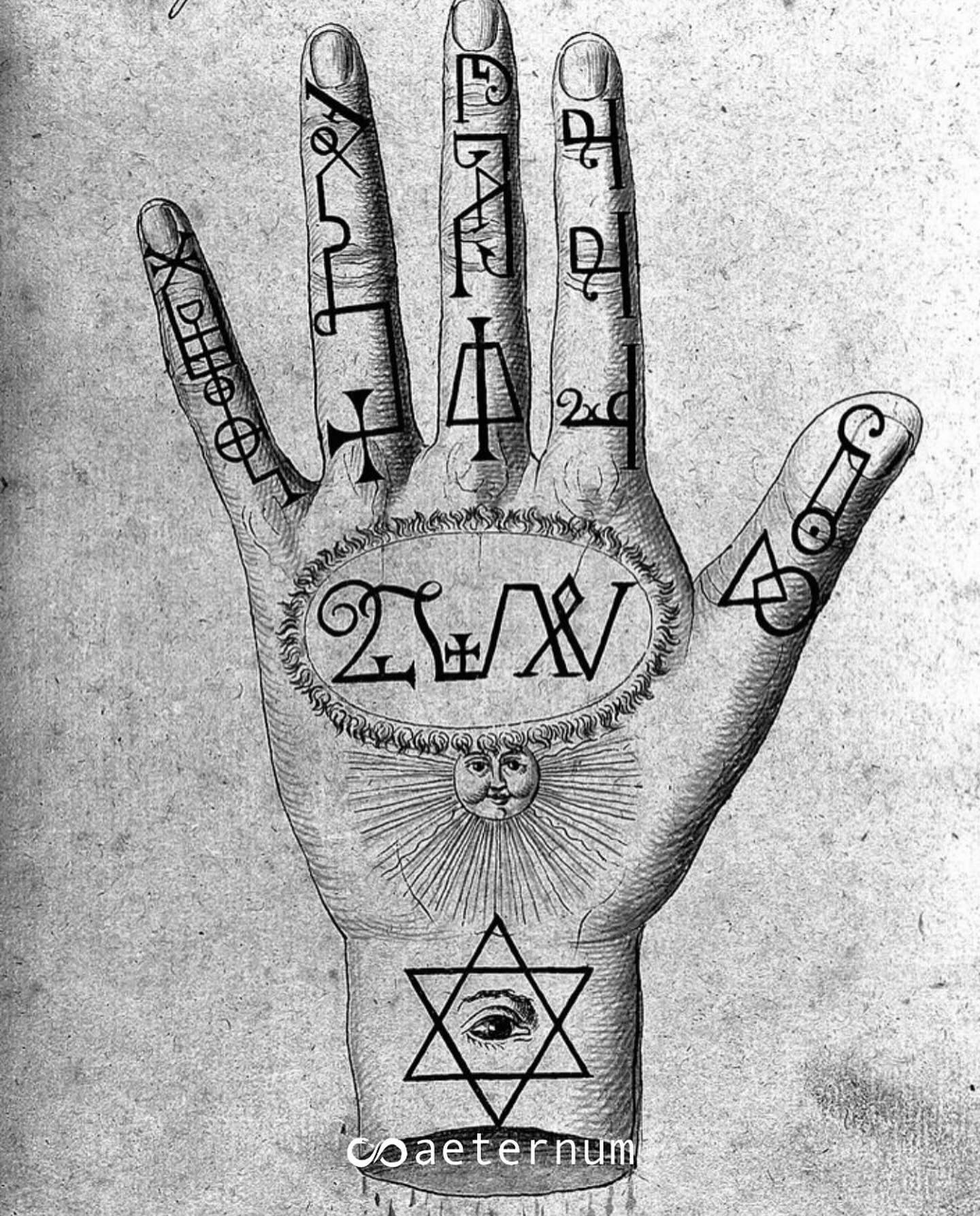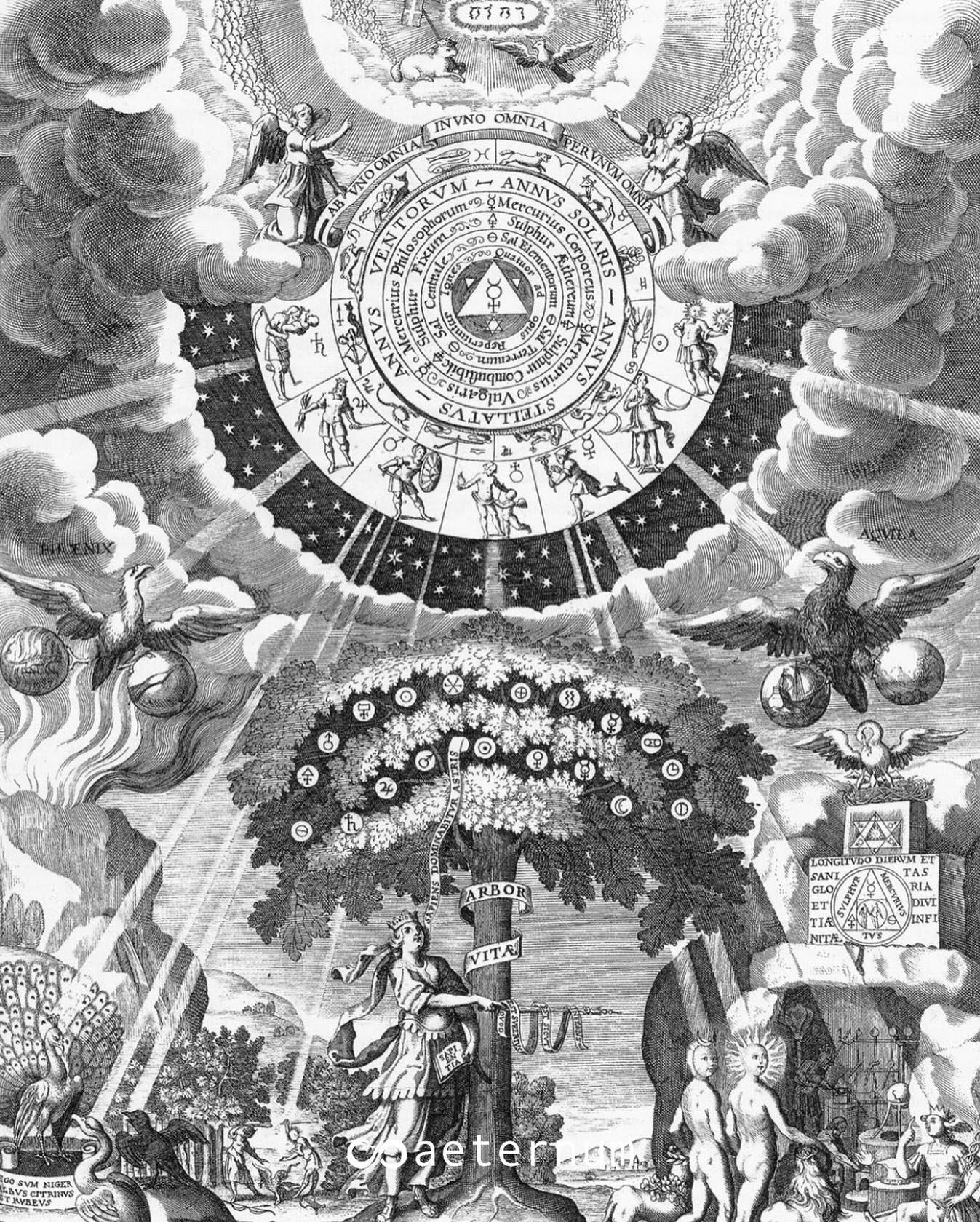
























































































































The Ordo Templi Orientis (or O.T.O., as indicated in particular on our Crowley tarot decks) is an occult initiatory society founded at the turn of the 20th century and closely linked to the emergence of Thelema. This esoteric spiritual movement revolves around the thought of Aleister Crowley and the Book of the Law (Liber AL vel Legis), Thelema’s sacred text from 1904. A secret organization inspired by Freemasonry, the O.T.O. distinguished itself by claiming to possess the “key to all Hermetic and Masonic secrets.” History.
The origins of the O.T.O.: fin-de-siècle occultism and Masonic legacies
The Ordo Templi Orientis emerged amid the occult and Masonic ferment of the late 19th century. Its very name—“Order of the Temple of the East”—evokes the legendary legacy of the Knights Templar. The order’s founders, Austrian industrialist Carl Kellner (1851–1905) and German occultist Theodor Reuss (1855–1923), did indeed draw inspiration from Templar myths and their tradition of esoteric rites. The Knights Templar, suppressed in the 14th century, were notably accused by their detractors of illicit sexual practices during secret ceremonies. It was in this context that Kellner and Reuss, both high-ranking Freemasons, developed a new initiatory society.
Around 1904, they officially established the Ordo Templi Orientis in Germany. From the outset, the order presented itself as a federation of high Masonic degrees: as early as 1902, Reuss and Kellner had obtained charters authorizing them to practice several occultist Masonic rites (Memphis, Misraïm, Swedish Rite), issued by Englishman John Yarker, an influential figure in irregular Freemasonry. These exotic rites—combining Egyptology, Illuminism, and Rosicrucianism—formed the core of the new order. In practice, the O.T.O. borrowed from Freemasonry its hierarchical structure of degrees, initiatory oaths, and part of its symbolism. Kellner’s ambition was to establish a “Masonic Academy” synthesizing the various existing systems of high degrees.
At the same time, the order incorporated more daring esoteric teachings. Kellner claimed to have discovered the true key to Masonic mysteries during his travels in the East, from three adept masters. In reality, his “adepts” seem to have been the old works he studied: erotic treatises such as the Kama Sutra and the Arabic manual The Perfumed Garden, sources of a doctrine of sexual magic that he intended to place at the heart of the order. From its beginnings, the O.T.O. presented itself as the possessor of a singular occult knowledge: mastery of sexual energies as a path to illumination. Reuss, a journalist and active Freemason involved in numerous occult circles, established himself as the order’s organizer. He attracted several prominent figures of fin-de-siècle occultism to the O.T.O.: in France, the esoteric physician Gérard Encausse (known as Papus); in Germany, the future founder of anthroposophy, Rudolf Steiner; and in the United States, H. Spencer Lewis (future founder of the Rosicrucian AMORC), all received charters from Reuss incorporating them into the emerging order.
As early as 1912, the O.T.O. publicly announced the nature of its secret teaching. In a special issue of its journal Oriflamme, Reuss proclaimed that the order “possesses the KEY that opens all Masonic and Hermetic secrets, namely the teaching of sexual magic, which explains without exception all the mysteries of Nature, all the symbolism of Freemasonry, and all religious systems.” This bold declaration marked the O.T.O.’s entry into the small world of esoteric societies of the time, while fueling curiosity and controversy. But 1912 was also the year of a decisive event that would shape the order’s future: Reuss’s meeting with Aleister Crowley.
Aleister Crowley and the integration of Thelema into the order
Aleister Crowley (1875–1947), an iconoclastic British occultist, was initiated into the Ordo Templi Orientis in 1912 and quickly became its central figure. Legend has it that his entry took place in dramatic fashion: Theodor Reuss allegedly approached Crowley to accuse him of divulging an O.T.O. secret in one of his books. Indeed, in his collection The Book of Lies (1912), Crowley had published—unconsciously, he claimed—a veiled instruction concerning the arcana of sexual magic. When Reuss pointed this out to him, Crowley suddenly understood the esoteric meaning of a passage he himself had written, revealing one of the order’s key sexual practices. Impressed by Crowley’s ingenuity, Reuss admitted him to the O.T.O. and, in 1912, appointed him head of the British branch, with the title of National Grand Master X° for Great Britain and Ireland. Crowley thus received authority to develop the O.T.O. throughout the English-speaking world, in exchange for his discretion regarding the order’s “secrets.”


Crowley, already an influential member of several occult orders (he had co-founded his own mystical school, the A∴A∴, and spent some time in the Golden Dawn), saw in the O.T.O. a ready-made structure into which he could insert his own spiritual vision: Thelema. This Greek term, meaning “Will,” designates the religious philosophy he founded after receiving the Book of the Law in 1904. This short prophetic text, which he claimed to have written under the dictation of a superhuman intelligence named Aiwass, proclaimed a new spiritual era, the Aeon of Horus, governed by a single law: “Do what thou wilt shall be the whole of the Law. Love is the law, Love under Will.” In other words, each individual must discover and fulfill their True Will, their authentic purpose within the cosmic order, in freedom and with respect for that of others. Crowley considered himself the prophet of this new Thelemic revelation and therefore devoted himself to disseminating it within the O.T.O.
Between 1913 and 1918, Crowley undertook a profound overhaul of the O.T.O. With Reuss’s approval, he rewrote all the initiation rituals to infuse them with the principles of Thelema, gradually removing purely Masonic references in order to create a coherent system suited to the new era. In 1913, he also composed the liturgy of a Gnostic Catholic Church attached to the order: a ritualized mass, known as the Gnostic Mass, celebrating allegorically the mysteries of creation, love, and will (this ritual, published as Liber XV, would become the O.T.O.’s central ceremonial according to Crowley). By integrating Thelema—that is, the Book of the Law and its precepts—as its ideological foundation, the O.T.O. became, according to Crowley, “the first of the great organizations of the Old Aeon to accept the Book of the Law.” The order thus acquired a new doctrinal corpus focused on realizing the True Will, spiritual freedom, and exploring mystical energies through symbols and rituals.
In 1922, following health problems, Theodor Reuss relinquished his functions and appointed Crowley as his successor as External Head of the Order (Outer Head of the Order, or O.H.O.). Now leading the O.T.O. internationally, Crowley accelerated the organization’s transformation according to his vision. He made the order the primary vehicle for his magical and religious philosophy. This Thelemic orientation was not universally accepted among the original members, however. When Crowley had the Book of the Law translated into German in 1925 for distribution among the German lodges, a crisis erupted. A group of German members rejected the doctrinal innovations imposed by Crowley. Rejecting the cult of Rabelais and Horus, as well as Crowley’s anti-Christian approach, they split away and continued their activities independently, preserving a pre-Thelemic lineage of the O.T.O.—this was notably the case with Eugen Grosche, who founded his own occult society, the Fraternitas Saturni, based on a system close to that of the O.T.O. but stripped of Thelema. Despite these departures, Crowley retained the support of other German disciples (such as Martha Küntzel and Karl Germer) and managed to maintain a branch of the O.T.O. in Germany that supported his views. Nevertheless, the unified order as conceived by Reuss no longer existed: it had split between an international Crowleyan movement and local dissident groups opposed to the “Law of Thelema.”
Rituals, internal organization, and esoteric legacies
The Ordo Templi Orientis adopted a structure and ritual practices inspired both by Freemasonry and by Western occult traditions. Initiation unfolds through a series of progressive degrees, each conferring particular teachings and secrets. Like Masonic degrees, the O.T.O.’s initiation ceremonies stage allegories and symbols intended to gradually transmit to the candidate an understanding of the “mysteries of Nature” and their own spiritual identity. Historically, the O.T.O. comprised ten numbered degrees (I° to X°) organized into three triads (symbolically corresponding to the Man of Earth, the Lover, and the Hermit). The first six degrees provide general occultist instruction, preparing the initiate for the more specific revelations of the higher degrees. It is in the 7th, 8th, and 9th degrees, in fact, that the sexual magic practices distinctive to the order are communicated: the use of sexual energy—notably through the control of ecstasy and the symbolic transmutation of vital fluids,...—for spiritual and operative development. The 10th degree is purely administrative, reserved for the order’s national leader (Rex Summus Sanctissimus). Under Crowley’s influence, an informal 11th degree was added, connected to nontraditional sexual techniques he was experimenting with, but this degree entails no hierarchical function. Finally, the title XII° or Frater Superior designates the O.H.O., the international head of the order.
The sexual magic taught in the O.T.O. has long fueled fantasies. However, internal documents published in the 1970s revealed a coherent symbolic system: the rituals of the higher degrees employ ritualized sexual practices (autoerotic in the VIII°, sacrally heterosexual in the IX°, and possibly homosexual in the XI°) as supports for ceremonial magic operations. Far from being a mere pursuit of pleasure, these rites seek to use ecstasy as the driving force behind the adept’s magical will—an approach influenced by Eastern esoteric traditions (Tantrism) but adapted to a Western occultist framework. This use of sex as a universal “key” was, as noted above, proclaimed by Reuss as early as 1912 and systematized by Crowley within the order’s Thelemic corpus.
Alongside its secret initiations, the O.T.O. has an ecclesiastical branch called the Gnostic Catholic Church (E.G.C.). Founded around 1913, it openly celebrates a central rite: the Gnostic Mass, written by Crowley. This mass, halfway between theatrical liturgy and magical ritual, features a priest and priestess officiating before an altar bearing the order’s symbol (the seal shaped like a chalice and pattée cross). Through poetic invocations and offerings, it aims to exalt the masculine and feminine principles, the Sun and the Moon, and symbolically unite the practitioner with the inner divine. Crowley regarded this rite as “the central ceremony of the public and private celebrations” of the O.T.O. The Gnostic Catholic Church considers itself heir to the French Gnostic movement launched at the end of the 19th century by Jules Doinel. Aleister Crowley himself was consecrated a Gnostic bishop through this lineage: he received an episcopal consecration validating his status as Patriarch of the Universal Gnostic Church, within the line initiated by Doinel and propagated by the French occultist Papus. He subsequently transmitted this spiritual authority to the head of the O.T.O., so that each leader of the order bears the title of Gnostic bishop. This Gnostic claim complements the O.T.O.’s Masonic heritage, illustrating the dual nature of the organization: both an esoteric initiatory order and a mystical church.
Doctrinally, the O.T.O. subscribes to the principles of Thelema formulated by Crowley. In addition to the law “Do what thou wilt”, the order embraces a vision of the universe governed by the cyclical evolution of the aeons (spiritual ages). According to Crowley, humanity has entered the Aeon of Horus, the age of the crowned and conquering Child, succeeding the Aeon of Osiris (the age of patriarchal sacrificial religions) and the Aeon of Isis (the primitive matriarchal era). The Aeon of Horus is said to be characterized by the affirmation of the sovereign individual, called to grow in consciousness and love in order to realize their true Self. The O.T.O. views itself as the instrument of this new era, tasked with anchoring the Law of Thelema in the world. In practice, this means that the order encourages the comparative study of religions, the quest for the Holy Guardian Angel (the individual’s divine soul), and the practice of various mystical techniques (yoga, Kabbalah, meditation, ceremonial magic), grouped under the term Magick. This eclectic synthesis attests to Crowley’s influence on the O.T.O.’s spiritual orientation: from a conventional esoteric Masonic society, he transformed it into a vehicle for a new philosophical religion infused with Hermeticism, Gnosticism, and modern occultism.
Crises, schisms, and the order’s revival (1920–1985)
In the 1920s, the O.T.O., fully Thelemized by Crowley, remained obscure and weakened by divisions. In Germany, the 1925 rupture led to the creation of the Fraternitas Saturni by Eugen Grosche, a rival organization that largely adopted the O.T.O.’s teachings (sexual magic, astrological esotericism) while rejecting the prophecy of the Book of the Law. This German occult fraternity, founded in 1926, still exists today outside the O.T.O. For his part, Crowley chose to concentrate his efforts on the English-speaking world, where his personal influence was stronger. From 1920 onward, he settled in Cephalonia (Greece) and then Paris, and founded the short-lived Abbey of Thelema in Sicily—a community experiment living according to the law “Do what thou wilt”. Although this communal project had no direct connection with the O.T.O. (it was Crowley’s private initiative), it helped shape the magician’s dark legend: expelled from Italy in 1923 for “immoral practices,” Crowley was stigmatized by the British press as “the wickedest man in the world.” These scandals affected the O.T.O., which became associated with his name, and fostered lasting public suspicion of the order and of Thelema in general.
During the interwar period, the O.T.O.’s activities in Europe declined under the pressure of fascism. In Germany, from 1933 onward, the Nazi regime banned occult and Masonic organizations: O.T.O. lodges, treated as equivalent to Freemasonry, were dissolved or driven underground, and several members had to flee the country. Karl Germer, one of Crowley’s leading German disciples, was interned in a labor camp because of his Masonic affiliation and ties to Crowley. He eventually went into exile in the United States. Likewise, the British O.T.O. gradually faded away. By the end of the 1930s, virtually only one active lodge remained in the world: Agape Lodge No. 2 in California. It had been founded in 1935 in Los Angeles by Wilfred T. Smith, a disciple of Crowley, with the help of Jane Wolfe (a former Hollywood actress who converted to Thelema). During the Second World War, Agape Lodge—relocated to Pasadena under the direction of astronomy engineer John Whiteside “Jack” Parsons—became the O.T.O.’s last active stronghold. Parsons, a flamboyant figure passionate about occultism, simultaneously pursued research into space propulsion (he would co-found the Jet Propulsion Laboratory) and served as a Gnostic priest within the O.T.O. Despite the isolation of this Californian enclave, Crowley continued corresponding with his American disciples during the war, hoping to keep the order alive.
In 1947, Aleister Crowley died in England at the age of 72. Before his death, he had taken care to bequeath all his rights and writings to the O.T.O. and officially appoint Karl Germer (Frater Saturnus X°) as his successor at the head of the order. Germer, a refugee in the United States, thus inherited the title of O.H.O. and the formidable task of rebuilding the organization. However, a period of dormancy began. Germer, a discreet and strict figure, decided to suspend initiations within the O.T.O. From 1947 until his death in 1962, he devoted himself primarily to posthumously editing Crowley’s works (he supervised the publication of Magick Without Tears in 1954 and the annotated The Vision and the Voice). Without new recruitment or a clearly designated successor (Germer had not appointed one), the O.T.O. dwindled. When Germer died in 1962, the order appeared almost moribund: Agape Lodge in California had dissolved shortly beforehand, and the remaining members still in contact could be counted on one hand.
Yet it was at this very time that an unexpected Thelemic revival would take place, through a series of claimants to Crowley’s legacy. During the 1960s and 1970s, no fewer than four distinct groups would claim succession to the historic O.T.O.
-
In England, Kenneth Grant (1924–2011), Crowley’s last secretary, had received Germer’s permission in 1951 to establish an O.T.O. lodge in London. An adventurous mystic, Grant soon blended Thelemic teachings with his own experiences (he claimed to make mediumistic contact with extraterrestrial intelligences he called Nou). In 1955, he created the New Isis Lodge, which diverged from Germer’s instructions; Germer subsequently expelled him from the order. Grant then pursued his path independently: over the course of numerous writings, he developed a personal esotericism combining Thelemic magic, Lovecraftian occultism, and Tantrism. He proclaimed himself Crowley’s legitimate heir, based on an ambiguous note in which Crowley viewed him as a possible trained successor. Grant’s group, later known as the Typhonian Order, still exists in the United Kingdom. However, it officially renounced the use of the name O.T.O. and has operated since the 2000s as an independent esoteric order shaped by Grant’s singular vision.
-
In Germany and Switzerland, another current was led by Hermann Metzger (1919–1990). Metzger had joined a branch of the O.T.O. that remained active in German-speaking Switzerland, originating from contacts Reuss had established before Crowley. Supported for a time by Germer, Metzger rebuilt an organization after 1962 that he considered the direct heir to the pre-Crowley O.T.O. Proclaiming himself O.H.O., he led his Illuminist Order from Stein, Switzerland, and initiated new members in Europe. However, this so-called Swiss lineage gradually died out after Metzger’s death (his successor, Annemarie Aeschbach, died in 2008, and the group ceased all activity shortly afterward).
-
In the United States, where the O.T.O. had survived, Grady Louis McMurtry (1918–1985) undertook to revive the order. McMurtry, a former army officer who had met Crowley during the war, possessed letters of appointment signed by Crowley authorizing him to “take charge of the entire Order in California to reorganize it” if necessary. On the strength of this legitimacy, he gathered former members of Agape Lodge around him (notably the occultist Phyllis Seckler and other veterans of the 1940s) and began initiating new adepts as early as 1970. McMurtry resumed the traditional title of Caliph (which he received from Crowley and which means successor) and officially rekindled the O.T.O.’s star in America. In 1979, he filed the articles of incorporation for Ordo Templi Orientis, Inc in California, giving the organization a legally recognized existence. In 1982, the State of California even granted it nonprofit religious association status. Despite modest beginnings and sometimes chaotic leadership (McMurtry, a colorful figure, favored occult experiences and could appear eccentric), this “Californian O.T.O.” grew in scope throughout the 1980s.
-
Meanwhile, in Brazil, a former student of Germer named Marcelo Ramos Motta (1931–1987) also claimed to be the legitimate successor. In the 1970s, Motta created a rival organization called the Society Ordo Templi Orientis (S.O.T.O.) and published substantial volumes of a new Equinox, combining Crowley’s writings with polemical pamphlets against his rivals. A legal battle then began between McMurtry’s and Motta’s groups over recognition of the “O.T.O.” trademark and rights to Crowley’s work. In 1985, after several years of litigation in the United States, the courts ruled decisively in favor of McMurtry’s organization: a court recognized it as the sole legitimate heir of the O.T.O. and exclusive owner of Crowley’s copyrights. Motta’s claims were rejected, sounding the death knell for his movement—the S.O.T.O. became marginal after Motta’s death in 1987.
Over the course of twenty years, the Ordo Templi Orientis thus rose from its ashes and clarified its succession. After Grady McMurtry’s death in 1985, the remaining members of the IX° degree elected William Breeze (born in 1955) as his successor, and he took the mystical name Hymenaeus Beta. Breeze, a publisher and Crowleyan scholar, has since held the offices of Frater Superior and O.H.O. of the so-called “Caliphate” O.T.O. Under his leadership, the order continued its international expansion, growing from a few dozen active members in the 1980s to several thousand affiliated initiates worldwide today.
An occult order under critical scrutiny
The O.T.O. has also had to face the suspicions of authorities in certain countries. In 1995, a French parliamentary report on cults included the Ordo Templi Orientis on a list of 173 concerning “cult movements.” This mention, motivated by the order’s occult reputation and its closed initiatory character, nevertheless led to no legal action. No specific offense or criminal abuse was attributed to it, and the O.T.O. was not banned. Moreover, French authorities have since abandoned such blanket listings: the O.T.O., which requires of its members only the free study of the Law of Thelema and does not violate civil laws, is no longer considered a threat by anti-cult monitoring organizations.
Within the Church and conservative circles, criticism has focused primarily on Aleister Crowley’s persona—accused of Satanism, depravity, or charlatanism—rather than on the order itself. However, this negative image long affected the O.T.O., which was regarded as a den of “black magicians” due to ignorance of its true philosophy. The reality, as we have seen, is more nuanced: the O.T.O. presents itself as the guardian of a syncretic mystical-initiatory tradition combining Masonic symbolism, Gnostic spirituality, and Thelemic ideals.
More than a century after its founding, the Ordo Templi Orientis continues to exist today with several lodges. Long shrouded in mystery and the subject of fantasies, it is now better documented thanks to the work of historians of esoteric movements. Despite the controversies surrounding it, the O.T.O. has endured: both a remnant of the initiatory societies of old and an actor in modern alternative spirituality.