



|
IN SUMMARY...
Youth and Beginnings |
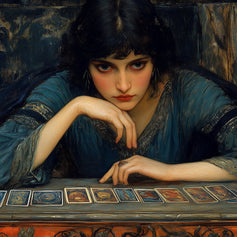
Madame de Thèbes, whose real name was Anne Victorine Savigny, was a famous French clairvoyant and palm reader during the Belle Époque. Active in Paris at the turn of the 20th century, she gained great notoriety thanks to her predictions and advice to high society. Her prophecies, fulfilled for some major world events, made her a prominent figure in the worldly occultism of her time. In an era fascinated by spiritualism and esotericism, Madame de Thèbes established herself as one of the most prominent seers, attracting both the curious and the powerful. Portrait.
Youth and Beginnings
Anne Victorine Savigny was born in 1845 and grew up in Paris. Before adopting her famous pseudonym, she led a modest life and held various jobs. In her youth, she worked notably as a cashier, then became a tutor in a bourgeois family around 1877, showing a certain education and ambition. Drawn to the arts, Anne then began a career on stage: in the 1880s, she performed in theater under the name Mademoiselle Dhalyle, trying her luck as an actress. Although this stage experience did not make her famous, it allowed her to mingle with artistic circles where she would later make valuable contacts. It was during the 1890s that Anne Savigny turned to divinatory arts. She learned cartomancy (card reading) and especially chiromancy (palm reading) from the renowned master Adolphe Desbarrolles, then considered the "father of modern chiromancy." As a student of Desbarrolles, she gained solid mastery of the art of palm reading and began offering clairvoyance consultations. These discreet beginnings in divination gradually brought her to the forefront of the Parisian scene.
Towards Fame
Anne Savigny's encounter with the literary world was decisive for her notoriety. She met the writer Alexandre Dumas fils, a respected author well connected in high society. Impressed by the young seer's emerging talents, Dumas suggested she adopt an evocative pseudonym: Madame de Thèbes. This name was inspired by the play La Route de Thèbes (which he had started but never finished), featuring a mysterious woman. Anne Victorine Savigny thus became "Madame de Thèbes," a stage name with esoteric and ancient resonances that helped forge her legend.
Dumas fils did not just advise the seer on a pseudonym: he actively launched her onto the social stage. Around 1894, he organized a spectacular demonstration for her before his prestigious colleagues of the Académie française. At a dinner, he challenged Madame de Thèbes to reveal the character traits of a dozen academicians simply by examining their hands, without even seeing their faces – the academicians stood behind a curtain. The chiromancer brilliantly met the challenge: the psychological portraits she drew, finger by finger, of each academician were surprisingly accurate and convincing. This blind reading session, staged as a social spectacle, caused a sensation. The success was immediate: Madame de Thèbes' performance earned her sudden recognition, first throughout Paris, then beyond its borders. Overnight, the press seized on this story of a modern "prophetess," and the seer of Avenue de Wagram gained national and even European fame.


Buoyed by this unexpected publicity, Madame de Thèbes attracted a prestigious clientele. The personalities of all Paris now came to consult this enigmatic woman to learn their future. Writers, aristocrats, and politicians frequented her salon. Among her loyal clients were even Marcel Proust, a young yet little-known author from high society, and a crowned head in exile, Queen Natalie of Serbia. The fact that a former sovereign and a future great novelist relied on her advice illustrates how fashionable Madame de Thèbes had become. Introduced into elite circles by Dumas and his allies, she now embodied the official seer of Parisian high society.
Prophecies and Activities in Her Salon
At the beginning of the 20th century, Madame de Thèbes was at the height of her career as a cartomancer. She received clients in her own clairvoyance salon, located at 29 Avenue de Wagram in Paris. This salon, in the heart of an upscale neighborhood (just steps from the Arc de Triomphe), became a sought-after place where the curious and worried gathered in search of revelations. In the hushed atmosphere of this antechamber of mystery, the seer observed hands, drew cards, and delivered predictions or advice with great seriousness. Each visit was as much a social ritual as an esoteric consultation. Madame de Thèbes cultivated her image as a "Parisian Pythia": she received clients in a carefully staged setting, sometimes dressed in orientalizing attire, and maintained secrecy around herself to sustain the aura of mystery that made her successful.

Madame de Thèbes' fame quickly spread thanks to a clever idea: the annual publication of her prophecies. Starting in 1903, she published each Christmas a Madame de Thèbes Almanac, recording her predictions for the coming year. Sold in bookstores and covered by the press, this almanac reached a wide audience and spread well beyond Paris. It was published without interruption until 1917. It contained, in an attractive format, advice for happy living mixed with announcements of future events. These booklets became very popular, making Madame de Thèbes a true celebrity in esoteric publishing. The seer also published more elaborate works: in 1901 appeared The Enigma of the Hand, a treatise where she presented her chiromantic doctrine. This book, dedicated to her friend and mentor Alexandre Dumas fils, was intended as a serious guide to studying the lines of the hand. A few years later, in 1908, she published The Enigma of the Dream: Explanation of Dreams, a work where she shared her experience of oniromancy (the art of interpreting dreams). Through these publications, Madame de Thèbes sought to establish her credibility by giving a quasi-scientific endorsement to her intuitions – not hesitating to claim that chiromancy was a true science, with verifiable laws, worthy of serious study.
Madame de Thèbes' renown mainly rests on the striking predictions attributed to her. Over the years, many major events seem to have been foretold in her consultations or almanacs. She is credited with predicting the Boer War in South Africa (1899–1902) and the Russo-Japanese War (1904–1905), two distant conflicts she supposedly foresaw. Even more impressively, she reportedly announced before 1914 the imminent outbreak of a world conflict in Europe. In her almanac, for example, the seer wrote that "the future of Belgium is extraordinarily sad" and that this small country "will set all of Europe on fire" – statements published as early as 1903, which would resonate prophetically when Belgium was invaded in 1914 at the start of World War I. Similarly, in 1913, Madame de Thèbes warned that "Germany threatens Europe in general and France in particular" and predicted the imminent fall of the German emperor and his empire. When the Great War broke out, many recalled these dark forecasts from her Almanac. Besides wars, Madame de Thèbes also reportedly predicted several tragic deaths that made headlines. She allegedly foresaw the violent death of General Georges Boulanger, a figure of the Boulangist movement who committed suicide in 1891, as well as the tragic end of poet Catulle Mendès, who died accidentally in 1909. She is also credited with predicting the death of British journalist William T. Stead, a famous spiritualist who perished in the sinking of the Titanic in 1912, and the political-judicial scandal of the Caillaux affair in 1914 involving a French minister. These successes fuel the legend of Madame de Thèbes. In the eyes of the general public, the seer of Avenue de Wagram is seen as a prophetess who could read the world's future in her cards and stars.
The Elephant as Emblem
At the heart of her social life, the elephant became prominent. From 1906, Madame de Thèbes belonged to the society of Friends of the Elephant, and her name remained on the lists until 1916. In Belle Époque Paris, dinners and conferences were held around this totem animal. It brought together scientists, colonial administrators, parliamentarians, journalists, and artists with a clear goal: to protect the elephant, regulate hunting and ivory trade, and promote its domestication in the colonies. The prestigious Natural History Museum influenced its leadership: Edmond Perrier was president, with Adolphe Brisson as vice-president. The society organized assemblies followed by highly publicized dinners (notably at Café Cardinal) and acted as a pressure group with public authorities. As of December 1, 1906, it had 92 members; Madame de Thèbes' admission was recorded on April 4, 1906.

Madame de Thèbes. Source
This membership established the elephant motif in her public circle and anchored her in a well-identified social scene. It appeared on her letterhead with the motto "I do not deceive, I warn." Her signature also appeared under a text titled "The White Elephant" in the magazine Femina, and the press eagerly illustrated this choice. The animal then acted as a good luck charm and a pledge of honesty: a promise to warn without deceiving, in line with the image she projected on Avenue de Wagram.
Over the years, two sources converged and reinforced this distinctive sign: the banner of a friendly society and a personal aesthetic. The association between her name and the elephant became established in people's minds; echoes are found in correspondence, on cards bearing her letterhead, and in press portraits. Hence the recurring presence of the elephant whenever one traces Madame de Thèbes in documents and images of her time.
Controversies and Skepticism
Despite her popularity, Madame de Thèbes did not escape criticism or doubts about the sincerity of her gifts. The press, quick to report her successes, was also often ironic towards her. One of the most debated episodes concerns her alleged prediction of the death of President Félix Faure. In February 1899, President Faure died suddenly of a stroke. The seer then claimed to have foreseen this death and boasted about it to some journalists. But columnist Jacques Mauprat, in Le Progrès Illustré, pointed out that Madame de Thèbes' "announcement" came the day after Félix Faure's death, seriously undermining her credibility. In other words, she had predicted nothing and merely claimed afterward an imaginary prophecy. Publicly exposed for this trick, Madame de Thèbes tried to respond: she declared she would soon predict other accidental or tragic deaths during the year, while carefully withholding names. This cautious dodge – announcing misfortunes without verifiable details – was met with skepticism by commentators. The episode of Félix Faure's posthumous "omen" cast doubt on the seer's infallibility and provided arguments to rationalists who denounced "salon prophets." Generally, while Madame de Thèbes had fervent supporters, she also had detractors who considered her at best a clever illusionist, at worst a fraud. Some satirical newspapers did not hesitate to mock her sometimes vague statements. Nevertheless, these controversies did not seriously affect her commercial success: high society continued to consult her, if only for fun or superstition, and her almanacs continued to sell well. Madame de Thèbes thus navigated between admiration and mockery, aware that mystery and controversy also contributed to her fame. And that ultimately, like anyone, she could make mistakes or be overly ambitious, which did not make her any less gifted.
Final Years and Legacy
When World War I broke out in 1914, Parisian life was disrupted and clairvoyance activities took a back seat. About 70 years old, Madame de Thèbes partially withdrew from the public scene. She left the war-torn capital to take refuge in a family property in Meung-sur-Loire, in the Loiret, near Orléans. Settled in this country farmhouse, the famous prophetess led a quieter life, far from the Parisian turmoil. However, she continued to follow current events and publish her annual predictions, which took on particular significance in the tragic context of the global conflict. A humorous note published in Le Cri de Paris in 1916 – humorously picked up by London's Fortnightly Review – reported that Madame de Thèbes, now a farmer, sent eggs, butter, and chickens to her nephews remaining in Paris, but that "strangely, she who can predict the fall of empires and the death of kings twelve months in advance, is unable to foresee week to week the rise or fall of egg prices!" The press playfully highlighted this paradox: the seer capable of predicting war could not predict the market, bringing her back to a more prosaic reality.
Madame de Thèbes passed away a few months before the end of the Great War. In December 1916, weakened by age, she died in her retreat at Clan, a hamlet of Meung-sur-Loire, at the age of 71. Her remains were then repatriated to Paris, where she was buried in the famous Père-Lachaise Cemetery. The death of the woman the press often called the "sibyl of Avenue de Wagram" was marked in newspapers by obituaries oscillating between respectful tribute and polite skepticism. With Madame de Thèbes ended an era: that of the seers of the Belle Époque, figures at the border of the worldly and the mysterious, whose audience declined between the wars in the face of rationalism's progress.
Yet Madame de Thèbes' legacy endures in a way. Her very name became synonymous with a prophetess. In the 1930s, journalist Geneviève Tabouis, famous for her columns anticipating international crises, was nicknamed "Madame de Thèbes" by her contemporaries in reference to the pre-war seer. A sign of the mark she left on the collective imagination, Madame de Thèbes' life also inspired a fictional work during her lifetime. In 1915, Swedish filmmaker Mauritz Stiller made a silent film titled Madame de Thèbes, whose plot was partly inspired by the biography of the famous seer. This feature film, rediscovered in the 21st century, testifies to the fascination exerted by the Parisian prophetess far beyond French borders.
In just a few decades, Madame de Thèbes went from anonymity to becoming the most prominent seer in the capital, embodying the vogue of occultism in the elegant society of the Belle Époque. Her journey illustrates the curiosity of an era eager for the supernatural and revelations. Madame de Thèbes remains an emblematic figure of French esoteric imagination, a symbol of a time when, for the duration of a consultation, one could see destiny unfold in a card game.
Sources:
-
National Library of France (BnF), authority record: "Savigny, Anne Victorine, known as Madame de Thèbes (1845-1916)".
-
CTHS – La France savante, prosopographical file "Madame de Thèbes" (bio, bibliography, and press mentions).
-
Davies, Owen, A Supernatural War: Magic, Divination, and Faith during the First World War, Oxford University Press, 2018 (chapters dedicated to Madame de Thèbes: youth, Dumas, almanacs, 1914-1916).
-
Gallica (BnF): The Enigma of the Hand (Félix Juven, 1901); The Enigma of the Dream: Explanation of Dreams (Félix Juven, 1908); Madame A. de Thèbes Almanac (editions 1903-1917).
-
Bulletin and Yearbook of the French Astronomical Society (late 19th-early 20th century), mentioning "Mme A. de Thèbes, 29, avenue de Wagram, Paris".
-
Press archives of the Belle Époque and the Great War: Le Figaro, Le Cri de Paris, Fortnightly Review, Parisian and international titles (announcements, reports, obituaries 1893-1916).
-
Film database of the Svenska Filminstitutet (Swedish Film Database): Madame de Thèbes by Mauritz Stiller, 1915.