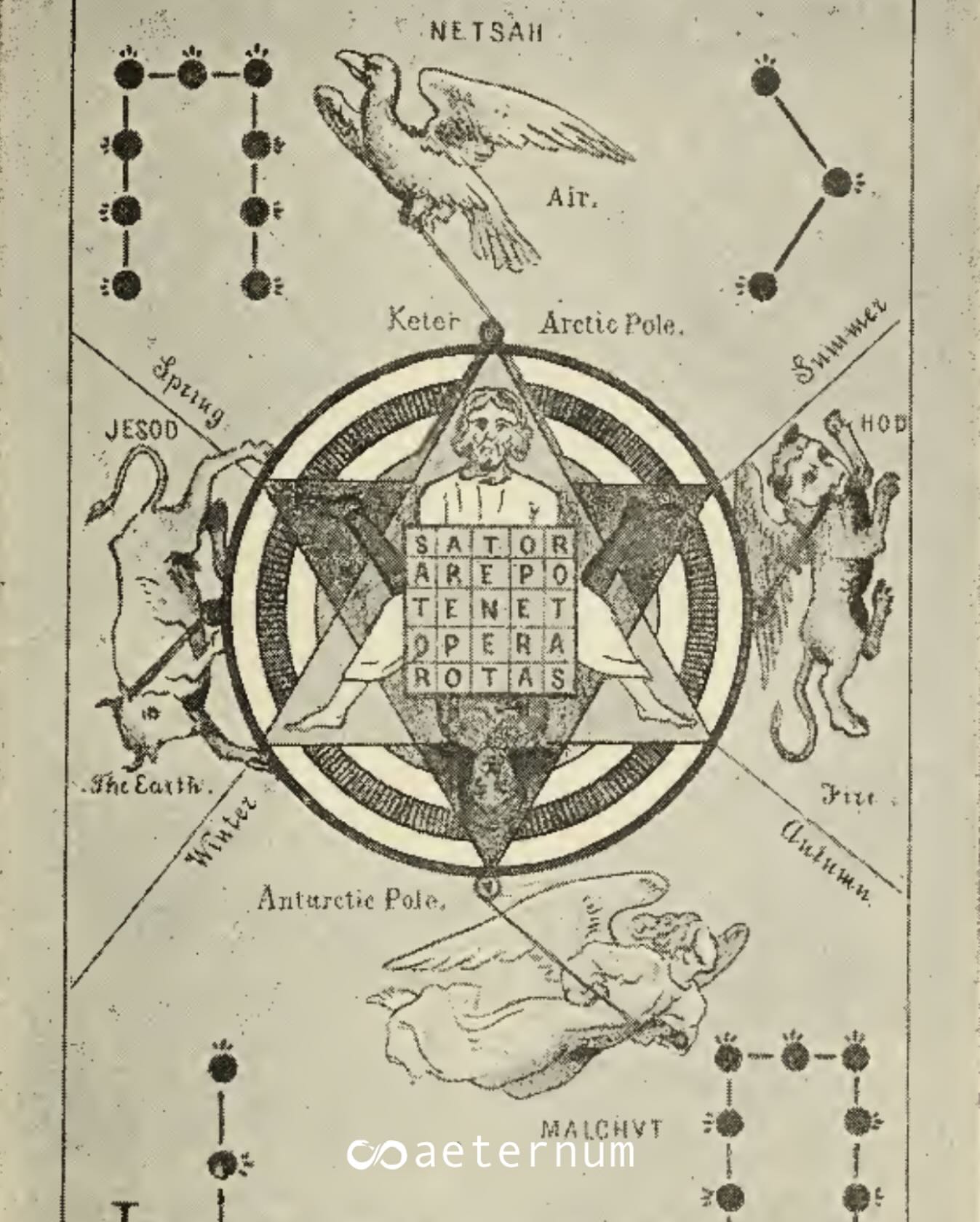




The Sator square is a mysterious Latin palindrome arranged in a square, consisting of the five words SATOR AREPO TENET OPERA ROTAS. This inscription forms a five-by-five letter grid that can be read in every direction and is one of the most famous magic squares of antiquity. The resulting Latin phrase has been translated literally as “The sower Arepo holds the wheels with care”—an interpretation that emphasizes its apparently agricultural context. Yet ever since its discovery, this square has fueled speculation about its hidden meaning and purpose, oscillating between a coded religious symbol and a magical formula with protective powers.
Ancient Origins and Dissemination of the Sator Square
The earliest known traces of the Sator square date back to the Roman Empire, attesting to its ancient origin. In 1936, a complete inscription was uncovered in Pompeii, engraved on a pillar of the city’s great palaestra (gymnasium). This Pompeian specimen, discovered beneath a layer of ash dated to before AD 79, proves that the Sator square was already in circulation in the 1st century—possibly even before the Christian era. Remarkably, the example from Pompeii’s palaestra is presented in the form ROTAS OPERA TENET AREPO SATOR, with the word ROTAS (wheels) first; it is therefore referred to as a ROTAS square. A fragmentary version of the inscription had also been found in Pompeii as early as 1925, on the wall of a private house, confirming the formula’s antiquity.
After Pompeii, further archaeological discoveries revealed the Sator square’s broad geographical distribution throughout the Roman world. As early as 1868, a complete example was found engraved on a wall at Cirencester (ancient Corinium) in Britain. In the 1930s, no fewer than four Sator squares were identified during excavations at the Roman colony of Dura-Europos in Syria. Similar inscriptions have been unearthed throughout the Empire: at Aquincum (near present-day Budapest) in 1952, and at Conimbriga in Portugal in 1971. Its distribution even extended beyond Europe: an inscription was, for example, reported in Brazil, presumably brought there through colonization. These consistent discoveries show that the Sator square was known and disseminated from the beginning of our era across numerous Roman provinces.
Linguistically, the square’s five words are popular or vernacular Latin. Sator means “the sower” (or, by extension, the creator), Tenet means “holds” or “maintains,” Opera translates as “works, labor” (or “with care” in some readings), and Rotas means “wheels.” The term Arepo, however, does not correspond to any known Latin word: it is generally considered a proper name or an invented word serving as a “filler” to complete the palindrome’s symmetry. The inscription can therefore be read as a coherent sentence—“Sator Arepo tenet opera rotas”—which can be understood in several ways. In addition to the literal agrarian translation already mentioned, some have seen it as a more proverbial formula. Reading the square boustrophedonically (in a zigzag), one obtains sator opera tenet – tenet opera sator, which has been interpreted as “as one sows, so shall one reap” or, in a more spiritual sense, “the Creator sustains his work.” These interpretations show that, in the absence of a single unequivocal meaning, the Sator square lent itself from the outset to varied readings, perhaps all perceived by its designer.
Interpretations and Hidden Symbols
The Sator square was shrouded in mystery very early on, prompting religious and esoteric interpretations over the centuries. In the Christian era in particular, many commentators believed they could discern a disguised profession of faith in these five words. Indeed, the central word TENET, readable vertically and horizontally, forms a perfect cross at the center of the square. For Christian interpreters, this hidden cross could not be accidental: it was thought to evoke the cross of Christ, especially since the letter T that closes TENET at each end could refer to the Hebrew Taw—a cross-shaped sign used as a symbol of God in the Bible. From the Early Middle Ages onward, the Sator square thus appeared in Christian buildings and on religious objects, regarded as a secret Christian cryptogram marking the presence of the faithful. A 6th-century bronze amulet discovered in Asia Minor and preserved in Berlin bears the square’s inscription (transcribed in Greek characters), accompanied by two fish and the word ICHTHUS—the famous Christian fish symbol—which demonstrates that by that time the formula had already been integrated into a Christian context.
The Christian interpretation reached its peak in the 20th century with the so-called Pater Noster theory. In 1926, a German priest, Felix Grosser, noticed that by rearranging the square’s letters, it was possible to make the words PATER NOSTER (Our Father) appear twice in a cross, while the remaining letters—two As and two Os—could represent the biblical Alpha and Omega. This discovery reinforced the idea that the Sator square intentionally concealed the Christian prayer of the Our Father, encoded at a time when early Christians had to remain discreet. For several decades, many took it for granted that this was a coded Christian symbol. However, the revelation of the square’s true antiquity—particularly through the Pompeian examples dated before AD 79—cast doubt on this purely Christian reading. The presence of Christians in Pompeii before the city’s destruction is neither proven nor ruled out, so the debate remains open. But the discovery of identical inscriptions in clearly pagan contexts suggested that the Sator square might originally have had no direct connection with Christianity. The correspondence with the Pater Noster may simply be an extraordinary coincidence, later exploited by believers.
Other theories have emerged in attempts to unlock the square’s secret. In 1968, the French historian Paul Veyne challenged the Christian interpretation by emphasizing the extreme complexity of such a palindrome. He pointed out that creating a perfectly symmetrical grid of 25 letters already imposed so many constraints that it is highly unlikely that the author also intended to conceal a second clear message. Veyne noted that the square necessarily uses very common letters (A, E, O, R, T, each repeated four times), and that an unknown word (AREPO) even had to be introduced to achieve balance. In his view, the cross formed by TENET is merely a mechanical consequence of the odd-numbered format, and numerous anagrams can be extracted from the 25 letters—including non-Christian formulas. He thus recalled that in the Middle Ages, some had already recombined the letters into a Latin sentence addressed to Satan (“SATAN, te ro oro te opera praesto”), proof that the square lends itself to highly varied readings without any one of them necessarily having been intended originally.
Despite Veyne’s rationalist warning, esoteric interpretations did not disappear. In 2006, a researcher, Nicolas Vinel, proposed a new reading placing the Sator square’s origins in ancient Judaism. According to him, the five-by-five grid recalled the divine instructions given to Moses for constructing the burnt-offering altar, described in the Bible as a square altar measuring five cubits on each side. Vinel pointed out that if the words TENET are placed diagonally, the letters T appear in the square’s four corners, evoking the “horns” of the Mosaic altar. By removing and regrouping certain letters, he also claimed to reconstruct the expressions ARA AEREA (“bronze altar”) and SERPENS (“serpent”), which would allude to the bronze serpent made by Moses in the desert. This ingenious theory links the Sator square to biblical symbols—the altar and the bronze serpent raised by Moses in Numbers 21:9—and suggests that it may have served as a rallying sign for a hidden Jewish or Judeo-Christian community in Pompeii. Nevertheless, here too, the approach has been criticized as overly speculative. As one commentator humorously observed, by manipulating the letters freely enough one could just as easily “prove” the influence of extraterrestrials—which shows how cautiously these interpretations should be treated.
Magical and Occult Uses of the Sator Square
Beyond scholarly speculation about its meaning, the Sator square has primarily endured through history as a talisman reputed to possess occult powers. From the Early Middle Ages onward, the formula can be found inscribed on objects and amulets believed to have magical virtues. Its status as a magic square—on a par with numerical squares and other incantations—rests on its supposed ability to affect reality once written or spoken. A 6th-century Christian manuscript discovered in the East shows that the Sator square was already being used as an apotropaic symbol: engraved in Greek letters alongside the word ICHTHUS (fish), it served to secretly invoke Christ for protection against evil. From the 8th–9th century onward, the inscription appeared in the West in official religious contexts—a handwritten Bible dated to 822 contains an example—and then spread across medieval monuments and documents, indicating that its protective aura was widely recognized.
It was especially during the medieval period that the Sator square acquired a reputation as a versatile magical formula. Late medieval collections of remedies and occult practices included it as a charm with varied applications. For example, it appears in 12th-century monastic medical manuals, recommended as a remedy for rabies (the disease caused by the bite of a rabid dog) or for high fevers. The prescribed method was to write the five words on a piece of bread and then have the sick person eat it. Similarly, the formula was used to facilitate childbirth: in England, the oldest evidence of such use appears in the margin of an 11th-century manuscript, where the Sator square is inserted into a prayer to protect a woman in labor. It was believed that reciting these words, or better still physically attaching them to the woman’s body (on parchment rolled into an amulet), ensured a successful birth.
The powers attributed to the Sator square did not end there. In continental Europe, it was regarded as protection against house fires: in Germany in particular, it was customary to inscribe the square on the threshold or walls of one’s house to protect it from fire. Inscriptions of the square can still be seen engraved on the stones of medieval buildings—on the wall of a fortified house at Oppède-le-Vieux in Provence, where the square was presumably carved to ward off flames or any other misfortune. Likewise, many churches and chapels have preserved the mark of the Sator square, believed to sanctify the premises and drive away diabolical influences. In Italy, the Cistercian Abbey of Valvisciolo (Lazio) has a medieval Sator square set into its wall, locally regarded as a symbol of blessing and sacred protection. In the French countryside, it is said that some farmers engraved these five magical words on agricultural tools or at the corners of their fields to ensure fertile soil and abundant harvests—perhaps perpetuating the square’s hypothetical ancient agricultural use as a seasonal good-luck charm.
Over time, the Sator square traveled with populations and their beliefs. European colonists carried it to the New World, where it experienced a second life in local folklore. During the 18th and 19th centuries, German communities established in North America (particularly in the Appalachians) continued to use the Sator square as a protective magic formula and a good-luck remedy. Traditional “healers” still advised people to carry it on their person in cases of illness or a curse, a practice attested until the beginning of the 20th century in some rural areas. Thus, from pagan antiquity to modern folk traditions, this strange formula has continually been endowed with occult properties. Its effectiveness, of course, depended on the faith placed in it, but its renown attests to the symbolic power attributed to it.
Interestingly, the Sator square was even adapted and reinvented through more elaborate esoteric rituals in the late Middle Ages. Two 15th-century English manuscripts, for example, provide detailed instructions for obtaining favor and love through the square: they prescribe drawing the grid on blank parchment with a bird’s blood, leaving this talisman on an altar for two days while sprinkling it with holy water, and then carrying it on one’s person to benefit from irresistible charisma. The Sator formula, unchanged, was thus incorporated into a true ritual blending magic and religion, reflecting the charm’s continual adaptation to human desires—whether healing, protection, or even social success. This process of gradual appropriation aptly illustrates how the Sator square survived through the ages: its five words, perceived as carriers of numinous power, were preserved almost unchanged, while the purposes for which they were used evolved according to the concerns of each era.