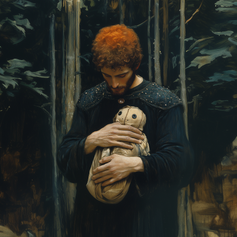





















































































































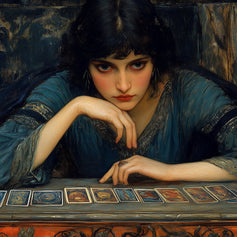




Catoptromancy, or divination by mirrors, actually refers to the art of interpreting visions obtained from a reflective surface. From polished bronze discs to the black mirrors of Renaissance occultists, this method was used throughout the ages to try to read the unknown. Practiced since Greco-Roman Antiquity and taken up again in medieval grimoires, catoptromancy fascinated kings and magicians as much as it aroused suspicion from philosophers and religious authorities. Explanations.
At the origins, sacred mirrors in Antiquity
The idea of observing a reflection to predict the future is very ancient. Authors from ancient Rome claimed that the practice originated in Mesopotamia or Persia – the scholar Marcus Varro, cited by Saint Augustine, already reported that this method of divination came from Persia. Whether it was an Eastern tradition or an independent discovery, catoptromancy appears as early as classical Greece alongside other divinatory arts. In Thessaly, a region known for its witches, legend has it that sorceresses wrote formulas in letters of blood on a mirror to consult the reflection of the moon and obtain oracles. While this story is mythical, other ancient testimonies formally attest to the use of mirrors in divinatory rituals.
One of the most famous accounts is reported by the traveler Pausanias in the 2nd century AD: in the Greek city of Patras, an oracle dedicated to the goddess Demeter used a mirror dipped in the surface of a sacred fountain to know the outcome of an illness. The seeker attached a small round mirror to the end of a string and let it float on the water of the well, after which prayers and perfume offerings were made to the goddess. Then, by leaning over the mirror, one would see the face of the sick person as they would be in the afterlife – smiling if recovery was near, or pale if death was imminent. According to Pausanias, this oracular fountain "never deceived," although it was only used for this limited type of consultation. In the same spirit, catoptromancy was considered a branch of hydromancy (divination by water) when the mirror was used together with a basin filled with water, a common practice in the Greek world. The principle remained to scrutinize a reflection – on a solid or liquid surface – to see prophetic images.
Latin authors confirm that the practice was known in the Roman world. The historian Ælius Spartianus, in his Historia Augusta, recounts that Emperor Didius Julianus (who reigned briefly in 193 AD) resorted to an enchanted mirror to question fate during a civil war. He had a young child prepared by ritual incantations, blindfolded, and placed in front of a polished mirror to see a vision. The child then reportedly saw in this mirror the image of the usurper Septimius Severus marching on Rome and thus predicted the imminent fall of Julianus. The scene depicted by Spartianus – a pure child-seer, a mirror as a portal to the invisible – perfectly matches the magical procedures described in later occult texts. Indeed, the writer Apuleius (2nd century) recounts a similar experience conducted in Asia Minor: a young boy, contemplating the reflection of a Mercury statuette in water, recited a hundred prophetic verses about the outcome of a war after having a vision induced by a magical ritual. These examples illustrate the diversity of ancient forms of catoptromancy. It could involve a shiny metal mirror, the surface of consecrated water, or even the polished bottom of a cup – the Greeks thus spoke of gastromancy to designate divination by reflection in a vessel, and lecanomancy when it involved a basin filled with water. Whatever the method, the quest remained the same: to glimpse, in the play of reflections, the veiled face of the future.
The magic of mirrors in the Middle Ages
After late Antiquity, catoptromancy did not disappear, quite the opposite. Ancient knowledge of mirror divination was transmitted and transformed in the esoteric treatises of the medieval East and West. Christian clerics, however, viewed these practices with hostility. Already in the 5th century, Saint Augustine and other theologians had included the art of divinatory mirrors among the list of pagan superstitions to be proscribed, considering it a demonic illusion incompatible with faith. Likewise, Isidore of Seville in the 7th century classified catoptromancy among illicit mancies, reinforcing the idea that anyone claiming to read the future in a mirror was actually inviting the complicity of demons. This unequivocal verdict of Christian doctrine officially relegated catoptromancy to the dark side of magic. But in practice, it continued to be practiced clandestinely within circles of magicians and medieval astrologers who saw the mirror as a privileged instrument for nigromancy – that is, ceremonial magic calling upon spirits.
From the 12th century, explicit traces of these secret rituals appear. The English scholar John of Salisbury, in his Policraticus (1159), is one of the first medieval authors to describe and condemn the practice of the "speculars" (specularii in Latin). He explains that these magicians "divine in polished and shiny objects – gleaming swords, basins, cups, and mirrors of all kinds – to answer the questions of curious people." He adds, not without irony, that he himself narrowly escaped in childhood the manipulations of a priest versed in this mirror magic, being unable to see the ghostly apparitions that his companion believed to discern in a water vessel. This testimony indicates that in the heart of the Middle Ages catoptromancy was widespread enough to be practiced by some unscrupulous clerics, and to the extent that young students could be initiated secretly. John of Salisbury ironically thanks Providence for having made him "immune" to these sacrilegious experiences by protecting him from the illusionary power of mirrors.


Indeed, despite the religious ban, recipes for divination by mirror circulated in magic manuscripts. Historians have found in 14th and 15th-century grimoires numerous experimenta – small practical rituals – to consult a mirror. These methods belonged to learned ritual magic, a mix of Christian prayers and occult conjurations in Latin or unknown languages. Medieval catoptromancy took the form of a complex ceremonial: the mage drew a protective circle on the ground, lit incense, recited psalms and formulas, then invoked an entity to appear in the mirror. It was common to use a child or a young person considered pure to serve as a seer medium: the adult pronounced the incantations while the child intensely fixed the mirror awaiting a vision. The summoned spirit could be presented as an angel (to give Christian legitimacy to the ritual) or more generally as a demon enslaved by magic. Thus, several late Latin grimoires describe the making of a small consecrated mirror, engraved with symbols, on which a demon is conjured to appear to answer the questions of the master operator. Among these recipes is the famous "Mirror of Floron," named after the invoked entity: the mirror, coated with substances and fumigated, was supposed to reveal the silhouette of a knight (manifestation of the demon Floron) who could be questioned about the past, present, or location of a treasure. This ritual, copied in several manuscripts, evidently had significant diffusion at the end of the Middle Ages.
Naturally, the Church reacted to these survivals of ancient magic. Ecclesiastical and civil courts prosecuted catoptromancy practitioners when discovered. A famous case is reported by the inquisitor Nicolas Eymerich, a great witch-hunter of the 14th century: in his Directorium Inquisitorum (circa 1376), Eymerich explicitly mentions and condemns the ritual of the Mirror of Floron, proof that he had to suppress it during his career. In general, inquisitors' manuals qualified these practices as idolatrous pacts with the Devil. In 1398, the University of Paris (faculty of theology) published a formal decree against catoptromancy and similar arts: it declared that trying "by magical arts to constrain demons in stones, rings, mirrors, or images" constitutes an odious act of idolatry. That same year 1398 in Paris, several magicians suspected of using mirrors or crystals to invoke spirits were arrested and tried.
Despite the threat of such sanctions, fascination for "magical mirrors" persisted at the end of the Middle Ages, sometimes encouraged by powerful patrons. Princes and lords intrigued by occultism did not hesitate to consult seers, including through mirrors. Gervais of Tilbury, an early 13th-century author, notes in his Otia Imperialia that the necromancers of his time boasted of being able to make visions appear in a sword or mirror to impress their audience. These practices remained marginal and secret, confined to magicians' workshops. At the dawn of the Renaissance, catoptromancy already had behind it a long history of clandestinity under the sign of religious transgression.
The rise of magical mirrors in the Renaissance
The Renaissance marks an ambivalent turning point for catoptromancy: on one hand, the medieval tradition of magical divination continued, sometimes protected by great cultivated figures; on the other, the emerging study of optical sciences and the humanist spirit brought a more critical and ingenious view of these phenomena. Mirrors nevertheless continued to haunt the imagination of astrologers, occultists, and even 16th-century sovereigns.
In France, Queen Catherine de Medici illustrates this ambiguity well. A protector of divinatory arts, Catherine surrounded herself with astrologers and seers to guide her decisions. According to chronicles, she herself experimented with catoptromancy. In 1559, at the Château de Chaumont-sur-Loire, her Italian astrologer Cosimo Ruggieri reportedly conducted a prophetic mirror session before her and her court. The ritual took place at night, in a dark room lit by candlelight. On Ruggieri’s order, a mirror was placed in the center, and the queen mother saw successively the ghostly silhouettes of her sons turning around. Each prince made in the mirror as many rotations as the years he was to reign over France: François II made only one turn (he indeed died after one year of reign), Charles IX made fourteen, Henri III fifteen, and the young Prince of Navarre – the future Henri IV – completed twenty-one. This spectacular vision amounted to predicting the length of the upcoming reigns. Legend has it that Catherine, frightened by the appearance of the last one who surpassed all the others, saw in it the omen that one day the Valois dynasty would end in favor of the Béarnais. According to the memoirist Pierre de Brantôme, this demonstration of catoptromancy was actually performed by Nostradamus, another occult advisor to Catherine. In any case, the scene testifies to the place that the ancient divinatory mirror still held at the very heart of the Renaissance, including among the powerful.
The English court was no exception. At the same time, Queen Elizabeth I counted among her close associates the scholar John Dee, a renowned mathematician but also a fervent follower of occult sciences. John Dee regularly practiced "crystal vision," a variant of catoptromancy using reflective surfaces or crystals. In November 1582, according to his journal, Dee saw the archangel Uriel appear at the window of his laboratory; the angelic entity gave him a polished black mirror, the size of a small plate, telling him that if he stared at it intensely he could see and hear celestial creatures ready to reveal the secrets of the future. This object – a perfectly smooth obsidian disc of Aztec origin – became the main tool of John Dee’s famous angelic conferences. For several years, the mage and his medium Edward Kelley sat before this obsidian mirror (which they called speculum) to invoke angels and meticulously note the messages they saw and heard through it. Dee’s black mirror, charged with a supernatural aura, still exists: it is now exhibited at the British Museum in London, where one can see its dark stone circle in which so many visions were sought.

Dee’s Mirror. Source
Besides these illustrious figures, many Renaissance scholars were interested in magical mirrors, either to uncover their secret or to reproduce their effects for spectacle or study. The French physician and philosopher Jean Fernel reported witnessing an astonishing experiment: a conjurer managed to make animated figures appear in a mirror, like miniature characters, who performed movements he commanded aloud. Fernel specifies that the gestures of these apparitions were so expressive and clear that all present spectators clearly distinguished the scene in the mirror. The audience could thus follow a true living tableau emerging from the mirror. This testimony, recorded in De abditis rerum causis (1560), shows that catoptromancy was not only subjective illusion: it could give rise to tangible public demonstrations, at least when the process was mastered by an experienced operator.
Moreover, the systematic study of mirrors and optics, characteristic of the scientific Renaissance, shed new light on these "wonders" for curious minds. As early as 1584, the Italian Giambattista della Porta, a Neapolitan scholar passionate about natural physics, published his treatise Magia naturalis where he reveals how to create optical illusions with hidden mirrors. Porta explains, for example, how to arrange several mirrors to make an observer see a fantastic scene floating in the air, or how a partially transparent mirror can superimpose an image on reality. These illusion techniques, later used by magicians, show that some catoptromancy phenomena could actually rely on cleverly designed optical effects rather than authentic supernatural intervention. The enthusiasm for automata, anamorphoses, and mirror games in the 17th century fits into this continuation: the magical mirror gradually left the exclusive domain of magic to enter the emerging fields of experimental science and spectacle.
Condemnations, debates, and survival of the practice
While the Renaissance saw a renewed interest in catoptromancy, it also saw the continuation of its criminalization by the Church and States. Demonology manuals of the 16th–17th centuries – such as those by Jean Bodin (1580) or Martin Delrio (1599) – list divination by mirrors among the Devil’s usual tricks to mislead credulous souls. Many witch trials mention mirrors seized as compromising instruments. A striking document is reported by the scholar Alfred Maury: around the beginning of the 17th century, the Spanish Inquisition arrested a man in Valladolid accused of magic, in whose possession was found a strange concave mirror covered with symbols. According to a note written in 1699 by the family who inherited the object, the magician covered the engraved back of the mirror with a cloth, then exposed the smooth face in front of a vase filled with ritually prepared water. In the dimness of his room, by orienting the mirror so that the sun reflected on the water, he managed to make the image of the demon he evoked appear on the surface of the liquid. Many eyewitnesses claimed to have seen these apparitions, and the ecclesiastical court sentenced the sorcerer to life imprisonment for demonic practices. He was even accused of using the mirror to show the silhouette of a target person to a child medium in order to cast a curse – an even more serious charge, but which could not be formally proven at trial. Over the 16th century, several astrologers and necromancers were thus arrested, in France and elsewhere, for attempting to predict the future or act by spell using mirrors.
Faced with repression and the spread of rationalism, catoptromancy began a slow decline in Western high society. In the 17th and 18th centuries, the idea of seeing the future in a mirror shifted from the realm of confidential occult knowledge to that of popular superstition. Enlightenment intellectuals did not fail to ridicule these "enchanted mirrors" of past centuries, seeing them as the work of charlatans exploiting the spectator’s imagination. As early as 1584, the Englishman Reginald Scot, in The Discoverie of Witchcraft, had revealed some tricks used by so-called seers to deceive the public, helping to demystify their artifices. Later, in the 19th century, psychologists like Pierre Janet analyzed catoptromancy visions as projections of the unconscious, self-induced hallucinations by suggestion and the ritual atmosphere. Between the harsh light of reason and the threat of the stakes, the old divinatory mirror thus lost its former prestige in modernized Western society.
Yet, the history of catoptromancy does not end completely with the Renaissance. The practice has persisted underground in rural areas and esoteric traditions. In some regions of the world, notably in the Middle East and Africa, the magical mirror remained a popular divination tool until contemporary times. Ethnologists observed in the 19th century Eastern seers who, after long fasts and purifying fumigations, claimed to make angels appear in a scented mirror, always having a child or a young virgin look to obtain the oracular vision. Even today, in some sub-Saharan African communities, it is reported that healers use mirror fragments or basins of reflective water to identify the origin of an ailment or to find stolen objects.
Thus, from the ancient temple of Patras to the chambers of Renaissance magicians, catoptromancy has been part of a long history made of both fervor and suspicion. An ancestral divinatory art, it has been practiced in various forms by peoples and cultures who saw in it a way to lift the veil on the unknown – whether to probe the will of the gods, communicate with spirits, or simply know destiny.
Sources:
-
Armand Delatte, Greek Catoptromancy and its Derivatives, Liège-Paris, 1932 – Exhaustive study of ancient and Byzantine sources on mirror divination.
-
John of Salisbury, Policraticus (1159), Book I, Chapter 12 – First detailed medieval mention of the specularii, with autobiographical anecdote (Keats-Rohan edition, Turnhout, 1993).
-
Julien Véronèse, "Divinatory Magic at the End of the Middle Ages," Cahiers de recherches médiévales et humanistes, no. 21, 2011 – Academic synthesis on divination rituals (mirrors, nails, crystals) in 14th–15th century manuscripts.
-
Nicolas Eymerich, Directorium Inquisitorum (circa 1376) – Manual of the Aragonese inquisitor condemning notably the Speculum Floronis ritual (Mirror of Floron).
-
Alfred Maury, "On a magical mirror of the 15th or 16th century," Revue archéologique, 2nd year, 1846, pp. 154-170 – Analysis of a mirror seized by the Spanish Inquisition, with parallels in ancient texts (Varro, Pausanias, Spartianus, etc.).
-
Giambattista della Porta, Magia naturalis (1584 edition) – Treatise on natural sciences containing explanations of illusions by trick mirrors, witness to the emerging scientific view on catoptromancy.
-
Richard Kieckhefer, Forbidden Rites: A Necromancer’s Manual of the Fifteenth Century, Penn State Press, 1997 – Study and partial translation of a magic manuscript (Munich, 15th century) including catoptromancy operations, and more broadly an overview of medieval necromancy.