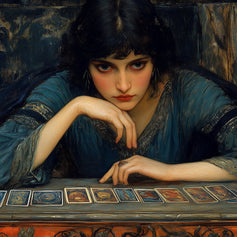




The Lenormand Oracle takes its name from Marie-Anne Adélaïde Lenormand, a famous 18th-century French cartomancer. Known for her accurate predictions and prestigious clients, she left a mark on the history of divination through her practice and methods. Although the Lenormand Oracle as we know it today was published after her death, it is largely inspired by the techniques and teachings of this great seer. Explanations.
1. The story of Marie-Anne Adélaïde Lenormand
Marie-Anne Adélaïde Lenormand was born on May 27, 1772, in Alençon, France, into a modest merchant family. Orphaned of her father at a very young age, she was sent to the Benedictine convent at the age of five. It was within this religious institution that she first discovered the arts of divination, an interest she would pursue throughout her life. Her curiosity for esotericism and occult practices appeared very early, and she quickly developed remarkable skills in cartomancy, palmistry, and other forms of divination.

At the age of fourteen, she left the convent and went to Paris, where she began practicing divination professionally. Settled in the French capital, she opened her own fortune-telling salon in the Faubourg Saint-Germain district, which quickly became a favorite spot for Parisian elites. Marie-Anne Lenormand gained a reputation as an exceptional seer thanks to her accurate predictions and unique approach to divination. Her consultations attracted iconic figures of the time, including Napoleon Bonaparte and Joséphine de Beauharnais, who came seeking her advice. She is also well known by the nickname the "sibyl of Faubourg Saint-Germain."
Her reputation extends far beyond French borders. Marie-Anne Lenormand is consulted by foreign dignitaries, writers, artists, and politicians, making her one of the most famous seers of her time. Her method of divination is based on a mix of traditional card games and personal interpretations, combining simple symbols with great intuition. She is also known for using a variety of objects in her readings, thereby increasing the depth and accuracy of her predictions.
Marie-Anne Lenormand was also a prolific writer. She published several books during her life, sharing her knowledge and experiences in the field of divination. Her works include memoirs, practical guides, and theoretical studies on the art of cartomancy. These publications helped spread her methods and establish a theoretical foundation for cartomancy practitioners.
Despite her success, Marie-Anne Lenormand's life was not without controversy. She was arrested several times for her activities, notably due to restrictive laws on occult practices and authorities' mistrust of her predictions. However, these obstacles only added to her legend, strengthening her reputation as a mystic defying authority.
Marie-Anne Lenormand died on June 25, 1843, in Paris. Her death marked the end of an era, but her legacy endures. The methods and principles she developed continue to influence the practice of cartomancy, and her name remains associated with the Lenormand Oracle.
2. The creation of the Lenormand divinatory Oracle
The Lenormand Oracle, although inspired by the methods and teachings of Marie-Anne Lenormand, has a distinct history that begins after her death in 1843. Thus, this particular oracle is more a tribute to Marie-Anne than a direct creation.
Moreover, Marie-Anne Lenormand is often credited with influencing the creation of this deck, although she left no documents or publications specifying a particular card deck.
The first standardized Lenormand Oracle deck was published in 1845, two years after the death of Marie-Anne Lenormand, by a German publisher. This deck, known as the "Petit Lenormand," consists of 36 cards, each illustrated with a distinct and easily identifiable symbol. The cards were based on symbols and motifs common in other divinatory card decks of the time, but they were organized and interpreted in a way that reflected the divination methods associated with Lenormand.
3. The composition of the Lenormand Oracle
The Lenormand Oracle consists of 36 cards, each illustrated with a distinct and easily recognizable symbol (which contributed to its success). These cards are created to represent various aspects of daily life, emotions, situations, and people. Each card is numbered from 1 to 36, often with a simple but meaningful illustration that aids interpretation.
| 1 | The Rider | News, messages, movement |
| 2 | The Clover | Luck, opportunities, happiness |
| 3 | The Ship | Travel, adventure, change |
| 4 | The House | Home, family, security |
| 5 | The Tree | Health, growth, longevity |
| 6 | The Clouds | Confusion, uncertainty, temporary problems |
| 7 | The Snake | Betrayal, complications, jealousy |
| 8 | The Coffin | End, transformation, loss |
| 9 | The Bouquet | Joy, gifts, happiness |
| 10 | The Scythe | Abrupt end, decision, danger |
| 11 | The Whip | Conflict, discussions, repetitions |
| 12 | The Birds | Communication, rumors, anxiety |
| 13 | The Child | Newness, innocence, simplicity |
| 14 | The Fox | Cunning, work, deception |
| 15 | The Bear | Strength, protection, finances |
| 16 | The Stars | Hope, aspirations, direction |
| 17 | The Stork | Changes, transitions, improvements |
| 18 | The Dog | Friendship, loyalty, support |
| 19 | The Tower | Authority, institutions, isolation |
| 20 | The Garden | Social, public, community |
| 21 | The Mountain | Obstacles, challenges, delay |
| 22 | The Paths | Choices, decisions, alternatives |
| 23 | The Mice | Loss, deterioration, stress |
| 24 | The Heart | Love, passion, relationship |
| 25 | The Ring | Commitment, contract, union |
| 26 | The Book | Knowledge, secrets, education |
| 27 | The Letter | Correspondence, information, news |
| 28 | The Gentleman | Important man, male querent |
| 29 | The Lady | Important woman, female querent |
| 30 | The Lily | Purity, virtue, maturity |
| 31 | The Sun | Success, vitality, positivity |
| 32 | The Moon | Intuition, emotions, recognition |
| 33 | The Key | Revelation, solution, breakthrough |
| 34 | The Fish | Abundance, finances, flow |
| 35 | The Anchor | Stability, perseverance, security |
| 36 | The Cross | Fate, trial, spirituality |
4. Differences Between Lenormand Oracle Cards and Tarot Cards
The Lenormand Oracle and the Tarot are two very popular divination tools, but they differ significantly in both their structure and their use and symbolism. The Marseille Tarot, one of the most well-known divinatory tarot decks, consists of 78 cards divided into two main groups: the Major Arcana and the Minor Arcana. The major arcana, numbering 22, represent archetypes and universal concepts such as The Fool, Death, and Judgment. The 56 minor arcana are subdivided into four suits (Wands, Cups, Swords, and Pentacles), each containing cards numbered from Ace to 10 and four court cards (Page, Knight, Queen, and King). Each tarot card is rich in symbolism and can be interpreted in multiple ways depending on the context of the reading and the question asked.
On the other hand, the Lenormand Oracle consists of only 36 cards. These symbols are generally simpler and more direct than those of the Tarot, making the Lenormand Oracle particularly accessible to beginners. While the Tarot often explores deep spiritual, psychological, and philosophical themes, the Lenormand Oracle focuses more on the practical and everyday aspects of life. Lenormand cards are designed to provide clear and precise answers, making them ideal for specific questions and quick readings.
5. Lenormand Oracle Reading Techniques
The Lenormand Oracle offers a variety of drawing techniques that allow adapting the consultation to the specific needs of the querent. Two of the most commonly used methods are the simple reading (including 3 and 5-card readings) and the Grand Tableau, which uses all 36 cards.
5.1. The simple reading (with 3 or 5 cards)
The simple three-card reading is one of the most accessible and straightforward methods to use the Lenormand Oracle. This reading is often used to get a quick and concise answer to a specific question. In this method, each card represents a specific aspect: the first card illustrates the past or past influences, the second card represents the present or current situation, and the third card symbolizes the future or probable outcome. This reading allows seeing a temporal progression and understanding how past events influence the present and future situation.

The five-card reading, on the other hand, offers a slightly more detailed perspective. In this method, the cards are arranged in a line, with the first card representing the distant past, the second the recent past, the third the present, the fourth the near future, and the fifth the distant future. This reading allows tracking the evolution of a situation over a longer period, providing a deeper analysis of influences and trends.

5.2. The Grand Tableau reading
The Grand Tableau is the most comprehensive drawing method of the Lenormand Oracle. It uses all 36 cards arranged in a grid of 4 rows of 9 cards each. This method offers a complete overview of the querent's life, examining not only specific aspects of the question asked but also the interactions between different areas of their life, such as love, work, family, and health.

In the Grand Tableau, the position of each card in relation to the others is crucial. The cards are read in relation to each other, forming combinations that enrich the overall meaning. For example, a card representing a professional opportunity could be influenced by a neighboring card representing obstacles or support. The Grand Tableau also allows examining diagonals, columns, and rows to obtain additional information and nuanced perspectives.
As you might have guessed, the Lenormand oracle is particularly suited for beginners due to its ease of drawing and interpretation. That is why it remains one of the most popular today.
[bloctwist]