



Contents...
Zener cards, often associated with extrasensory perception (ESP) experiments, are less well known than tarot or oracle cards, probably due to their somewhat specific use. These cards, designed to test and measure psychic abilities such as telepathy and clairvoyance, consist of five distinct symbols: a star, a wave, a square, a cross, and a circle, each repeated five times in a deck of 25 cards.
1. What is parapsychology?
Before getting to the heart of the matter, I prefer to explain what parapsychology concretely is and what lies within this field.
Parapsychology is a branch of psychology that studies psychic and paranormal phenomena that are generally not explained by the known natural laws of traditional science. These phenomena include, among others, telepathy (the communication of information from one mind to another without using known senses), clairvoyance (the ability to perceive events or objects distant in space or time), precognition (the prediction of future events), and psychokinesis (the ability of the mind to directly influence a physical object).
Parapsychology aims to test these abilities under controlled and repeatable conditions, often using experimental methods to study the validity and nature of these phenomena. Although often viewed with skepticism by the scientific community due to the difficulty of reliably reproducing experimental results and the often subjective nature of the evidence, parapsychology continues to attract interest because of its potential to expand our understanding of human abilities and the limits of psychological science.
Researchers in this field rely on a variety of experimental techniques, including the use of Zener cards, to explore these unconventional interactions between the mind and the physical world, seeking to demonstrate that consciousness can transcend the traditional boundaries of sensory and physical perception.
2. The History of Zener Cards
Zener cards were designed in the 1930s by psychologist Karl Zener, a professor at Duke University. The initial goal of Zener and his colleague, J.B. Rhine, was to create a tool that would reliably and standardizedly test extrasensory abilities in a controlled experimental environment. The simple and easily recognizable symbols on the cards (star, wave, square, cross, and circle) were specifically chosen to minimize interpretation errors and facilitate focus on the extrasensory perception task.
2.1. The Creation of the Cards
The design of the Zener cards was the result of collaboration between Karl Zener and J.B. Rhine, who sought to develop a more objective and less biased method for studying parapsychology than previous approaches, often criticized for their lack of scientific rigor. The cards were intended to eliminate sensory cues and communication biases that might otherwise influence the results of extrasensory perception tests.
2.2. The Experiments at Duke University
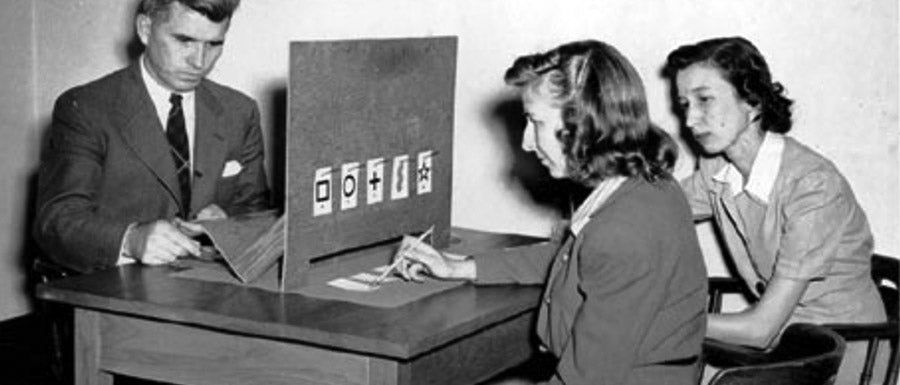
Under the direction of Rhine and with the use of Zener cards, Duke University became a pioneering center for parapsychology research. Rhine and his colleagues conducted a series of experiments where subjects were asked to guess the symbols on cards drawn out of their sight. These experiments were designed to be repeated under identical conditions, allowing the collection of statistical data on performances that exceeded chance expectations, thus suggesting the possibility of perception abilities beyond the five senses.
2.3. The Influence of Zener Cards on Parapsychology
The results obtained with the Zener cards had a profound impact on the field of parapsychology. They not only provided empirical data supporting the potential existence of extrasensory perception but also helped legitimize parapsychology as a scientific field of study. However, these studies were not without controversy. Critics often questioned the validity of the experimental methods and the interpretation of results, sparking ongoing debate about the nature and existence of psychic abilities.
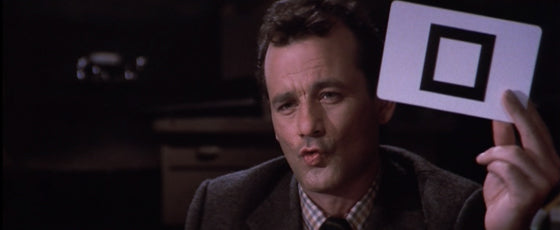
As a fun fact, these cards are used in the first Ghostbusters movie by the character Peter Venkman.
3. Description of the Zener cards
Each symbol is represented five times in the deck, creating a balanced and standardized set of 25 cards. The symbols are chosen for their graphic simplicity and immediate distinction from each other, thus reducing the risk of confusion or misinterpretation by experiment participants.
3.1. The symbols
Here is the description of the 5 symbols and their meaning in the Zener cards.
 |
Often five-pointed, this symbol is distinct and generally associated with mystical or spiritual connotations, which can psychologically influence participants. |
 |
Represented by a series of wavy curves, the wave is a fluid symbol that can be interpreted as representing water or movement. |
 |
With its four equal sides and right angles, the square is a symbol of stability and regularity. |
 |
Consisting of two lines crossing at the center, the cross can be perceived as a point of intersection or a symbol more traditionally associated with religion and spirituality. |
 |
The circle, without beginning or end, is often seen as a symbol of unity and wholeness. |
3.2. The composition of the card deck
As I mentioned earlier, each Zener card deck contains 25 cards, with five repetitions of each symbol. This number allows sufficient variety for statistical tests without being overly complex for participants. The cards are generally standard size, easy to handle, and designed to minimize wear through repeated use in experiments.
In a typical test, the cards are shuffled and either the test subject must guess the symbol on the drawn card without seeing it, or another person (the "sender") sees the card and tries to transmit the image to the subject's mind (the "receiver"). The goal is to assess how effectively the receiver can identify the symbols without conventional sensory input, providing potential data on extrasensory perception ability.
4. Methods of using Zener cards
Zener cards were initially designed to facilitate extrasensory perception (ESP) tests, such as telepathy, clairvoyance, and precognition. Thus, there are several methods of use depending on the experiment conducted, which use statistical measures to assess the probability that results exceed what would be expected by pure chance.
4.1. Classic extrasensory perception (ESP) tests
4.1.1. The clairvoyance test
In this type of test, all Zener cards are shuffled (manually or with a device) and placed face down. The subject must guess the symbol on each card without any visual clues. This test measures the ability to perceive objects or information without direct sensory interaction. The basic hypothesis is that chance yields about 25% success in this test, and a 100% result therefore indicates clairvoyance ability.
4.1.2. The telepathy test
Here, a sender (or agent) looks at one card at a time while a receiver, located remotely and without visual contact with the sender, tries to guess the symbol on the card. This test is designed to examine the transmission of information between two minds.
4.1.3. The precognition test
The subject is asked to predict the symbol that will appear on the cards before they are drawn or shown. This type of test explores the ability to perceive future events.
4.2. Modern tests
With advances in technology and research methodologies, tests using Zener cards have been adapted and modified to meet more rigorous scientific standards and to explore new hypotheses about extrasensory perception:
-
Techniques such as functional magnetic resonance imaging (fMRI) and electroencephalography (EEG) are now used to observe the brain activity of subjects during Zener card tests, allowing researchers to explore the physiological correlations of alleged ESP abilities.
-
To reduce bias and improve the rigor of experiments, modern tests are often conducted double-blind, where neither the subject nor the experimenter knows the card symbols until the end of the test session. This helps prevent any unintentional influence on the test results.
-
The analysis of data collected during Zener card tests now uses advanced statistical techniques to assess the significance of the results, helping to distinguish genuine outcomes from coincidences.
-
Zener cards are also used in online experiments, allowing for larger-scale data collection and participation from subjects in various geographic regions. These online tests can also incorporate automated controls to ensure data integrity.
5. What scientific validity do Zener cards have?
Zener cards, although instrumental in parapsychological research, have not escaped controversy and criticism, particularly regarding the scientific validity of their tests. These debates often highlight methodological challenges, the implications of the results, and the differing opinions between skeptics and supporters of extrasensory perception (ESP) abilities.
5.1. Methodological biases
The main points of contention concern the methodology used in Zener card tests. Critics often highlight the lack of rigor in the design of the initial experiments, including issues with variable control and the possibility of fraud or experimenter bias. For example, J.B. Rhine's early experiments were criticized for lacking adequate procedures to prevent unintentional communication between the experimenter and the subject, or between subjects themselves, which could skew the results.
5.2. Mere coincidences?
Many scientists and researchers in the field of conventional psychology argue that the phenomena studied by parapsychology are not based on robust empirical evidence and that the alleged ESP abilities could rather be the result of poorly applied statistical techniques, psychological biases, or mere coincidences. They emphasize the need for stricter scientific standards and transparency in parapsychological research.
5.3. Helpful equipment?
In the early versions of the experiments, it seems that due to lack of resources, the cards were printed on slightly transparent materials, which inevitably calls the results into question. It also appears that the cards had distinctive marks that guided the participants' choices.
You now know more about Zener cards. They are still distributed today, so you still have the opportunity to test your parapsychic abilities!
[bloctwist]