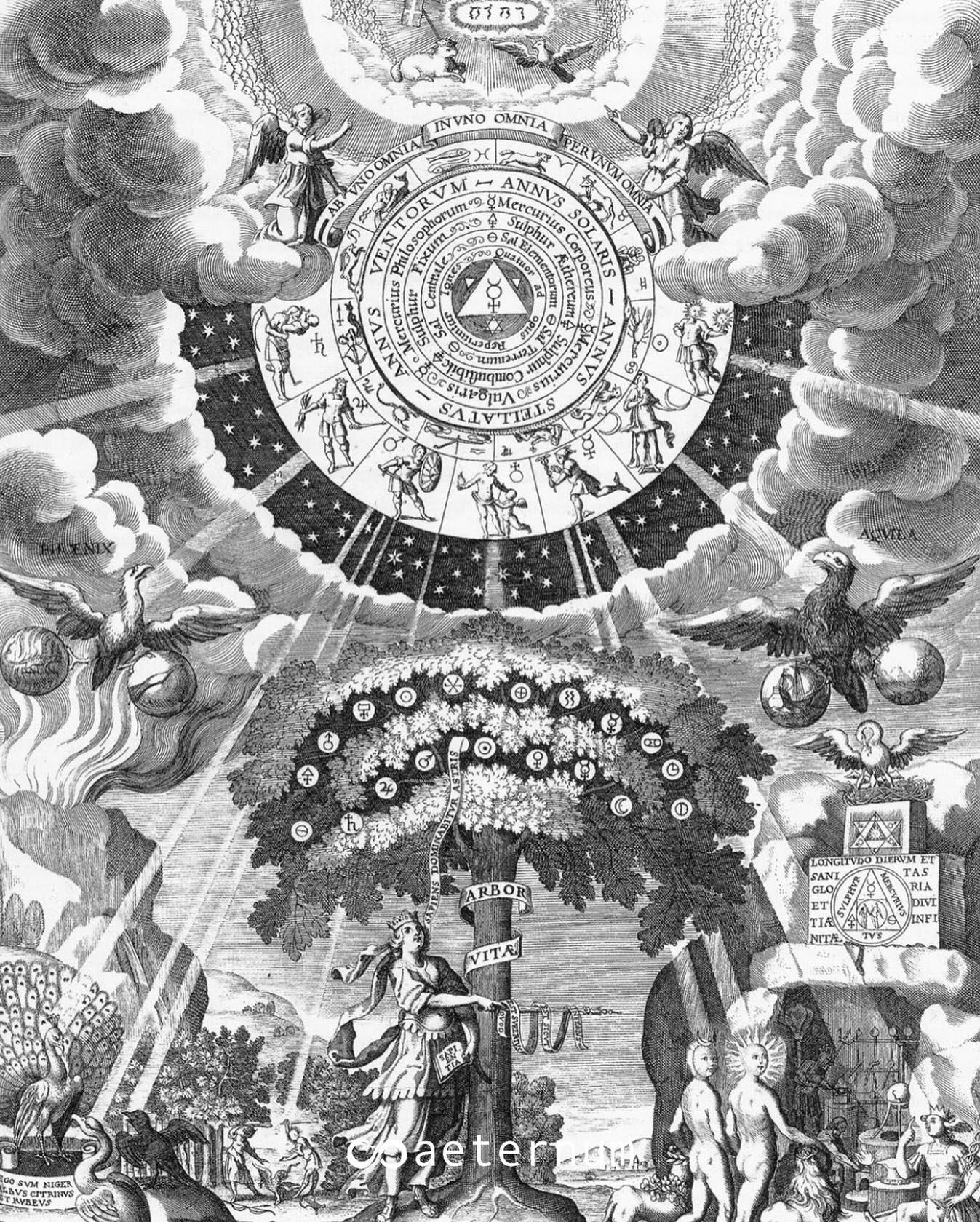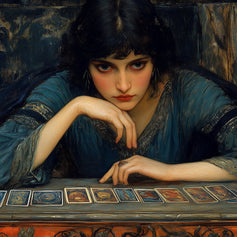




For this somewhat special article, I decided to explore the influence of esotericism beyond quiet or private circles. Indeed, many fields have been inspired by various esoteric and occult movements throughout history. Art, in particular, and more specifically Art Nouveau. So why focus on this movement? First, because Nicolas and I are fascinated by its natural, colorful, and, it must be said, somewhat mystical aesthetic. Also because this style is accessible to everyone: it can be found in Paris’s grand brasseries, on vintage advertising posters, and in architecture. Finally, because it is a movement particularly connected to esoteric knowledge. Let’s decode it.
First of all, what is Art Nouveau?

Art Nouveau is an artistic and architectural movement from the late 19th century that developed amid major upheavals. This period, marked by the Industrial Revolution, scientific and technological advances, and increasing urbanization, inspired some artists to reconnect with more organic, aesthetic, and spiritual forms of expression. It was from this desire that Art Nouveau was born.
The main characteristics of Art Nouveau
Art Nouveau is distinguished above all by its use of sinuous lines and floral motifs, a true signature of the movement. Works associated with this style—whether architecture, furniture, or decorative arts—highlight fluid curves evoking vines, waves, or arabesques. The rigid, geometric forms of earlier styles were abandoned in favor of a more natural aesthetic. This approach reflects an admiration for nature, considered an essential and inexhaustible source of inspiration. Plants, flowers, insects, and idealized female figures are omnipresent in the imagination of Art Nouveau artists.

This movement also emerged in reaction to the artistic academicism and industrial aesthetics that dominated the 19th century. The Industrial Revolution had given rise to standardized mass production, perceived as impersonal and cold. Art Nouveau artists rejected this so-called "mechanistic" approach and turned back to craftsmanship. They valued manual work and the expertise of the decorative arts, bringing an artistic dimension to everyday objects.


Another fundamental aspect of Art Nouveau is its pursuit of unity between art and everyday life. Artists of this movement were not content to create isolated works, but sought to design entire environments infused with their aesthetic. This ambition manifested itself in architecture, where the interiors and exteriors of buildings were conceived as a coherent whole, but also in the design of utilitarian objects such as lamps, furniture, and textiles. Art Nouveau thus became a philosophy of life, in which beauty could be found in the smallest aspects of existence.
Artistic Transcendence
Beyond its aesthetic, Art Nouveau also carries a spiritual and transcendental dimension. This movement emerged during a period of social and intellectual upheaval, when many traditional certainties were collapsing. Modernity, with its scientific and technological innovations, inspired both hope and anxiety. In its quest for universality and harmony, Art Nouveau offered a response to this crisis. By exalting beauty and nature, it aspired to “re-enchant” a world losing its bearings and becoming disconnected from Nature.

The pursuit of pure beauty lies at the heart of the Art Nouveau artists’ approach. This quest goes beyond simple aesthetic pleasure to touch on profound aspirations. Beauty, perceived as a means of spiritual elevation, becomes a universal value. Artists draw inspiration from philosophies and the natural sciences to create works that transcend the divisions between art and life, and between humanity and the universe.
Nature, omnipresent in Art Nouveau, embodies a regenerative and spiritual force. Organic forms and natural motifs express a vision of the world in which everything is interconnected, an idea already close to the esoteric philosophies that influenced artists of this period. The idealization of femininity, common in Art Nouveau, is also part of this quest for transcendence. Women are represented as divine figures, bearers of life, wisdom, and beauty, far removed from the other societal and religious patterns of thought of the time (and, unfortunately, still persistent today).
Occult Culture
Esoteric Boom
At the end of the 19th century, Europe experienced a renewed interest in esotericism, influencing intellectual and artistic circles. Movements such as Theosophy, the Rose-Cross, and Freemasonry gained popularity, offering alternative spiritual perspectives in the face of dominant rationality. This esoteric fervor is reflected in Art Nouveau, where many artists incorporated mystical symbols and occult philosophies into their works.
The rise of secret societies is a particularly notable phenomenon. Organizations such as the Theosophical Society, founded by Helena Blavatsky in 1875, and the Kabbalistic Order of the Rose-Cross, revived by Joséphin Péladan, attract influential members, particularly artists, writers, and philosophers. These groups offer a mystical vision of the world, blending ancient traditions with contemporary concerns. The idea of a universe in which everything is connected by invisible spiritual forces appeals to a generation of artists eager to challenge the materialism of their era.

Source: Paris ZigZag
The ideas spread by these movements directly affect artistic circles. Theosophy popularizes the idea of a universal and timeless wisdom accessible through symbols, rituals, and meditation. Freemasonry, for its part, emphasizes initiation and degrees of knowledge, while the Rosicrucians advocate a spiritual quest based on art as a path to elevation. These influences can be found in the works of many Art Nouveau artists, transforming their output into a visual language rich in hidden meanings.
The Marriage of Art Nouveau and Esotericism
Art Nouveau artists are not merely influenced by these currents; many even become personally involved in them. Alphonse Mucha, a major artist, for example, is an active member of Freemasonry and takes an interest in Theosophy. His work Le Pater (1899) perfectly illustrates this influence. This book, composed of illustrations inspired by the Christian prayer Our Father, is imbued with mystical and Masonic symbols.

Source: Galerie Fledermaus
Jean Delville, another major figure in Symbolism and Art Nouveau, was also deeply influenced by occultism. A painter and writer, Delville joined the Theosophical Society and took an interest in Kabbalah and alchemy. His works, such as The Angel of Splendors (1894), express a quest for spiritual idealism and transcendent beauty. In his paintings, the human figure is often idealized, representing a divine and cosmic form of existence. The use of light, color, and sacred geometric forms conveys a vision in which art becomes a mirror of the invisible.

Source: Wikimedia Commons
Beyond these two emblematic figures, many Art Nouveau artists incorporate direct or indirect references to esotericism into their works. Gustav Klimt, although more closely associated with Austrian Symbolism, shares common ground with Art Nouveau. His paintings, particularly those of the Beethoven Frieze, explore mystical and spiritual themes, blending ancient symbols with modern representations. Similarly, Antoni Gaudí, in his architecture in Barcelona, uses organic forms and geometric motifs that convey a profound understanding of nature and universal laws.
The hidden symbolism in Art Nouveau
The visual language of Art Nouveau is teeming with esoteric symbols if one takes the time to admire them closely.
Sacred geometry is a key element of many Art Nouveau works. Ideal proportions, spiral motifs, and arabesques recall the fundamental structures of the universe, as found in esoteric traditions.

Source: Le Lorraine
The use of color and light in Art Nouveau works is also charged with symbolism. Artists use specific palettes to evoke emotions or spiritual states. Golden and luminous hues refer to divine light or spiritual illumination, while dark tones suggest mystery or introspection.
Interpreting an Art Nouveau work
Interpreting an Art Nouveau work first requires paying close attention to its details. The lines, motifs, and compositions are never purely decorative. The fluid curves and floral motifs represent a dialogue between humanity and its environment. Take the time to follow the lines with your eyes: they often direct your gaze toward key elements of the work.
Human figures, particularly female ones, are central to this style. Observe their posture, gaze, or the objects they hold. These details tell a story or convey an emotion. A woman surrounded by flowers symbolizes fertility or a connection with nature, while a decorative halo around a figure suggests a divine aura.
Colors also play a fundamental role in Art Nouveau. They are not chosen at random and contribute to the overall atmosphere of the work. Golden hues convey a quest for spiritual elevation or a tribute to light. Green and blue evoke serenity and balance. Try asking yourself why an artist used a particular color palette and what it makes you feel.
Approach the work with curiosity. If certain motifs or symbols seem mysterious, research their meaning. Art Nouveau draws on diverse influences, such as mythology, esotericism, and Eastern cultural references, particularly Japanese ones. A representative example: a peacock symbolizes vanity, but also royalty or immortality, depending on the context.
Finally, let your emotions guide you. An Art Nouveau work is designed to move the person observing it. What do you feel when faced with a poster, an architectural façade, or a stained-glass window? Rather than trying to analyze everything immediately, let yourself absorb the atmosphere it conveys. Art Nouveau seeks to establish an intuitive connection between the work and the viewer, making it an experience that is both sensory and intellectual.
Major Art Nouveau artists
Alphonse Mucha (1860–1939)

Source: Info
Alphonse Mucha, a Czech-born painter, poster artist, and decorator, is one of the most iconic names in Art Nouveau. Born in Moravia, he studied in Munich before settling in Paris, where he attracted attention with his style. Mucha’s career took a decisive turn in 1894, when he created a poster for Sarah Bernhardt, a famous stage actress. This collaboration marked the beginning of his meteoric rise.
His style, known as “Mucha style,” is distinguished by fluid lines, floral motifs, and idealized female figures surrounded by decorative halos. Behind this aesthetic lies a profound spirituality. Mucha was an active Freemason and was interested in theosophy, occultism, and esoteric philosophies.

Mucha returned to Czechoslovakia in 1910, where he embarked on his masterpiece, The Slav Epic, a series of monumental paintings celebrating Slavic history and culture. Despite his popularity, he was arrested by the Gestapo in 1939 because of his patriotism and Masonic affiliations. He died shortly afterward, leaving behind an unparalleled artistic legacy.
Victor Horta (1861–1947)
A brilliant Belgian architect, Victor Horta is considered the father of Art Nouveau architecture. Born in Ghent, he studied at the Royal Academy of Fine Arts in Brussels before beginning his career in architecture. He distinguished himself as early as 1893 with the design of the Hôtel Tassel, considered the first truly Art Nouveau building.

Source: Admirable Façades
Horta is renowned for his innovative use of metal, glass, and organic forms in his buildings. His buildings feature sinuous lines, motifs inspired by nature, and meticulous attention to detail. Among his most famous works are the Solvay Hotel, the Van Eetvelde Hotel, and the Autrique House, all located in Brussels.
Horta was also interested in integrating the decorative arts into architecture. He designed not only the buildings, but also their furniture, stained-glass windows, and interior decorations, creating complete harmony between the space and its elements. Although his style evolved toward simpler forms after the First World War, his influence on Art Nouveau remains invaluable.
Gustav Klimt (1862–1918)
Austrian painter and central figure of the Vienna Secession, Gustav Klimt embodies the fusion of Art Nouveau and Symbolism. Born in Baumgarten, near Vienna, he began his career as a theater decorator before turning to more personal and daring painting.
Klimt is known for his works rich in golden motifs, sensual female figures, and his use of mystical symbolism. His paintings, such as The Kiss (1907–1908) and Danaë, explore universal themes such as love, mortality, and spirituality. His style combines varied influences, ranging from Byzantine mosaics to Japanese aesthetics, along with organic motifs typical of Art Nouveau.

Source: RTS
Klimt’s works, often controversial for their eroticism and boldness, are deeply spiritual. He incorporated esoteric elements, such as alchemical and mythological symbols, to express invisible realities. His pursuit of aesthetic and spiritual ideals makes him a major figure of Art Nouveau.
Jean Delville (1867–1953)
The Belgian Symbolist painter Jean Delville is an essential figure for understanding the links between Art Nouveau and esotericism. Born in Leuven, he studied at the Royal Academy of Fine Arts in Brussels and became interested in mystical movements at an early age. Delville was influenced by occultism, Theosophy, and the Kabbalah, themes that deeply permeate his work.
Delville sought to express spiritual truths through art. His paintings, such as The Angel of Splendors and The Glorified Christ, use idealized human figures, luminous compositions, and geometric motifs to represent a transcendent reality. He also wrote about art and spirituality, contributing to the theory of art as a spiritual journey.
A member of the Theosophical Society and close to occult circles, Delville saw art as a means of reconciling humanity with the divine. His influence on Art Nouveau, though less well known than that of Mucha or Horta, is significant, shaped by his pursuit of an idealized and spiritual beauty.
Where can you see Art Nouveau in France?
You can find Art Nouveau buildings in pretty much every major city.

Source: Un Jour de plus à Paris
Regarding Paris:
-
Lavirotte Building (29 avenue Rapp, 7th arrondissement): designed by architect Jules Lavirotte in 1901, this building stands out for its exuberant façade adorned with colorful ceramics and detailed sculptures. It won the City of Paris façade competition that same year.
-
Castel Béranger (14 rue La Fontaine, 16th arrondissement): designed by Hector Guimard between 1895 and 1898, Castel Béranger is considered the first Art Nouveau apartment building in Paris. Its asymmetrical façades, elaborate ironwork, and botanical motifs make it a masterpiece of the genre.
-
Hôtel Mezzara (60 rue Jean de La Fontaine, 16th arrondissement): also designed by Hector Guimard, this private mansion built in 1910 features refined architecture with decorative elements typical of Art Nouveau. It is currently being renovated to become a museum dedicated to Guimard.
You will also notice that the metro entrances are in the Art Nouveau style, with their characteristic green metal.
To enjoy the style while eating well, you can also choose a brasserie:
-
Bouillon Julien: opened in 1906, this brasserie is an Art Nouveau masterpiece. Its interior is adorned with mosaics, stained-glass windows, and mirrors, creating an elegant and refined atmosphere. The wall frescoes and light fixtures add to the establishment's charm.
-
Bouillon Racine: founded in 1906 by the Chartier brothers, this brasserie is a typical example of Parisian Art Nouveau. Listed as a Historic Monument, it stands out for its carved woodwork, beveled mirrors, and colorful mosaics, offering an immersion in Paris circa 1900.
-
Brasserie Mollard: opened in 1895, Brasserie Mollard is renowned for its listed Art Nouveau decor. The wall mosaics, frescoes, and stained-glass windows reflect the elegance of the period and provide diners with a sumptuous setting.
-
Brasserie Bofinger: founded in 1864, it is one of the oldest brasseries in Paris. The main dining room is adorned with a stained-glass dome featuring floral motifs.
Mucha's famous posters are also still very popular, and reproductions are very affordable. So you can even have a little Art Nouveau in your home!
That concludes this article about this artistic movement, which I hope has helped you understand it better. So, if you also like this style, look up and around you: works of art are hidden everywhere, and of course, they pay tribute to Nature, which takes such good care of us.