















































































































































































































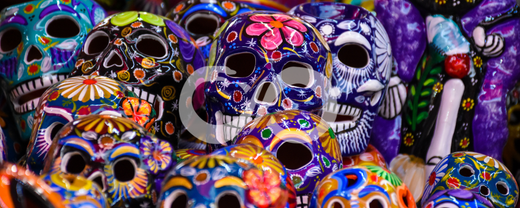
You have undoubtedly already heard of Día de los Muertos, this colorful Mexican celebration that honors the deceased with flowers, offerings, and dances. How can a celebration centered on death be so joyful, filled with music and laughter? Let’s dive together into this celebration that honors both life and death, with joy and far from sadness.
1. Where does Día de los Muertos come from?
To find out, we need to go back 3,000 years to the pre-Hispanic traditions of Mesoamerican civilizations, such as the Aztecs, Mayans, and Purépechas. These peoples already viewed death as a continuation of the cycle of life, in which the deceased could temporarily return among the living during specific periods of the year. The rituals associated with this belief were ways of maintaining a spiritual connection with ancestors. The world of the dead (the underworld) is guarded by the goddess Mictecacihuatl, the Lady of the Dead, who watches over both souls and bones. The festivities in her honor then lasted one month.

With the arrival of the Spanish in the 16th century and the introduction of Catholicism, these celebrations merged with the Christian holidays of the Day of the Dead dedicated to children who had passed away (November 1) and All Saints’ Day (November 2).
Proof of its spiritual and historical importance: in 2008, UNESCO added Día de los Muertos, or Day of the Dead, to the Intangible Cultural Heritage of Humanity list.
2. The symbols and practices of Día de los Muertos
Día de los Muertos is rich in symbolism. Among the essential elements of this celebration, the ofrenda (altar) lies at the heart of the festivities. Creating one is a ritual in itself, involving decorating it with meaningful objects: photographs of the deceased, candles, copal incense (used to purify the space), cempasúchil flowers (marigolds with a vivid orange color), and food offerings, particularly dishes the deceased enjoyed during their lifetime. The ofrenda is placed either on the deceased person’s grave or inside the home.

papel picado is another visible element of altars and decorations. These finely cut paper banners feature symbols and sometimes words. They are traditionally displayed during all celebrations throughout the year.

Calaveras (skulls), made of sugar, ceramic, or other materials (and worn as masks), are ubiquitous during the celebration. They represent death, but in a festive way. Some calaveras even bear the names of the deceased, symbolizing the idea that death is an integral part of life and should be celebrated rather than feared.
Finally, pan de muerto (Bread of the Dead) is a sweet brioche flavored with orange blossom (a symbol of immortality), shaped either like a skull or an animal and decorated with dough bones. It is a common offering on ofrendas, representing both food for the living and for the spirits who return among us during these days.

For a bit of history, this brioche was already being made by the Aztecs and buried with the deceased as an offering to the deities Izcoxauhqui, Cuetzaltzin, or Huehuetéotl, to ensure their passage to the afterlife.
3. Who is this elegant and mysterious Catrina?
Catrina, or Calavera Catrina, has become one of the most iconic symbols of Día de los Muertos. Originally created by Mexican illustrator José Guadalupe Posada around 1910, La Catrina had a satirical role. She represented a skeletal woman wearing an elegant hat, criticizing the Mexican elite who sought to adopt European fashions and values. Posada used this figure to denounce the hypocrisy of social classes that sought to reject their Indigenous roots in favor of a luxurious Western lifestyle.

The name Catrina comes from the Mexican word catrín, which referred to a well-dressed man or woman, reinforcing Posada’s social criticism of the upper classes. Although this figure was created in a context of political criticism, she was quickly adopted into Mexican popular culture as an elegant personification of death. Her popularity grew even further when she was incorporated into the work of the famous muralist Diego Rivera, notably in his painting Dream of a Sunday Afternoon in the Alameda Central, where she holds the hand of a young Rivera.

Source: WikiArt
Today, La Catrina represents an elegant vision of death in Mexican culture, where death is perceived as a natural part of life. During Día de los Muertos celebrations, La Catrina appears in various forms, from sculptures to elaborate makeup worn by participants.
Thus, La Catrina transcends her original role to become a powerful symbol of Mexican culture, celebrating both life and death while reinforcing the idea that, regardless of our social class, death concerns us all. She now embodies Mexico’s cultural pride and heritage while serving as a vehicle for reflection on identity and mortality.
4. A famous procession... thanks to James Bond
One of the most famous is the Mega Procesión de Catrinas, held every year in Mexico City. This procession gained widespread visibility after being popularized in the James Bond film Spectre.

Source: AlloCiné
Until this event, the Day of the Dead was celebrated relatively privately, in homes and cemeteries. Since then, its impact has been so powerful that this procession has become a genuine public celebration of the Day of the Dead, featuring concerts, street performances, and parades with decorated floats. Thousands of participants dress up as Catrinas and skeletons while walking through the streets of the Mexican capital.
5. Celebrating death as much as life

What may initially stand out compared with our more solemn and, let’s say, darker traditions is that Día de los Muertos is a joyful and highly colorful celebration. For Mexicans, death is seen as a natural, cyclical transition rather than a tragic end. The deceased are welcomed among the living each year for a brief period, creating an atmosphere of festivity, reunion, and shared stories. This not only preserves their memory but also maintains living ties with ancestors. Like the candles we light and place in the window during Samhain, it is customary to use very bright colors to guide the deceased to us and then toward the underworld.
That is why everything is so joyful and festive: we must create a fabulous atmosphere that will encourage the deceased to return and share this moment with the living. We recall memories through jokes and sometimes even gentle teasing. A beautiful lesson that teaches us not to take life too seriously.

Par Olivier of Aeternum
Passionate about esoteric traditions and the history of the occult from the earliest civilizations to the 18th century, I share some articles on these topics. I am also co-creator of the online esoteric shop Aeternum.













