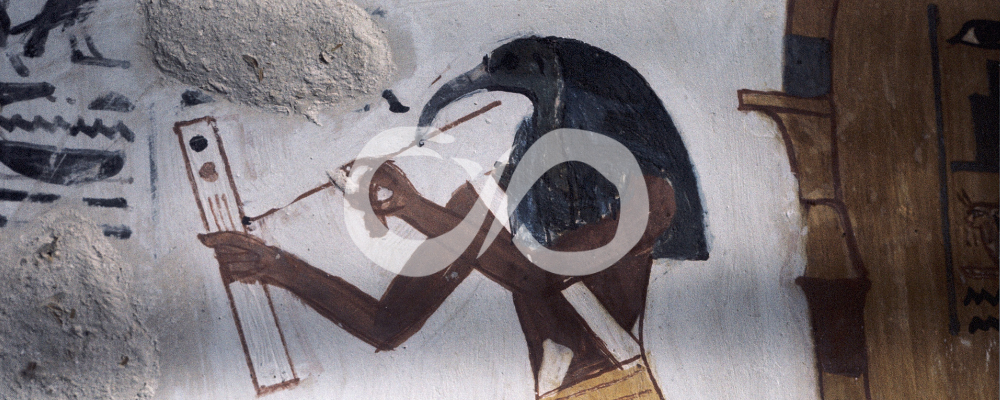
Thoth dominates the thought of ancient Egypt: this god governs writing, calculations, and celestial justice. He has influenced most systems of occultism since antiquity, yet his identity has become scattered across translations and eras. A portrait.
The Roots of Djehuty, Master of Words
Djehuty resides at the heart of Khemennu, the city of the eight that the Greeks would later name Hermopolis, where he presides over the balance of primitive creation. The texts of the Ogdoad present him as the demiurge who emerges from the primordial ocean through the sheer force of his conscious will. The ibis and the baboon manifest his essence in the physical world through symbols of vigilance and rigor. The baboon regularly greets the return of the sun with loud cries, thereby marking the rebirth of light and knowledge. The ibis searches the river silt with its curved beak, reproducing the gesture of the reed pen that engraves signs on papyrus to preserve human memory. This creature lives between heaven and earth, ensuring an essential mediation between the spiritual plane and matter. This god's role extends far beyond the simple management of writings, for he possesses Heka, the magical force capable of transforming an idea into a tangible form. Thoth speaks the names of all things, and the universe immediately appears through the effect of his voice. Speech serves not merely to exchange information but constitutes the active instrument of universal genesis. Every hieroglyph, or word of god, vibrates with real authority that alters the arrangement of the elements. The word thus becomes a fertile seed in the heart of the earth. Thoth acts as the tongue and heart of the creator, translating a silent will into a law that every being can grasp.
Time itself obeys his mathematical calculations, for he masters the rhythms of the moon and the sun with complete precision. One legend recounts how he won five extra days in a game to allow the goddess Nut to give birth to her children. Without this lucid intervention, the cycle of the years would have remained trapped in an incomplete form. He thus becomes the master of the seasons, the geometer who marks the boundaries of territories and establishes the laws of social life. The priests study the stars under his guidance because he knows the exact position of every star. His wisdom ensures the permanence of cosmic order against the forces of disorder.
The Passage to the Afterlife and the Justice of Ma'at
The Hall of Truth welcomes every deceased person for the decisive trial of weighing the heart against the feather of Ma'at. Thoth stands with his scribe's palette and records the result of the examination with an impartiality that commands respect. The heart represents the seat of memory and deeds, while the feather embodies truth and the balance of the universe. Djehuty declares the soul justified if the two pans of the scales reach a perfectly equal level. The baboon watches over the instrument's precision from the top of the balance beam to prevent any error of judgment. The god does not merely judge, for he ensures that harmony reigns on earth as in heaven. The traveler of the invisible receives from him the formulas necessary to overcome the obstacles of the Duat, the realm of shadows. These powerful incantations repel demons and open the gates guarded by fearsome entities. Thoth pleads for the purity of those who live according to the principles of justice and balance. His presence reassures the spirit because he knows the winding paths that lead to the paradise of the righteous. His word serves as a shield against attacks from darkness during the nocturnal journey. Tradition attributes to this god the writing of forty-two volumes containing the entirety of human and divine knowledge. These writings cover every field of law, medicine, astronomy, and geometry. They are intended for an elite capable of grasping the true meaning hidden behind symbols and images. The priests preserve these works in the secret parts of temples to prevent them from falling into ignorant hands. It is said that whoever succeeds in reading the formulas of the true Book of Thoth gains absolute authority over the forces of nature.
The Transformation into Hermes Trismegistus
The meeting between the Greek and Egyptian civilizations in Alexandria brings about a fusion of their respective deities. The Greeks recognize their messenger Hermes in the learned figure of Thoth and thus form the character of Hermes Trismegistus. This name means "Thrice Great" because he masters the three parts of the philosophy of the entire world. He embodies an ancient sage who bears an original revelation explaining the relationship between humanity and the divine. This new identity encourages Egyptian wisdom to travel throughout the Mediterranean basin.
The Corpus Hermeticum brings together dialogues in which Hermes teaches the mysteries of the universe to his closest disciples. The central idea lies in the kinship between the human intellect and the creator's spirit. Humanity is not an insignificant creature but a mortal god capable of recovering its luminous condition. Gnosis makes it possible to break the chains of matter and return to the source of all existence. These texts emphasize the need for spiritual awakening through contemplation of the beauty and order of the world. Human reason then directly participates in universal reason.
Hermeticism rests on an organic vision of the cosmos in which everything is connected by invisible chains of sympathy. The planets, metals, plants, and parts of the human body vibrate in unison according to harmonious relationships. The scholar who understands these connections becomes the true master of nature through knowledge of celestial influences. The universe resembles an open book written by the hand of the scribe god, where every object constitutes a word to be deciphered. By observing the movements of the stars, the initiate grasps the movements of their own heart. The structure of the world becomes an exact mirror of the structure of the human soul.
The Emerald Tablet, the Heart of Alchemy
One of the most famous texts associated with this figure remains the Emerald Tablet, discovered in a sealed crypt beneath the statue of Hermes. This short document contains the fundamental principles of the transmutation of matter and spirit. It serves as a guide for alchemists seeking to transform the lead of ignorance into the gold of pure knowledge. Each sentence conceals several levels of meaning that require careful study and great perseverance. The text reveals a force capable of penetrating every solid thing and overcoming every subtle thing.
What is below resembles what is above; this sentence illustrates the law of analogy at the heart of Hermetic thought. The human microcosm faithfully reflects the universal macrocosm in an exceptional unity of principle. By understanding their own inner mechanisms, the student gains access to the most distant secrets of the stars. This vision makes it possible to pass from the material plane to the spiritual plane without any break in continuity. It suggests that unity reigns behind the multiplicity of forms we perceive through our physical senses.
The text mentions the sun as the father and the moon as the mother of the creative force. This evokes the necessary union of masculine and feminine, active and passive polarities to accomplish the Great Work. The alchemist separates the subtle from the dense with great rigor to extract the quintessence from raw matter. The objective lies not merely in producing metallic gold but in transforming the human being itself. This quest demands purity of heart and a discipline of mind practiced every day of one's existence.
The Inspiration of Initiatory Societies
The figure of Thoth-Hermes nourishes the spirit of numerous fraternities that preserve ancient knowledge through the ages. Renaissance alchemists see him as their rightful patron because he embodies the primordial tradition. His image regularly appears on the frontispieces of scientific books to recall that human curiosity remains a gift of divine intelligence. Movements such as the Rosicrucians adopt the principles of Hermeticism to establish their rituals of initiation and spiritual reform. Freemasonry is likewise inspired by the sacred architecture and geometry that the scribe god uses to construct the ideal temple.
In the twentieth century, occultism takes up these foundations to structure highly elaborate systems of knowledge such as the Hermetic Order of the Golden Dawn. Members must master astrology, alchemy, and Hermetic Kabbalah under the aegis of Thoth. Aleister Crowley published the Book of Thoth in 1944 to accompany his tarot deck, which became a true map of consciousness. This work does not seek simple prediction but proposes an initiatory journey through the arcana of the world. The Thoth tarot incorporates complex symbols to stimulate the seeker's intuition and encourage their inner transformation.
The fascination with this entity can be explained by his role as mediator between the different planes of the universe. He offers the tools that enable humanity to understand its exact place in creation without resorting to blind obedience. His wisdom represents the central point between light and shadow where proper measure is established. The history of Thoth becomes fragmented over time, but his power remains intact for those who seek to gather its traces. He embodies sovereign intelligence, revealing what remains hidden from the eyes of the uninitiated through the rigor of study.
The history of Thoth shows that knowledge remains an active and living force in the hearts of humanity. He remains the one who gave language to human beings so that they could finally name their own destiny. As the scribe of the gods and regulator of time, he watches over every sign traced in the clay of the world.

Par Olivier of Aeternum
Passionate about esoteric traditions and the history of the occult from the earliest civilizations to the 18th century, I share some articles on these topics. I am also co-creator of the online esoteric shop Aeternum.