













































































































































A man has already left. He has crossed the yard, taken the road, and disappeared behind the trees. Yet something of him remains: the imprint of his foot in the damp earth. For centuries, European folk traditions treated this footprint as more than a sign that someone had passed by. Trod earth, a hollow formed in the dust, and tracks left by shoes could be used in symbolic workings aimed at an absent person. The man was no longer there, but his passing seemed still to preserve a connection with him.
This idea runs through several historical traditions. Nineteenth-century collectors of folklore described practices in Germany, England, and other regions involving earth taken from a footprint. In the southern United States, African American Hoodoo traditions placed particular importance on the body passing through a place, road dust, and shoe tracks. Their vocabulary has its own expressions, including foot-track magic, foot-track work, and hot foot. The kinship between some principles should not obscure the differences in their histories.
A footprint is neither a worn object nor a fragment detached from the body. It is a sign produced by contact. This very quality gave it magical authority. The shape remains in place after its maker has left; the trace therefore connects two places and two moments. There was no need to know the traveler personally to recognize their step. In the eyes of ancient traditions, the invisible lay in this enduring connection between the one who walks and the earth that preserves their memory.
The history of footprints sheds light on contact magic, the relationship between paths and destiny, defenses against bewitchment, and the place of the body in rootwork. It deserves to be studied in its own right, without turning archival records into recipes to reproduce or confusing European practices with African and African American traditions.
When the earth preserves a person's passing
A footprint is usually distinguished from simple material presence. A shoe can be left on a doorstep, a garment abandoned in a chest, and a lock of hair kept in a pouch. A footprint, by contrast, exists only because a body has passed through a place. It is the result of an ordinary act that brings together a person’s weight, the ground, and movement. This origin gives it a particular significance in the history of magic: it appears spontaneously, without having been made to become a ritual object.
The ground does not record every step in the same way. Dry, hard earth retains few marks, while clay, sand, or mud preserve clearer outlines. A shoe can leave the shape of its sole, a bare foot the shape of its toes and heel. These differences fostered the sense that a footprint could capture something personal. Long before modern identification methods became available, a trace already told a story of a route, a direction, and sometimes the passage of a recognizable individual.
Folk magic extended this connection beyond practical information. According to the principle now called contact magic, two things that have touched can retain a symbolic connection after being separated. A personal object, a substance from the body, or a place marked by someone's passage can become a possible focus for interpretation. This language does not claim that the material has a proven physical property; it describes a principle passed down and recognized in witchcraft traditions.
The historian Edwin Sidney Hartland gives it an important place in the second volume of The Legend of Perseus, published in 1895. In his chapter on sympathetic magic, he explains that earth taken from a footprint could be considered as closely linked to an individual as a part of their body. Hartland reports several European customs, then compares them with other accounts from around the world. His work is a major source for the history of comparative research of his time, but his general conclusions should not be repeated as proof of a universal origin.
The footprint lies at the intersection of the body and the land. Hair or nails accompany a person for part of their life and can later be separated from them. A footstep, by contrast, is a momentary connection with a path. Its interpretation therefore also concerns departure, walking, return, the ability to move forward, or the inability to leave a place. This logic appears in several accounts in which people seek to stop an adversary, turn away a visitor, or protect someone from a hostile influence.
The fact that footprints are generally erased by time also plays a symbolic role. Wind fills in a mark in the sand, rain flattens the earth, and other feet blur the original shape. The sign is fragile, but it seems all the more powerful to someone who finds it before it disappears. It bears witness to a passage that has just taken place. Ancient traditions attached importance not only to durable objects; they also gave value to ephemeral materials linked to a moment.
A common misconception should be avoided: not all footprints considered sacred involve magic performed on someone who is absent. Some footprints in rock have been venerated as traces of saints or supernatural beings. In her study of footprints and the religious landscapes of the British Isles, historian Alexandra Walsham shows that these marks can transform a place into a space of memory and devotion. They belong to a different category from soil gathered from a footprint to act symbolically on a person.
These distinctions make the history of footprints richer. One might seek to recognize someone, preserve the memory of a passing, venerate a sacred mark, or treat trodden earth as an extension of a person. The same word describes functions that should not be confused. Contact magic concerns a connection transmitted through an action, not merely the visible resemblance of a foot outlined on the ground.
Footprints in European Folk Traditions
Collectors of customs in the 19th and 20th centuries preserved detailed accounts of footprints. In Germanic Europe, several authors report the idea that material taken from the place where someone had walked remained linked to the fate of the person who had trodden on it. The relationship between the condition of this material and that of the traveler lies at the heart of these accounts. This is not a doctrine developed by a school of high magic, but a set of local customs described in surveys and compilations.
James George Frazer brings together several examples in The Golden Bough. He mentions accounts collected in Mecklenburg, Germany, as well as in regions of France. In these accounts, the footprint serves to symbolically reach someone who can no longer be touched. He also recounts an English story from Stowmarket, Suffolk, where the footprint of a woman regarded as a witch becomes a place believed to have power over her movements. These are historical beliefs reported by identifiable authors, not events whose efficacy has been demonstrated.
The same subject appears in Hartland, who cites German traditions involving earth taken from a place where someone had walked. In some accounts, changes to the soil are said to affect the body or vitality of the person who walked on it. This brings us back to the broader theme of the links between a person and their material traces. These accounts reflect a worldview in which the connection does not necessarily disappear when physical contact ends.
England also offers examples related to protection against supposed bewitchment. Hartland recounts a story from the Isle of Man about a sick foal whose condition was attributed to the evil eye. Dust from the path of the suspected person played a part in the healing story. The document tells us about an old way of explaining an animal's illness and seeking symbolic help. It should neither be turned into a treatment method nor cited as medical evidence.
These records show that footprints were not used exclusively to cause harm. The collections include protective practices, intentions of romantic fidelity, attempts to restrain someone or force them to leave, and ways of seeking the cause of a misfortune. To understand an account, we must identify the purpose attributed to the object. A footprint linked to love belongs to a different story from a mark associated with theft or illness, even if both share the same principle of contact.
The presence of iron tools in some accounts points to another area of folk magic. Metal represents stopping, constraint, resistance, or the power to cut. A footprint represents a person's movement. Their juxtaposition in witchcraft accounts establishes a symbolic opposition between movement and immobilization. We have already explored the material and uses of protective iron in European traditions: this article focuses on the link attributed to the footprint, not on the same objects.
Modern historians also question the quality of the testimony. Frazer and Hartland are essential authors for learning about the material collected in their time, but their approach of organizing traditions into broad stages of human evolution reflects an anthropology rooted in its historical period. Owen Davies has shown how important it is to place folk magic practices in their social, religious, and material contexts. A village custom does not automatically become the remnant of a prehistoric rite that was identical across the continent.
Caution is also warranted when it comes to the idea of pagan survivals. The fact that a story involves the earth, the body, or a path does not prove that it has been passed down unchanged since antiquity. Christian populations in early modern Europe preserved, adapted, or invented forms of protection and witchcraft of their own. Footprints are part of these local histories. Their existence in historical records is well documented, but their precise origin requires evidence that is not always available.
Footprints also tell us about a kind of magic rooted in everyday life. A typical scene requires neither a temple nor an exceptional library: a country path, a doorway, a stable, a street, or a yard is enough to provide a setting for the story. The supposed power comes not from a rare object, but from an everyday passage. This familiarity explains why footprint magic was reported in social settings far removed from scholarly treatises.
Hoodoo and the Power of Foot Tracks
In the southern United States, African American traditions collectively known as Hoodoo or conjure give footprints an important role. The English term foot track means a footprint or trail; foot-track magic refers to contact practices in which a person's passage and the ground they have walked on hold symbolic value. This tradition should not be reduced to a mere American translation of a German custom. It developed in a distinct historical context shaped by slavery, African heritage, local resources, and the experiences of Black communities in the South.
Hoodoo took shape at the crossroads of traditions from West and Central Africa, Christian cultures, and North American realities. In Mojo Workin', Katrina Hazzard-Donald emphasizes the existence of an old African American religious and healing tradition long passed down outside official institutions. Her study distinguishes regional expressions, folk medicine, the role of practitioners, and magical goods that emerged on the commercial market. This complex history cannot be assigned to a specific African origin based solely on the resemblance of a practice.
The road occupies a distinctive place in the material life of the communities where these practices were recorded. Paths connect fields, homes, markets, churches, and workplaces. Crossing a threshold or taking a path means exposing one's body to a specific place for a moment. The foot touches the ground directly or indirectly, then leaves. In the logic of rootwork, this contact can establish a connection that the practitioner considers to remain even after the passerby has moved on.
Zora Neale Hurston is a major source in this field. An African American writer and anthropologist, she published Hoodoo in America in 1931 in The Journal of American Folklore, following her research in Southern communities. She reports the words, categories of workings, and terms used by her informants. Her pages show that practices involving walking cannot be reduced to a single commercial name. Her account reflects the voice of an observer engaged in fieldwork, although the circumstances of collecting and the choices made in writing must also be examined historically.
The collections of Harry Middleton Hyatt, drawn from interviews recorded mainly in the 1930s and then published in several volumes beginning in 1970, make this material even more visible. They preserve accounts from Alabama, Georgia, South Carolina, and other regions. Recorded themes include ways to protect oneself from an influence thought to be attached to a path, signs attributed to an attack through a footprint, and responses sought from specialists. These accounts should not be turned into a uniform manual.
The connection to footsteps also appears in accounts of objects buried on a path or near an entrance. Tradition assigns the body's passage over a place a meaning distinct from that of earth taken from an already-made footprint. In one case, the trodden ground retains the person's mark; in the other, crossing a prepared spot is considered the moment when an influence is received. These mechanisms are related but not identical, and sources do not always refer to them by the same name.
Our feature on Hoodoo, from the plantations to rootwork presents its historical context and the main families of materials used. Here, the foot serves as a guiding thread: it helps us recognize a grammar of the relationship between the body and the path, without repeating the entire history of African American traditions or turning them into mere folklore curiosities.
The words recorded by Hyatt also remind us that these practices could be understood as a threat to guard against. Choosing a route, fearing an object found in front of one’s home, or seeking out a conjure specialist were part of some people’s everyday lives. Footprint magic was therefore not only an offensive technique invented to impress; it also reflected concerns about protection, health, neighbors, and social relationships.
The expression foot-track magic now encompasses practices whose historical attestations remain varied. It is a useful category, but does not remove the need to ask who is speaking, in which region, during what period, and with what intention. Modern esoteric trade networks have standardized product names more readily than archives have preserved detailed lineages. Faithfulness to Hoodoo calls for preserving these nuances.
Sending someone away, holding them back, protecting: the magic of the path
Direction is one of the defining features of foot-track magic. A footprint indicates that someone came from somewhere and continued on toward somewhere else. It therefore already contains a story of movement. When a tradition seeks to drive someone away, it symbolically turns toward the exit, departure, or breaking of a habit. When it seeks to hold someone back, by contrast, it favors restraint and obstruction. The trace provides a natural language for expressing these opposing intentions.
In Hoodoo commercial vocabulary, Hot Foot and Moving Powder eventually came to denote product families associated with driving someone away or moving them elsewhere. Hurston’s accounts attest to related terms in the early 20th century. However, the presence of an expression in a modern catalog does not prove that all local traditions shared a fixed recipe. Commercial names have their own history, distinct from that of the words recorded from rootworkers.
Hazzard-Donald specifically cautions against treating the market for magical supplies as the entirety of historical Hoodoo. Packaged products and standardized names developed alongside urbanization and commercial distribution. Traditions once tied to a family, a specialist, or a region may have been reorganized by this economy. Understanding the magic of the path therefore means distinguishing what is documented in field research, what is a scholarly interpretation, and what a contemporary brand presents.
In both European and African American accounts, a footprint may be imagined as vulnerable because it remains accessible after the person who made it has left. This vulnerability has nothing to do with medical reality: it belongs to a symbolic system in which a connection persists despite absence. It also explains the place of the protective measures described in the sources. Some people feared not so much the object itself as the influence that might have been attached to a route.
The footprint thus becomes a paradoxical object: it is less personal than a signed letter, but much more bodily in the imagination of contact magic. It does not tell what the person wanted to say; it bears witness to what their body did. A step connects everyday life to a symbolic act without any declaration being made. This silent connection explains its role in traditions where a person can be affected in their absence.
Protective practices should be treated separately from hostile accounts. European collections mention defense against witchcraft attributed to a neighbor; African American traditions also record concerns about points of entry and paths. The objects and interpretations do not necessarily align. Functional similarities between two forms of protection are never enough to demonstrate direct lineage. We have explored the general history of apotropaic magic, which helps explain this vocabulary of defense and repelling.
The passage may also be connected to romantic relationships. Folklorists have reported customs intended to retain affection or influence someone’s return. In some traditions, walking represents the separation of people, and the footprint remains as a place where the relationship can be imagined. Intentions vary from one account to another. It would be wrong to treat every footprint as an instrument of domination: some accounts express a desire for someone to return or a fear of losing someone, while others express an explicit desire to compel.
What emerges from all these records is a concrete conception of fate. Leaving, staying, crossing a threshold, and choosing a road are physical acts before they become images. The magic of the path does not address an abstract idea of the future; it is tied to visible movements and decisions that change lives. In this respect, the footprint is a highly coherent symbol, even when traditions do not share the same terms or origins.
The history of paths must finally be situated within social relations. In rural societies, people's movements could be tracked; in communities subjected to coercion, the freedom to come and go could become a major issue. The symbolism of departure and confinement therefore did not carry the same weight everywhere. An expression that evokes nothing more than banishment to a modern reader could have had a much more immediate meaning in the life of someone whose work, family, or safety depended on a particular place.
What Footprints Reveal About Ancient Magical Knowledge
Footprints show that folk magic does not always rely on objects specially made for it. An ordinary material is enough when tradition assigns it a particular connection to a person. Contact, the memory of the gesture, and the object's position in space then become part of its meaning. We can understand the logic without repeating the practices described by early collectors or treating their conclusions about efficacy as verified results.
This dossier also invites us to recognize the value of geography. The Germanic customs documented by Hartland and Frazer are not direct evidence of the origins of African American foot-track work. Communities in the American South developed their own traditions within a history shaped by African heritage, the violence of slavery, Christian religion, and available resources. A similarity in principle does not allow us to conflate the people who carried it on or the paths by which it was transmitted.
Field sources therefore occupy an irreplaceable place. The accounts preserved by Hurston and Hyatt belong to a time when witnesses actually spoke to an investigator. Their language, hesitations, and ways of naming practices make visible a tradition that cannot be reduced to a printed treatise. The collectors' biases, the social conditions of the interviews, and what the people they spoke with were willing to share must also be examined. A discreet practice is never fully contained in public archives.
Ancient comparisons gave this subject a vocabulary that remains useful when used with care. We speak of contact magic, symbolic contagion, or sympathetic connection. These concepts describe a mechanism attributed to tradition. They do not establish that a footprint contains measurable energy. Conversely, distinguishing historical facts from interpretations does not erase the coherence of traditional logic. It allows that logic to be passed on precisely.
A footprint has something in common with the objects of passage found in other areas of magical history. The threshold of a house, the lock, the path, the door, or the crossroads are places where relationships change. We have already discussed the protection of thresholds in our article on iron and the invisible; the footprint adds a mobile element to this history, produced by the momentary encounter between a body and a place.
The path of folk magic is not just about gathering rare objects. It knows how to read the effects of everyday life: what has been touched, carried, crossed, lost, or abandoned. A person can leave a place without leaving a name or lasting material trace, and yet the earth preserves a moment of their passing. This simple event gives language to fundamental questions: who comes, who leaves, who may enter, who must go away, and how to maintain a connection when the other person is absent.
Finally, the traditions’ plurality must be restored. The history of foot-track work belongs to the communities that passed it down; European accounts belong to their local contexts; the holy footprints studied by Walsham reflect another way of inscribing presence in space. There is value in recognizing their analogies, but much would be lost by dissolving their identities into a single imaginary doctrine. Ancient knowledge remains alive when its origins and nuances remain clear.
A footprint disappears easily. Rain, wind, or the next passerby covers it. Yet its symbolic uses were significant enough to leave entire pages in witchcraft investigations and Hoodoo archives. Perhaps that is the most striking feature of this magic: it gave great importance to what seemed least likely to last. The absent person was no longer on the path; in the traditional language of contact, something of them remained where their foot had touched the ground.
Sources and references
Edwin Sidney Hartland, The Legend of Perseus, vol. II, 1895, chapter IX. European accounts of footprint earth and symbolic action directed at absent people.
James George Frazer, The Golden Bough, expanded edition, Part One, passages on footprints in Europe. A historical source to be understood in the context of the anthropology of its time.
Zora Neale Hurston, “Hoodoo in America,” The Journal of American Folklore, 44, no. 174, 1931, pp. 317–417. A major study of African American traditions.
Harry Middleton Hyatt, Hoodoo–Conjuration–Witchcraft–Rootwork, five volumes, 1970–1978, interviews collected primarily in the 1930s.
Katrina Hazzard-Donald, Mojo Workin': The Old African American Hoodoo System, 2013, Smithsonian Libraries and Archives record. Social and religious history of this tradition.
Owen Davies, “The World of Popular Magic,” The Oxford History of Witchcraft and Magic, 2023. Analysis of popular practices and European material culture.
Alexandra Walsham, “Footprints and Faith: Religion and the Landscape in Early Modern Britain and Ireland”, on sacred footprints and the memory of places, a category distinct from contact magic.
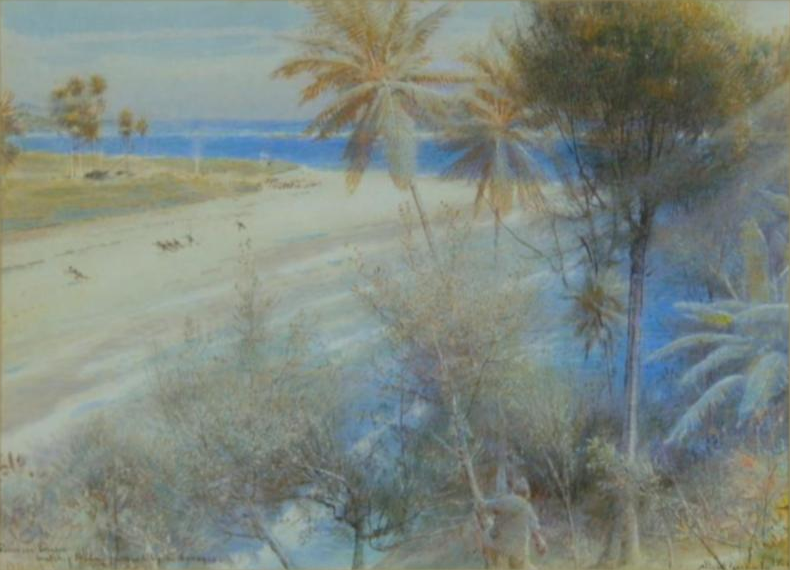
Cover: Albert Goodwin, Robinson Crusoe, 1906 watercolor depicting the discovery of a footprint. Public domain work, Wikimedia Commons. A literary illustration of the evocative power of a trace, not a depiction of a Hoodoo rite.

Par Olivier of Aeternum
Passionate about esoteric traditions and the history of the occult from the earliest civilizations to the 18th century, I share some articles on these topics. I am also co-creator of the online esoteric shop Aeternum.