















































































































































































































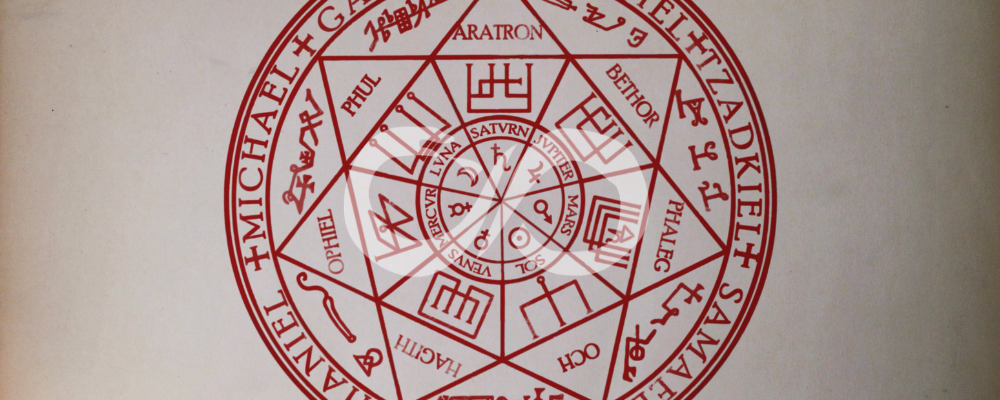
They appear on medals, talismans, pentacles printed or engraved on metal or wood, and sometimes even on candles. Seven archangel names, written in a circle or around a cross, surrounded by symbols. These archangels do not all appear in the official Bible. Their presence also comes from apocryphal texts, Jewish Kabbalah, ancient Christian traditions, or more recent esoteric movements. Their common point: a strong connection with protection. They are called upon to watch over a home, guide a decision, or drive away anything that could cause harm.
1. Where do these seven archangels come from?
The seven archangels found on protection talismans do not come from a single text or a single religious tradition. Their gathering took shape over the centuries through the accumulation of stories, manuscripts, spiritual interpretations, and liturgical choices. The idea that there is a group of seven archangels first appears in ancient Jewish texts, particularly the Book of Enoch, a work not recognized in the Western biblical canon but highly influential in apocalyptic and esoteric circles. In this text, several angel names are given, each associated with a specific function, part of the world, or role among humanity.
In the Christian tradition, only three archangels are officially named in the Bible: Michael, Gabriel, and Raphael. Michael is mentioned in Revelation, Gabriel in the Gospels, and Raphael in the Book of Tobit. Uriel, although very prominent in ancient religious literature, was excluded by ecclesiastical authorities during the formation of the canon, but his name continued to circulate in apocryphal texts and popular traditions. The same applies to the other archangels associated with talismans: Barachiel, Raguel, Jophiel... Their names appear in Byzantine traditions, certain Orthodox prayers, and practices connected with Christian Kabbalah during the Renaissance.
The number seven, in biblical symbolism, is linked to the idea of totality, fullness, and a completed order. It is found in the seven days of creation, the seven seals of Revelation, and the seven gifts of the Spirit. The association of seven archangels with the seven days of the week or with the seven planets known in antiquity is not random. It reflects a system of correspondences used since the Middle Ages by theologians, copyist monks, and scholars of Christian esotericism. This structure of seven figures became established in medieval angelology, particularly in grimoires and spiritual works intended for individual prayer or household protection.
The modern use of these seven names on protective objects therefore did not arise yesterday. It is rooted in a continuity between ancient religious texts, oral traditions, and devotional practices. Even though these archangels are not all the subject of official worship, they have found their place in forms of popular spirituality where prayer, symbolism, and the intention of protection come together.
2. Their names, their functions, their place in the texts
Among the seven archangels found on protection talismans, some are known to a broad public, while others belong to more obscure traditions. All of them have nevertheless endured through the centuries, carried by ancient texts, visions, oral traditions, or prayers written in the margins of manuscripts. Their names are never arbitrary: they correspond to a function, a mission, and sometimes a spiritual quality. Each name evokes one aspect of divine action as perceived in angelic traditions.

Michael holds a special place. He is the most frequently mentioned and invoked, and his name means “Who is like God.” In Revelation, he fights the dragon. On talismans, he embodies protection against hostile forces. He is placed at the top of the circle, as a central figure or anchor point. Gabriel, the messenger par excellence, is associated with announcement, communication, and clarity. The New Testament attributes to him the revelation made to Mary. Raphael, present in the Book of Tobit, accompanies, guides, and heals. He appears as a benevolent companion, close to the sick and travelers.
These three well-known names are joined by Uriel, whose name evokes the light of God. He does not appear in the canonical Bible, but is found in several apocryphal texts and ancient traditions, particularly the Book of Enoch. Uriel is associated with wisdom, hidden knowledge, and inner revelation. Barachiel, whose name means “blessing of God,” is sometimes depicted with flowers or a sheaf of wheat. He is associated with providence, gentleness, and discreet yet constant protection. Raguel, another figure from the Enochian tradition, acts for justice and balance. He settles disputes and restores order when it has been disturbed. Finally, Jophiel, sometimes absent from ancient texts but present in more recent angelology, embodies beauty, mental clarity, and a form of elevation through thought or prayer.
These archangels are associated with days of the week, planets, colors, or cardinal directions, depending on the tradition. These correspondences are not part of a fixed system, but of a gradual construction influenced by Hebrew, Christian, Byzantine, and esoteric texts. Their presence on a talisman therefore depends not only on their mention in Scripture, but also on their symbolic function in a worldview where protection comes through identified and named forces.
3. The archangels and protection
The idea that certain archangels can offer protection dates back to the oldest texts. Michael, in Revelation, does not merely appear as a messenger: he fights. He acts against hostile powers and drives away evil. This warrior dimension, in the spiritual sense of the term, gives him a central place in protective invocations. From the earliest centuries of Christianity, prayers were addressed to him to ward off danger, accompany the dying, and watch over inhabited places. He became the protector of armies and churches, as well as of people facing illness or danger.

Archangel Michael
Gabriel is also invoked in situations of tension. His role as a messenger associates him with communication between the visible and invisible. In certain ancient prayers, he is called upon to dispel confusion, clarify a choice, or maintain peace in the home. Raphael, the guide of young Tobias, is regarded as a protector during journeys, life changes, or moments of uncertainty. He is associated with health, stability, and the benevolent presence of an invisible ally.
Over time, other figures were added. Uriel, associated with knowledge, is called upon to face the unknown. Barachiel, discreet yet constant, watches over family relationships, births, and everyday blessings. Raguel intervenes in conflicts, tensions between loved ones, and emotional imbalances. Jophiel, finally, intervenes in the realms of intuition, fine understanding, and the beauty of the world. Each acts in their own way within specific areas of human life.
These archangels are not invoked only by priests or within a strict liturgical setting. They are called upon in private prayer, in silence, in anguish, and in moments of inspiration. Their names are written on parchment, repeated in whispered phrases, and carried in simple objects. This is not magic in the ritual sense of the term, but an inner connection between a name and trust. Some traditions also use these names in practices for blessing the home, purification, or prayer for the sick.
Today, these figures are present in spiritual books, objects, meditation manuals, and prayer circles. They can be found in Orthodox churches and Catholic communities, as well as in contemporary movements seeking to revive a direct connection with invisible powers without passing through a formal religious structure.
4. Deciphering the Seal of the 7 Archangels
The origin of the Seal of the 7 Archangels remains largely mysterious. This symbol, represented by a heptagram (seven-pointed star) inscribed in a circle, is clearly associated with spiritual protection and guidance. It therefore incorporates the names of the seven archangels we have just discussed.

Seal of the 7 Archangels
Although some sources suggest a connection with the Grimoire of Armadel, a 17th-century esoteric manuscript, this seal is not explicitly mentioned there. The grimoire contains references to symbols and archangels, but the seal as we know it appears to be a later synthesis, probably influenced by various esoteric and spiritual traditions.
The number seven, central to this symbol, has a particular meaning. In the context of the seal, each point of the heptagram represents an archangel, a planet, and a day of the week, thereby creating a symbolic link between heaven and earth.
5. Talismans, medals, and consecrated objects
The seven archangels are found not only in texts or prayers. They also appear on material objects that people wear, give as gifts, or place in a location so that they may act as silent guardians. Among these, protection talismans hold a special place. They are often metal discs, sometimes made of wood, engraved on leather, or printed on paper, bearing the names of the seven archangels arranged around a symbolic center. Some feature crosses, stars, Hebrew letters, or verses taken from Scripture.
These objects are not new. Since the Middle Ages, protective medals have circulated in Christian circles. Some feature solar or planetary symbols, while others bear geometric figures. What distinguishes them from simple religious medals is their direct connection with a function: to protect, drive away evil, or bring peace to a place. Their use has been passed down through families, monastic traditions, or individual practices. They are blessed, consecrated, and kept on one’s person, in a pocket, under a pillow, or in a bag.
Today, these talismans are found sometimes in a religious setting and sometimes in a more esoteric approach. Some are simple, while others are highly detailed. Their appearance varies according to the countries, traditions, or languages used. They can be found in Latin, Greek, Hebrew, and French. They may be worn as pendants, hung on the wall of a home, or incorporated into a personal altar. For those who use them, their power lies not only in the material, but in the connection they create with the names they bear.
These objects are not passive amulets. They accompany gestures, prayers, and acts of attention. They recall a presence. They structure a spiritual space where one can address what cannot be seen. In a world marked by agitation, they allow some people to establish an anchor, an intention, and protection.
6. Between faith, tradition, and modern adaptation
The seven archangels found on protection talismans belong to an ancient tradition, but their use has never been fixed. They have passed through eras, translations, and cultural transformations. Their presence in objects today is not a matter of nostalgia or reconstruction. It bears witness to a living continuity in which protection still passes through names, forms, and gestures.

Archangel Gabriel
For some, these archangels are real presences sent by God to accompany human beings. For others, they embody symbolic forces that help people persevere, make decisions, and navigate uncertainty. What matters is not always doctrine, but the personal connection woven with them. This connection is often discreet, sometimes passed down through a family, and sometimes discovered alone, without explanation.
Talismans bearing their names answer this very ancient need to give material form to a request. They have a place in a pocket, on an altar, or in a bedroom. They recall a commitment, an expectation, and trust. Their power does not come from the metal or the design, but from what they represent to the person who carries them.
The Church, however, does not encourage every use, although it recognizes certain forms of prayer to the archangels, particularly Michael, Gabriel, and Raphael. It also acknowledges that popular traditions continue to keep ancient figures alive, even when they have sometimes been forgotten by official texts. Objects bearing the seven names do not belong to an institutional practice, but they form part of a spiritual heritage that many people continue to keep alive in their own way.
We do not know exactly who first drew the circle around the seven archangels. The symbol as it exists today appears in no canonical text or single identifiable original grimoire. It seems to have emerged at the crossroads of several traditions, between esoteric manuscripts, prayer practices, and ancient correspondences. In an unstable world, the figures of Michael, Gabriel, Raphael, and the others remain there, set upon a circle, like so many names called upon to watch over us. Perhaps it is precisely this mystery that makes them so effective...

Par Olivier of Aeternum
Passionate about esoteric traditions and the history of the occult from the earliest civilizations to the 18th century, I share some articles on these topics. I am also co-creator of the online esoteric shop Aeternum.













