















































































































































































































Vodou is a religious and magical tradition rooted in several African heritages that developed in particular in Haiti during the colonial period. Haitian Vodou recognizes Bondye, the creator God, and gives a central place to serving the lwa, spirits with distinct personalities and attributes, as well as to ancestors. This religion is part of its followers’ everyday lives as well as their major ceremonies.
Prayers, songs, drums, offerings, vevés, herbal baths, divination, and protective workings are among its practices. Each ritual follows customs that depend on the spirits honored and the traditions of the Vodou house. To understand Vodou magic, one must therefore know the lwa, how they are served, the roles of priests and priestesses, and the commitments that bind believers to the spirits.
The African origins of Vodou and its birth in Haiti
The word vodou refers to traditions of West Africa, particularly the Fon and Ewe worlds. In Haiti, the religion took shape through contact with traditions forcibly brought to Saint-Domingue by enslaved Africans. Fon, Yoruba, Kongo, and other heritages came together, while Catholic prayers, images, and calendar became part of ritual practices.
This history is one of transmission wrested from violence. Songs, the names of spirits, and ways of healing and honoring the dead survived because men and women kept them alive. Vodou accompanied the lives of enslaved communities and the history of the Haitian Revolution. The Bois-Caïman ceremony, associated with the 1791 revolt, became a founding episode, though details of how it unfolded remain debated.
Haitian Vodou must also be distinguished from Vodun, practiced notably in Benin and Togo, and from the traditions of Louisiana. They share historical connections, but they do not form a single school with interchangeable practices. In New Orleans, Marie Laveau shaped the history of a local practice whose contours do not overlap with those of a Haitian Vodou house.
Bondye, the lwa, and ancestor worship
At the top is Bondye, the creator God. In ritual life, relationships are formed chiefly with the lwa, spiritual powers with their own names, songs, colors, personalities, and particular ways of receiving service. They are neither reduced to gods in the sense of an ancient pantheon nor to mere psychological symbols. For believers, the lwa act in people’s lives, with whom they maintain bonds.
Papa Legba opens the passages and makes ritual communication possible. Damballah is associated with the serpent and ideas of wisdom, purity, and origin. Ogou brings together warrior figures associated with iron, discipline, and authority. The different Ezilis speak of love, desire, motherhood, suffering, or fierce defense of their own: Ezili Freda and Ezili Dantò are not two names for a single personality. The Gede, with Baron Samedi, remind us that death, sexuality, humor, and the continuity of generations can come together in a single ritual presence.
Ancestors also hold an essential place. It is not enough to seek the help of a great lwa while forgetting those who came before us. Family memory, the dead, and our duties toward them form part of the spiritual foundation of many practices.
The Rada, Petwo, and Gede families of lwa
You may hear of the nanchon, families or nations of lwa. The Rada are generally associated with rites inherited from West African traditions and a style of service considered more measured. The Petwo suggest a fiercer intensity, struggle, the speed of certain interventions, and the strength needed to face adversity. The Gede hold a distinct place concerning the dead and the fecundity of life. Other groups, such as the Kongo or Nago, are also important.
It would be wrong to conclude that Rada means “good” and Petwo “evil.” This division largely stems from outside oversimplifications. A lwa cannot be understood through a simplistic moral label or a universal correspondence of color or offering. Its service depends on the house, the lineage, and what has been passed down.
How a Vodou ceremony unfolds in an ounfò
The ounfò is the house or place of worship. Ceremonies take place under the guidance of a manbo or an oungan, priestess or priest, with the participation of officiants and community members, including the ounsi. The ritual space often includes a peristil, where dances and songs take place, and the poto mitan, the central post around which many services are organized.
The place, objects, and offerings are prepared; then come the greetings, prayers, invocations, and songs suited to the lwa being honored. The drums are not music added for atmosphere. They carry a ritual language: the rhythms accompany specific sequences, while the sung responses engage the entire assembly. Dance is not separate from prayer. The body takes part in the service.
A lwa may sometimes “mount” a person. In the tradition’s vocabulary, this is called ritual possession, and people say the spirit rides its “horse.” Followers recognize its presence in a person’s demeanor, way of speaking and dancing, requests for certain objects, or manner of addressing the assembly. This moment can bring guidance, blessings, or words addressed to someone. It does not occur automatically at every ceremony, nor can it be induced using a recipe to reproduce alone.
The service does not end with the final drumbeat. Tidying up, sharing, giving thanks, and honoring commitments are all part of the work. This is also why the ceremony is a community affair, not simply an individual performance.
Vevés, altars, and ritual objects
The veve is a ritual drawing associated with a lwa. It can be traced on the ground with flour or other materials, depending on the customs. Its lines are not a decorative logo: they form part of a whole that includes words, gestures, and offerings. The same spirit may have several forms of veve across different lineages. Copying a drawing without understanding its context is not the same as conducting a service.
On altars and in consecrated spaces, you may find bottles, glasses of water, images of saints, fabrics, embroidered flags, candles, and objects associated with the lwa being honored. Their presence reflects a ritual relationship; simply accumulating accessories is not what makes a working effective. In many houses, Catholic images have a life of their own within Vodou. An image of a saint can serve as a focal point for a relationship with a lwa without reducing that lwa to the Christian figure depicted.
The colors, fragrances, drinks, or foods associated with the spirits are important, but correspondence charts found online give an overly rigid picture of the practice. What is appropriate in one house does not automatically apply in every other one.
The meaning of offerings and promises to the lwa
In Vodou, people speak of sèvis lwa, the service of the spirits. Followers bring drinks, dishes, lights, or other offerings depending on the recipients and circumstances. Some ceremonies include animal sacrifices, performed within a specific ritual framework; others do not. There is no basis for reducing this entire religion to blood or sacrifice.
An offering is not an automatic payment that obliges a lwa to carry out a command. The relationship is built over time through greetings, celebrations, thanks, and commitments. Making a promise is serious: it is best to understand what you are offering before making a commitment. The priest or priestess guides this discernment rather than providing a formula supposedly valid for every problem.
Protective practices, leaf baths, and divination
What do people ask of the spirits? Their concerns are very practical: finding stability, protecting children, supporting a livelihood, dealing with a conflict, receiving guidance, or getting through a period of bad luck. Spirituality does not remain confined to the temple. It accompanies the home, decisions, work, and relationships.
Leaf baths, prepared according to transmitted ritual knowledge, play a role in practices of purification, protection, and spiritual restoration. The leaves are not simply interchangeable ingredients: the choice depends on the person, the timing, and the work being undertaken. A ritual bath is not a medical treatment and does not replace necessary care.
Consultations may combine prayer, interpretation of signs, dreams, and divination methods specific to the practitioner. The goal is not just to predict the future. It is to understand which relationships need to be maintained, what obstacles lie ahead, and what action seems right. A serious consultation does not necessarily involve a spectacular ritual: it may lead to advice, a change in attitude, or a cleansing service.
There are also practices intended to defend, ward off an influence, or respond to hostility. Vodou is not a tradition where everything comes down to gentleness. But reducing it to spellcasting, as the movies do, distorts the everyday lives of its followers. The terms “white magic” and “black magic” are too simplistic to convey how each house judges actions, responsibilities, and their consequences.
Bokò, dolls, and zombies in the Vodou tradition
The bokò is associated with ritual knowledge and sorcery in certain Haitian contexts. The term does not refer to the same role everywhere, and it is not enough to contrast an evil bokò with a necessarily benevolent manbo or oungan. Practices and judgments vary from one community to another.
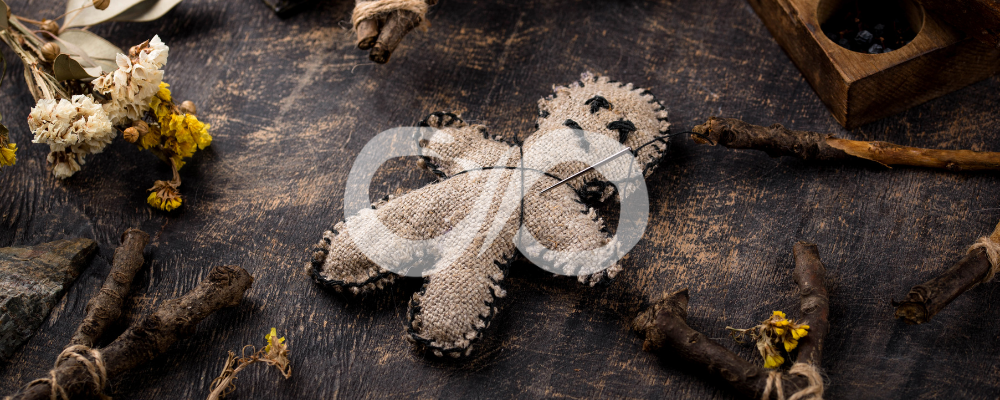
As for the famous pin-studded doll, it owes much to popular culture and stories of magic circulating in the Americas. Figurative objects may exist in ritual traditions, but making this doll the emblem of Haitian Vodou is misleading. Zombies, on the other hand, are very much part of Haiti’s religious and social imagination; sensational explanations claiming to reduce all accounts to a drug or secret technique fail to explain them.
By constantly looking for menace and spectacle, we miss what brings Vodou to life: a community, spirits served, the dead honored, and responsibility for the commitments made.
Fèt Gede and Vodou rites honoring the dead
Around the beginning of November, the celebrations of Fèt Gede make room for the spirits of the dead. Black, purple, crosses, cemeteries, music, and provocative humor are among their familiar expressions. The Gede speak of mortality, but they also remind us of the power of life that continues. Laughter and irreverent gestures are not disrespectful; they are part of a particular way of facing death.
Devotees visit and tend graves, offer prayers, and perform the services appropriate to their tradition. The relationship with the dead is not macabre decoration. It connects generations and reminds us that human existence is not limited to what we can see.
Vodou practice and initiation rites
You can learn about the history of Vodou, listen to its songs, learn the meaning of its major figures, and understand the place of the ancestors without claiming ritual authority. Participation and forms of devotion are not all the same, and not every devotee is a priest or priestess. However, initiations and reserved rites cannot be invented from a book. The kanzo, where it is practiced, entails a transmission, a house, and lasting obligations.
The question, then, is not how to gather as many vevés as possible or improvise an invocation after finding a list of offerings. It is about knowing what kind of relationship you are entering, who you are learning from, and what you are prepared to respect. Vodou begins with service, not with domination over invisible forces.
Serving the lwa and maintaining relationships with the spirits
Vodou magic can only truly be understood by returning to this idea: the lwa are not tools. They are greeted, listened to, and their presence celebrated; bonds are maintained with them that entail obligations as much as they offer support. The rites can be powerful, joyful, solemn, or demanding; they are never separate from the history of the families, lineages, and communities that carry them on.
This is why Vodou cannot be reduced to a doll, a spell, or a photograph of a ceremony. It is a living tradition, born of African heritage and shaped in Haiti, in which the dead, the living, and the spirits continue to speak to one another.
To discover the figures mentioned here in more detail, explore our Vodou pantheon and the profiles of their attributes and traditions.

Par Olivier of Aeternum
Passionate about esoteric traditions and the history of the occult from the earliest civilizations to the 18th century, I share some articles on these topics. I am also co-creator of the online esoteric shop Aeternum.













