















































































































































































































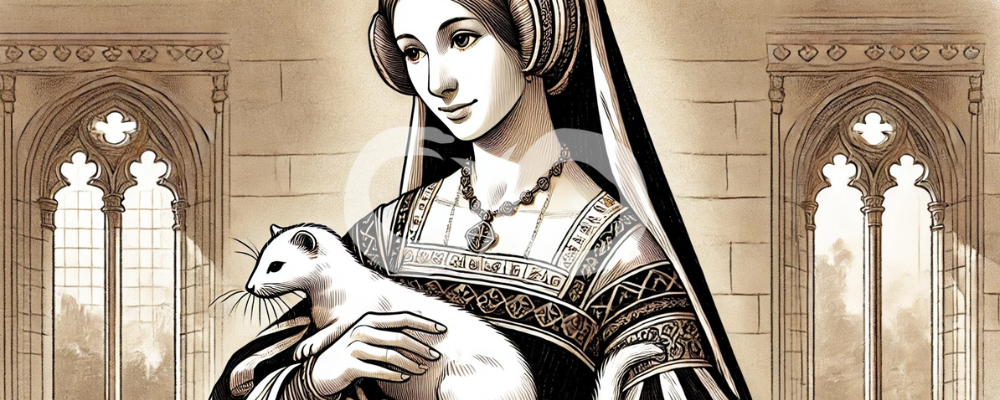
As you may know, behind Aeternum is a small business based in Brittany (in southern Finistère, to be precise). And it is well known that this region lives to the rhythm of legends, myths, and magical practices that are more or less well known (Brocéliande, Merlin, the Fairy Viviane, the Alignments, and many others). Thus, to showcase our beautiful region, we will regularly publish little-known legends from Breton history. This week, we explore Brittany’s well-known symbol: the ermine.
Duchess Anne of Brittany loved wandering through the forests and moorlands of her duchy. One day, while hunting near Vannes (it is worth noting that before Rennes, Vannes was the capital of the Kingdom of Brittany), she spotted a small, pure-white ermine fleeing from the hounds. Agile and swift, the creature leapt between the brambles and stones, refusing to be caught.
But soon, the ermine found itself cornered in front of a puddle of black mud. It stopped abruptly. Rather than soil its immaculate coat by crossing the pool, it turned around, held its head high, and waited for the hounds, ready to die.
Moved by this silent courage, Anne stopped the hunt with a gesture. To her, the animal embodied a nobility far greater than that of men.
— Better to die than to soil oneself, she murmured.
Thus, the ermine became the symbol of Brittany. Anne made it her personal emblem, accompanied by a motto that has remained famous: « Kentoc'h mervel eget bezañ saotret » — Better death than defilement, which the Bretons know very well.

Even today, the ermine adorns numerous coats of arms, but above all the Breton flag, recalling the history of this pure and fearless animal, and the moment when a duchess saw in it the very image of honor.

Par Olivier of Aeternum
Passionate about esoteric traditions and the history of the occult from the earliest civilizations to the 18th century, I share some articles on these topics. I am also co-creator of the online esoteric shop Aeternum.













