















































































































































































































She appears at the crossroads, where roads hesitate. Torches in hand, she looks in every direction without ever turning back. Hecate did not need great epics to exist. She is neither queen of Olympus, nor muse, nor nurturing mother. She is elsewhere. An introduction.
1. At the archaic origins of an enigmatic goddess
Hecate appears as early as the Archaic period (800 to 480 BCE) as a singular and powerful goddess. Absent from the Homeric epics, she is nevertheless celebrated by Hesiod in the 8th century BCE: in the Theogony, Zeus grants her “glorious privileges” and power over both the earth and the barren sea. Daughter of the Titans Perses and Asteria according to this tradition, Hecate thus comes from an ancient lineage, honored even after the victory of the Olympians. Hesiod portrays her as benevolent toward humans, protector of warriors, hunters, fishermen, and children. This favorable image of a tutelary goddess, dispenser of wealth and success, contrasts with the darker reputation she would later acquire. Indeed, in the following centuries, her worship gradually took on a chthonic character (linked to the underworld).

Sanctuary of Hecate at Lagina, Turkey.
The exact origins of Hecate remain partly mysterious. Her name itself has no certain etymology. Some clues connect her to the regions of Asia Minor: an important sanctuary was dedicated to her at Lagina, in Caria, where excavations uncovered numerous offerings. The oldest archaeological trace of her worship comes from a circular altar dating to the 6th century BCE, discovered at Miletus on the Ionian coast (present-day western Turkey). These eastern connections have led scholars to think that Hecate may have been introduced into Greece from Caria, so vibrant was her worship there. In any case, the Greeks of the Archaic period fully considered her one of their own, and her name already appears among the Titan goddesses worshiped locally. The cities of Thessaly, Thrace, and the island of Aegina were among the earliest centers of her devotion. On the island of Aegina, Hecate was even believed to cure mental illnesses in a mystery cult (an initiatory religious cult) dedicated to her. Thus, from the outset, this multifaceted goddess occupied a place apart, at the boundary between Greek and Anatolian influences. Historians readily describe her as “ambivalent and polymorphous, more at ease on the margins than at the center of Greek polytheism,” straddling boundaries and eluding any simple definition. Hecate therefore already embodied a dual nature, capable of both good and evil, foreshadowing the evolution of her role through the ages.
2. Hecate in classical Greek religion
During the Classical period (the 5th and 4th centuries BCE), Hecate became more integrated into civic religion while taking on darker attributes. She remained a goddess honored alongside the Olympians, but from the 5th century BCE onward, the goddess became associated with the darker side of human experience, namely death, witchcraft, magic, the Moon... and creatures that wander in the darkness. In Greek cities, her worship thus took on a liminal character: Hecate presided over crossroads, nighttime roads, and the thresholds of homes. It was common to place small altars or statues bearing her likeness (called hekataia) before the gates of cities and homes, so that she would keep malevolent spirits away from these places. In Athens in particular, she was worshiped as protector of the oikos (household) alongside Zeus, Hestia, and Hermes, serving as guardian of the entrances to the home. Each new moon, inhabitants dedicated the Deipnon, or “supper of Hecate,” to her: at night, at a crossroads or on the threshold of the home, they placed offerings of egg cakes, cheese, bread, and even pieces of sacrificial dog, accompanied by lit torches. Through this monthly expiatory rite, they sought to win the goddess’s favor and appease the wandering souls under her protection. Hecate was indeed regarded as mistress of ghosts and nocturnal apparitions: the Greeks saw her as a power capable of containing the restless dead and the forces of the underworld roaming at the margins of the city.
At the same time, Hecate retained a benevolent aspect integrated into the great Greek myths and cults. In the story of Demeter and Persephone, she played the valuable role of mediator. The Homeric Hymn to Demeter portrays her hearing Persephone’s cries when she is abducted by Hades (associated with autumn and winter), then guiding the grieving mother through the night with her torches. After Persephone’s return from the Underworld (bringing spring and summer), Hecate became her faithful companion in the underworld, alongside Hades. This connection with the Eleusinian Mysteries (which recount this abduction and return, manifests Hecate’s luminous aspect, honored as an initiate into the great secrets and a protective figure of order. Likewise, certain traditions associate her with Artemis: the two goddesses share attributes (torches, lunar connections, and the role of protectors of crossroads and wild places) to the point that they were sometimes confused. Hecate was thus seen as Artemis’s nocturnal double, ruling over the places abandoned by day. This association is illustrated by shared epithets (such as Phosphoros, “light-bearer,” or Enodia, “goddess of the roads”) and by local cults in which a syncretic “Artemis-Hecate” was worshiped near necropolises. Nevertheless, Hecate retained a distinct identity in the classical pantheon: that of a goddess minor in rank, yet omnipresent in the interstices of the Greek world, at the thresholds of everyday life and the borders of the unknown.

Relief of the triple Hecate. Source: Magickal Spot
A symbol of her integration into civic religion, the first triple statue of Hecate was erected in Athens in the 5th century BCE. The sculptor Alcamenes is credited with this iconographic innovation, depicting the goddess in three back-to-back forms and placing her at the entrance to the Acropolis. The three-formed Hecate, looking in every direction of the crossroads, thereafter became an emblematic image: she frequently appears in the art of the Classical and Hellenistic periods as three young women, each holding an attribute (torch, key, dagger...). This triple Hecate expresses her nature as goddess of passages and transitions. On a famous relief from the Great Altar of Pergamon (2nd century BCE), she appears with three heads and three bodies fighting the giant Clytius, armed with a torch, a sword, and a spear, assisted by a hunting dog. Hecate then fully embodied the protective and terrifying power at the crossroads of worlds - both light in the darkness and vengeful shadow.
3. Her evolution in the Roman world: Trivia and the lunar triad
Under the Roman Empire, Hecate was assimilated and reinterpreted without losing her liminal character. The Romans often called her Trivia, “the Three-Way Goddess,” in reference to her domain of crossroads. In late Roman religion, she formed part of the lunar triad alongside Diana (goddess of earthly hunting) and Luna (the celestial Moon). Latin poets thus celebrated a threefold Diana, identified with Hecate in her infernal aspect.
Hecate indeed retained her role as sovereign of the Underworld and the specters. Virgil presents her in the Aeneid as the feared mistress of the underworld: it is Hecate who grants the Cumaean Sibyl the authority to guide the hero Aeneas through the darkness of Tartarus. Before the descent into the Underworld, the priestess invokes the goddess with sacrifices of black sheep and a nocturnal sow, seeking the favor of the “queen of shadows.” Likewise, in Roman tragedies, sorceresses implore Hecate during their rites. In his Medea, Seneca has the heroine call upon her divine patron in these words: “O moon, orb of night... you, triple Hecate!”
The goddess of witches is here conflated with the Moon itself, reflecting the strong identification between Hecate and the nocturnal celestial body in the Roman imagination. She is now triformis, with three faces turned toward the heavens, the earth, and the underworld.
Although Hecate probably had no grand public temple in Rome, her worship remained vigorous in the provinces and countryside. Italy’s rural crossroads continued to be filled with her protective presence: offerings were placed there at the Kalends for Trivia, to protect travelers and flocks from spells. Latin authors such as Ovid and Statius mention her name to evoke the unsettling atmosphere of terrifying nights. In Metamorphoses, Ovid depicts her accompanying the underworld goddess Persephone or granting the wishes expressed in enchantresses’ formulas. Magical inscriptions invoke her under the name triceps Diana (Diana of three heads). Greco-Roman syncretism even took the fusion further: by analogy, Hecate was compared to the Egyptian goddess Selene (or Hecate-Ereshkigal) in certain esoteric texts. Although her name changed, Hecate passed through the Roman era while preserving the essence of her myth: she remained the guardian of boundaries - especially that between life and death - and the source of occult powers, feared and revered in equal measure by those who invoked her name.

Altar relief dedicated to Selene, Louvre. Source: Wikipedia
The material cult of Hecate also continued during Late Antiquity. Votive offerings and inscriptions concerning her appear as late as the 2nd and 3rd centuries CE. In Caria (southwestern present-day Turkey), her sanctuary at Lagina remained an active site of pilgrimage and devotion where statues and offerings were deposited in her honor, testifying to continuity from the Hellenistic period. Likewise, in Phrygia, reliefs depict her flanked by torches. Described by the Latin historian Tacitus as “extravagant in her infernal aspects,” Hecate found her place “on the margins of the pantheon,” never fully Olympian but never forgotten either. On the eve of the Christian world, her image as a triple goddess with nocturnal powers was firmly established throughout the Greco-Roman Mediterranean.
4. The survival of Hecate, muse of witches
Despite Christianization, the memory of Hecate did not disappear. In the Middle Ages, her name and image survived in clerical literature. Medieval scholars, rediscovering ancient authors, described her as the “queen of witches” of pagan times. Her attributes then blended into the figure of Diana, invoked in popular beliefs concerning nocturnal hunts and sabbats of women in trances. In the 15th century, as Europe was gripped by fear of witches, Hecate unexpectedly returned to the forefront. The inquisitor Heinrich Kramer’s treatise, the famous Malleus Maleficarum, or “Hammer of the Witches” (1486), claimed that witches worshiped a pagan goddess whom he identified with Diana-Hecate. Equated with Satan by the author, Hecate is described in this text as the patroness of nocturnal gatherings and maleficium. This reference helped shape the imagery of the sabbat: around the midnight fire, witches were supposedly calling upon “Hecate, queen of the Underworld” to carry out their dark works. The irony of history is that Christian theology thus revived, in its own way, the myth of the three-faced goddess...

Diana, Louvre. Source: Odysseum
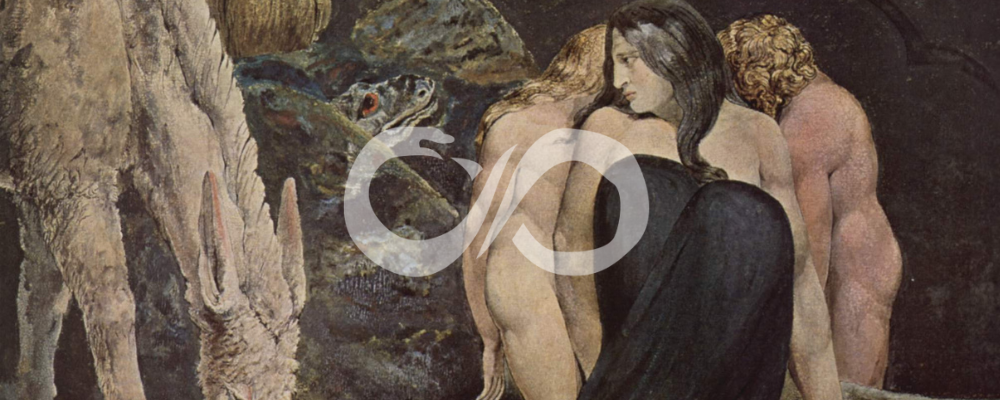
The Renaissance, fascinated by Antiquity, incorporated Hecate into the arts and literature. Shakespeare even featured her in Macbeth (1606): she appears in person as mistress of the three Witches, planning their evil prophecies in a famous incantatory scene (Act III, Scene 5). Her name is also mentioned in A Midsummer Night’s Dream and King Lear, testifying to her diffuse presence in Elizabethan culture. Visual artists took up the figure: she was depicted surrounded by a retinue of spirits or in the guise of a nocturnal fury. In the 18th century, the painter and poet William Blake offered a striking vision of her in The Night of Enitharmon’s Joy (1795), titled The Triple Hecate. It depicts a triple-backed woman, barefoot and with vacant gazes, accompanied by an owl with fixed eyes, a spread bat, and a hideous spectral head suspended in the shadows. Blake drew his inspiration from the scene featuring Hecate in Macbeth, highly popular at the time, and created a true allegory of Night and witchcraft. The painting, inspired by Romantic mysticism, established Hecate as the muse of occult arts and symbols of the subconscious.

The Triple Hecate, William Blake. Source: Wikipedia
In modern times, Hecate continues to fascinate esoteric and artistic circles. The Romantic movement celebrated her as the archetype of the pagan sorceress, free and unsettling. At the turn of the 20th century, occultists such as Aleister Crowley and Arthur Edward Waite mentioned her in their rituals and writings, seeing in her the personification of the Primordial Witch. Her name also appears throughout fantastic and Gothic literature, from Goethe to Lovecraft, as the embodiment of Night, the dark Moon, or the “three-faced goddess.” Emerging psychoanalysis took an interest in these triple figures (the trinity of Maiden-Mother-Crone), of which Hecate is one mythological model, reading in them a representation of the cycles of life and death.
At the same time, Hecate was restored to prominence in the esoteric and religious revival of the 20th century. The neopagan movement gave her a place in contemporary practices. In Greece itself, some followers of Hellenism reconstructed ceremonies in her honor: the Deipnon is sometimes celebrated again each month by devotees who place offerings at crossroads for Hecate at the new moon. Above all, Wicca - a Western neopagan movement founded in the 1950s - incorporated Hecate among its principal deities. Worshiped as the “goddess of witchcraft,” she is identified with the Crone aspect of the Wiccan Triple Goddess, alongside the Maiden and the Mother. This modern triad, centered on the phases of the Moon, strikingly echoes the ancient Artemis-Selene-Hecate triad. Contemporary occultists consequently regard her as a protector and guide in the practice of magic, reconnecting with her original role as a benevolent goddess. It is notable that in these new cults, Hecate regains a positive image: far from being merely a dark witch, she is once again invoked to ward off malign influences and bring inspiration and wisdom to initiates - just as in Archaic Greece she granted wealth and favor to pious men.
Neither truly Olympian nor entirely infernal, Hecate eludes the usual categories. She watches over thresholds, illuminates crossroads, speaks to the dead, and accompanies mothers. In the texts, she arrives on soft footsteps, rarely at the center, always at the edge. And yet she occupies a singular place in the religious history of the Mediterranean. From Archaic Greece to the margins of the Roman Empire, her image evolves, darkens, and multiplies. Hecate becomes triple, subterranean, lunar, magical, initiatory. Tracing her history means following the paths she guards: those that lead beyond certainties, between worlds, where light and shadow no longer obey ordinary laws.
Sources:
-
Mark Cartwright, Hecate, World History Encyclopedia.
-
Theoi Project - Hekate, mythological database on Greek deities.
-
Encyclopedia of World History (worldhistory.org), articles on the worship of Hecate and her representations.
-
Pausanias, Description of Greece.
-
Chaldean Oracles, translated and commented fragments (Neoplatonic period).
-
Diodorus Siculus, Library of History IV, 45 (Medea’s genealogy).
-
Apollonius Rhodius, Argonautica III-IV (sacrifice to Hecate).
-
Virgil, Aeneid VI (descent into the Underworld and invocation of Hecate).
-
Seneca, Medea (ritual mention of the goddess).
-
William Shakespeare, Macbeth, Act III, Scene 5 (Hecate’s intervention).
-
DailyHistory.org, article Who was Hecate? (analysis of her place in ancient and modern witchcraft).

Par Olivier of Aeternum
Passionate about esoteric traditions and the history of the occult from the earliest civilizations to the 18th century, I share some articles on these topics. I am also co-creator of the online esoteric shop Aeternum.













