















































































































































































































|
CONTENTS...
1. Labradorite: who are you and where do you come from? |
You only need to turn a Labradorite between your hands to understand that it is not a stone like any other. With its changing, iridescent and dark reflections, it has its own unique personality. But what does it really conceal, and what is its connection to true magic? Here are the answers.
1. Labradorite: who are you and where do you come from?
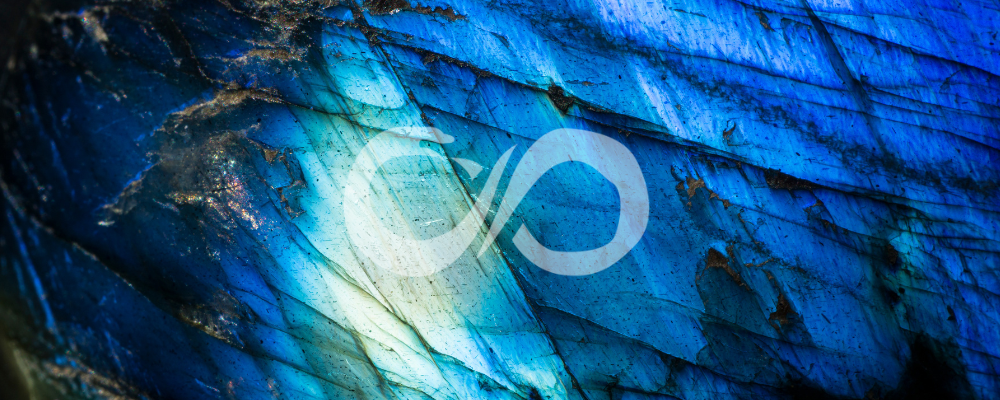
In the light, Labradorite reveals blue, green or golden reflections that are almost metallic. This phenomenon has a name: labradorescence. Behind this highly technical word lies simply the play of light that gives this stone its lively appearance. It is not an optical illusion, but a genuine feature of its mineral structure. It belongs to the large feldspar family (minerals found in many volcanic rocks) and was first discovered in Labrador, Canada, around 1770. Hence its name, nothing more. Since then, it has also been found in Madagascar, Finland and Russia. It is fairly solid (a hardness of 6 to 6.5 on the Mohs scale), opaque or slightly translucent depending on the pieces, and quite heavy for its size.

2. Shamanic and Indigenous Traditions
In shamanic cultures, Labradorite serves as a talisman for inner journeys and spiritual protection. Native American peoples saw it as a “guardian” capable of protecting against evil. It is said to facilitate communication with spirit guides and strengthen shamanic visions and dreams. More generally, archaeological excavations (in Panama, dating back 4,000–4,800 years) have uncovered collections of crystals (quartz, pyrite,...) intended for ritual practices. These ancient uses show that healers preserved particularly sparkling stones for trance and healing, and suggest that Labradorite, once discovered, would naturally fit into these universal traditions of shamanism. In practice, the shaman places it on or around the body during rituals to “project” positive energy.
The Inuit of the Far North saw this stone as a fragment of the northern lights frozen in rock. One legend tells of a warrior who struck the stone with his spear to release the celestial light, leaving part of the aurora trapped inside the Labradorite. The ancient Inuit therefore called it the “stone of shamans”, a means of “passing from the known world to another”. From then on, it gained a reputation for connecting the visible world with the spirit world while offering protection and guidance.
3. European Occultism and Magic
Although Labradorite was unknown to medieval magicians (as its discovery came later), it entered the Western esoteric tradition in the 19th century. In Scandinavia, it was said to be linked to starlight and Nordic magic. Later, in folk magic, Labradorite became known as a protective stone against witchcraft. In modern occultism (Hermeticism, Neopaganism), it was called the “stone of transformation”. This name refers to its multifaceted nature: it is seen as a symbol of transmutation (both material and spiritual). Its internal optical effect is thus interpreted as a metaphor for inner fire or hidden light. Contemporary alchemists and esotericists see it as a mirror of the soul’s processes: beneath its dark appearance lie reflections that “reveal” the truth. Its connection with the third eye is therefore naturally emphasized.
Thus, Labradorite is considered today to be a protective stone, not by repelling but by absorbing harmful energies and curses. It can also be a valuable aid during divination and séance sessions.

Par Olivier of Aeternum
Passionate about esoteric traditions and the history of the occult from the earliest civilizations to the 18th century, I share some articles on these topics. I am also co-creator of the online esoteric shop Aeternum.













