















































































































































































































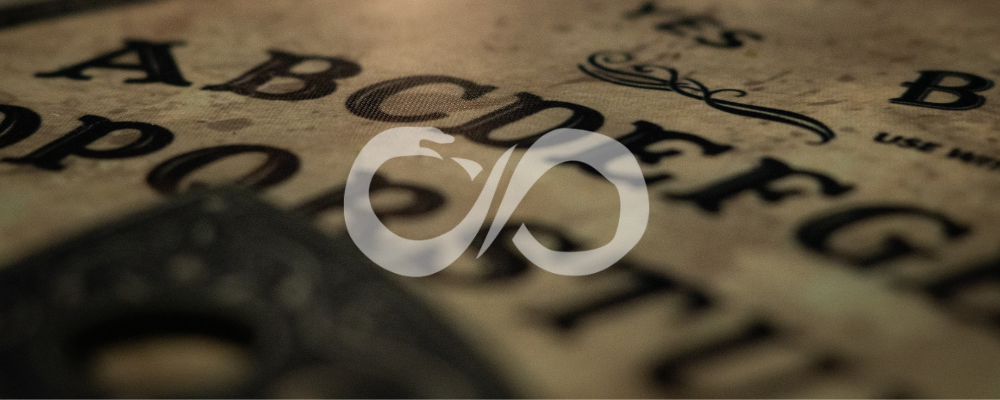
The Ouija board is certainly one of the esoteric accessories that has generated the most discussion. Considered folklore used to scare people, a means of communication beyond the world of the living distinct from mediumship, or the subject of numerous horror films, the Ouija is popular. But do you really know it? Do you know its power? And above all, do you know how to use it properly? We cover all of this in this practical guide.
1. Discovering the Ouija board
1.1. What is a Ouija board?

A Ouija board, also known as a "talking board" or "spirit board", is an instrument used to attempt to communicate with spirits or spiritual entities. The board is generally made of wood and always includes the alphabet, the numbers 0 to 9, the words "yes", "no", "hello", and "goodbye". Accompanied by a planchette, a small pointer called a drop, it allows users to form words and sentences by moving the planchette over the letters and numbers on the board. The board's graphic style may vary, including gothic, modern, or Celtic designs.
1.2. Where does the Ouija board come from?
It is important to know that before the Ouija board, people had to call on a medium to attempt to communicate with the dead. But this was expensive and time-consuming. The talking board then became popular as a simple and quick way to get started with spiritualism, which was one tool among others such as the cablegraph, the psychograph, or the spiritoscopes.

Important fact: this period was marked by the devastation of the Civil War and the loss of many loved ones (approximately 850,000 victims). Mourning then led people to seek evidence of life after death in an attempt to communicate with the deceased.
In 1890, inspired by the talking board, two American businessmen, Elijah Bond and Charles Kennard, adopted the idea and obtained their patent on February 10, 1891, thus marking the official invention of the Ouija. However, Bond and Kennard did not pursue the commercialization of their creation, leading to their bankruptcy in 1892. Two of Kennard's employees, brothers William and Isaac Fuld, were nevertheless convinced of the object's commercial potential. In 1901, they each began producing boards of their own manufacture. William Fuld's company acquired the rights associated with the Ouija name and invention, and after several years of legal battles, William eventually ousted his brother. After his death, the brand was acquired and is still owned by Hasbro.
1.3. What does the term Ouija mean?
The origin of the name is uncertain and revolves around two explanations.
The best-known explanation is that the name "Ouija" is a combination of the French word "oui" and the German word "ja", both of which mean "yes". This is because these simple words supposedly make it possible to communicate clearly with spirits.

The other explanation is that in 1890, when Elijah Bond and his associates were seeking to patent their talking board, one of the people involved in the project was Helen Peters, a renowned medium. During a session with the board, they are said to have asked what it should be called. The board allegedly spelled out the word "O-u-i-j-a". When they asked what it meant, the board reportedly replied that it meant "good luck".
2. What equipment is needed?
The main tool needed for a séance is the Ouija board itself. This board is generally made of wood or cardboard and features the letters of the alphabet arranged in an arc, the numbers 0 to 9, as well as the words "yes", "no", "hello", and "goodbye". The board's quality can vary, but it is recommended to use a well-made board with clear lettering and a smooth surface to facilitate the movement of the planchette.
The planchette, or pointer, is the movable element participants use to indicate the letters and numbers on the Ouija board. It is generally heart-shaped and has a small hole or transparent window to make it easier to see the letters over which it moves. The planchette should be lightweight and glide easily across the board's surface. A good-quality wooden or plastic planchette is essential for a smooth and accurate session.
To create a favorable atmosphere and increase concentration, several additional accessories can be used during a Ouija session:
-
Candles are often used to provide soft, dim lighting, creating a mystical atmosphere. White candles are recommended for purity and protection, but other colors can be chosen according to personal preferences or the goals of the session.
-
Burning incense, such as sage, sandalwood, or copal, can help purify the space and create an atmosphere conducive to spiritual communication. Incense is also used to ward off negative energies and invite benevolent spirits.
-
Crystals such as Amethyst, Clear Quartz, or tourmaline can be placed around the board to provide additional protection and increase spiritual vibrations.
-
Light background music or natural sounds, such as birdsong or the sound of rain, can help participants relax and concentrate. However, many people prefer complete silence to better hear any potential messages.
-
It may be useful to have a notebook and a pen within reach to write down the questions asked and the answers received. This helps keep a record of the session and better analyze the messages afterward.
3. How to prepare to use a Ouija board?
A Ouija board should not be used without preparation, and even less so just "to scare yourself." It is therefore advisable to do a little preparation beforehand.
3.1. Choosing a suitable place
The first step in using a Ouija board is choosing a suitable place for the session. The ideal location is a quiet, secluded place away from interruptions and outside noise. A familiar, reassuring room where participants feel comfortable is preferable. It is important for this space to be clean and orderly, as a disorganized environment can disrupt concentration and the energy of the session.
3.2. Choosing a suitable time
Choosing the right time to use the Ouija board is just as crucial. Sessions are often more effective in the evening or at night, when the atmosphere is naturally quieter and more conducive to concentration. Some prefer the hours between midnight and three in the morning, often called "the witching hour." However, it is essential to choose a time when all participants are awake and alert, as fatigue can interfere with the experience.
3.3. Creating the atmosphere
Creating a suitable atmosphere is essential for a successful Ouija board session. Dim lighting, provided by candles, can help establish a mystical and relaxed atmosphere. The use of white candles is recommended to symbolize purity and protection. Incense, such as sage or sandalwood, can also be burned to purify the space and create an atmosphere conducive to spiritual communication. Soft music or nature sounds can be used to encourage relaxation and concentration, but it is often preferable to maintain complete silence to better hear any potential messages.
3.4. Preparing the participants

Preparing the participants is a key step in ensuring a harmonious and effective session. All participants should be open-minded, respectful, and ready to take the session seriously. It is recommended to have at least two people, as a single person could unintentionally influence the movements of the planchette. The collective state of mind should be positive and calm, avoiding negative emotions such as fear or excessive skepticism, which can disrupt the energy of the session. It is also helpful to discuss expectations and rules of conduct in advance, such as the need to remain focused and not joke around or interrupt the session inappropriately.
4. How to use a Ouija board?
4.1. Setting up the equipment
To begin, place the Ouija board on a flat, stable surface, such as a table or the floor. Make sure that all participants can reach the planchette comfortably without having to lean or stretch excessively. Place candles around the board to provide soft lighting and create a mystical atmosphere. If you use incense, light it before beginning to give the smoke time to purify the space. Place crystals or other protective objects around the board if desired. Also make sure that the notebook and pen are within reach for taking notes during the session.
4.2. Starting a Ouija session
Before beginning, it is important for all participants to agree on the basic rules and expectations for the session. Then, sit around the Ouija board and gently place your fingers on the planchette, making sure that all participants are lightly touching it. Close your eyes for a few moments, take a few deep breaths, and focus on the purpose of the session. Create an atmosphere of calm and respect, ensuring that everyone is ready to take the experience seriously.
4.3. Introductory phrases to invite spirits
To initiate communication, begin with respectful and clear introductory phrases. Here are some examples:
-
"Kind spirit, we invite you to communicate with us tonight."
-
"We seek to make contact with a spirit who wishes to share a message with us."
-
"If a spirit is present, please move the planchette to indicate your presence."
-
"We welcome you with respect and hope to receive your messages."
It is essential to use a respectful and calm tone to establish positive contact with spirits.
4.4. What you should never do with a Ouija board
Certain actions should be absolutely avoided when using a Ouija board:
-
Do not intentionally push or pull the planchette. Let it move freely.
-
Never ask how or when someone will die. This may attract negative energies.
-
Never use the Ouija board if you are emotionally unstable, depressed, or under the influence of drugs or alcohol.
-
Always move the planchette to "goodbye" to close the session. Never leave the board open and unattended.
-
Do not treat the session as a game or a joke. The Ouija board should be used seriously and respectfully.
Additionally, to minimize the risk of negative experiences, follow these tips:
-
Make sure all participants are calm, positive, and ready to take the session seriously.
-
Crystals, prayers, or incantations can be used to protect the participants and the space.
-
Begin each session by clearly stating your intention to contact only benevolent spirits.
-
If the planchette starts moving erratically or aggressively, end the session immediately.
-
Record all questions and answers. This can help analyze the experience and detect patterns or anomalies.
-
Take breaks if necessary: If the atmosphere becomes tense or someone feels uncomfortable, take a break or end the session.
5. How to Interpret the Responses?
5.1. Reading Messages
During a Ouija session, messages are formed by moving the planchette over the letters and numbers on the board. Participants should note each letter indicated by the planchette to form words and sentences. It is important to remain patient and not rush the process. Often, messages may be fragmented or difficult to understand immediately, but by taking careful notes, you can reconstruct the complete messages after the session. It is useful to designate one person as a scribe to record the letters and words formed by the planchette.
5.2. Understanding the Movement of the Planchette
The planchette can move in different ways, and it is crucial to understand these movements to interpret the messages correctly. If the planchette moves slowly and smoothly, this may indicate a clear and strong connection with the spirit. Fast or jerky movements may indicate uncertainty or a disruption in communication. Sometimes, the planchette may move in circles or hesitate over certain letters, which may mean that the spirit is trying to clarify a point or find a precise answer. The key is to remain attentive and patient, allowing the planchette to move freely under the participants' light finger pressure.
5.3. Interpreting Signs and Symbols
In addition to letters and numbers, the planchette may indicate other signs or symbols on the board, such as "yes", "no", "hello", and "goodbye". It is crucial to take these indications into account to interpret the messages correctly. For example, if the planchette moves toward "yes" or "no", this may directly answer a question that was asked. If the planchette moves toward "goodbye", it is respectful to close the session, as this may mean that the spirit wishes to end the communication.
Sometimes, unusual symbols or movements may appear, and interpreting them may require further thought or discussion among the participants. It may be helpful to consult additional resources on interpreting spiritual signs or seek advice from someone experienced in using a Ouija board.
6. How to close a Ouija session?
6.1. Ending the session properly
Closing a Ouija session properly is essential to ensure safety and respect toward the spirits contacted. When you feel the session should end, inform all participants of your intention to close it. Make sure everyone agrees to end the session. Then, clearly and calmly ask the spirit to end the communication. Move the planchette toward "goodbye" to signal the end of the session. This helps close the communication channel respectfully and safely.
6.2. Thanking and releasing the spirits
Use respectful closing phrases to thank and release the spirits. Here are some examples:
-
"We thank you for your communication and your presence tonight."
-
"Benevolent spirit, we thank you for the messages shared. We will now end the session. Goodbye."
-
"Thank you for your time and guidance. We are releasing you now. Goodbye."
-
"We appreciate your help and answers. We will now close this session. Thank you and goodbye."
These phrases show respect and gratitude toward the spirits, helping to close the session on a positive note.
6.3. Purifying the space
After finishing a Ouija session, it is important to perform purification rituals to cleanse the space and protect the participants:
-
Pass a lit sage stick around the board, the participants, and throughout the room to purify the space and drive away negative energies.
-
Place crystals such as Black Tourmaline or Clear Quartz around the room and on the board to absorb residual energies.
You now know everything you need to use a Ouija board properly. Be sure to follow what you should and should not do, and everything will go well. However, be careful not to treat the Ouija as a simple "game".

Par Olivier of Aeternum
Passionate about esoteric traditions and the history of the occult from the earliest civilizations to the 18th century, I share some articles on these topics. I am also co-creator of the online esoteric shop Aeternum.













