















































































































































































































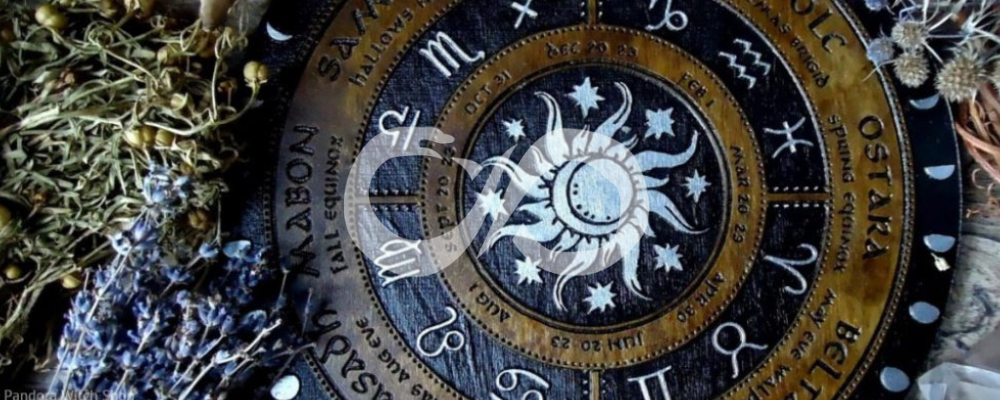
The sabbats give the seasons a rhythm: the return of the light at Yule, the springtime energy of Beltane, the ripening of the harvests, and the time of remembrance at Samhain. To prepare for a celebration, the first question remains very practical: what date does the festival fall on this year, in my hemisphere and at my local time?
The calendar below brings together the eight festivals of the Wheel of the Year. You can choose a year, adapt the cycle to the Northern or Southern Hemisphere, and display the times of the equinoxes and solstices in your time zone. Fixed dates are distinguished from astronomical events. You will then find markers to help you understand each festival and prepare for your ritual observance.
The calendar of the eight sabbats for the year of your choice
Choose your year, hemisphere, and time zone, then find the eight festivals and the next Wheel event. The calendar can also be exported to prepare for your celebrations in your calendar.
Below, find the seasonal markers for the Northern Hemisphere.
Annual markers of the Wheel of the Year — Northern Hemisphere
| Sabbat | Date | Reference | To prepare for the festival |
|---|---|---|---|
| Imbolc | February 1 | Fixed festival; February 2 is also observed in some practices. | Renewal, hearth, first preparations for spring. |
| Ostara | March Equinox | The date and time vary depending on the year and time zone. | Balance, germination, beginning. |
| Beltane | May 1 | The eve may be observed on April 30. | Vitality, blossoming, connection. |
| Litha | June Solstice | The date and time vary depending on the year and time zone. | Peak of the light, gratitude, radiance. |
| Lughnasadh / Lammas | August 1 | The eve may be observed on July 31. | First fruits, craftsmanship, sharing. |
| Mabon | September Equinox | The date and time vary depending on the year and time zone. | Harvest, reflection, preparation for autumn. |
| Samhain | Night of October 31 to November 1 | November 1 is the reference date. | Remembrance, closure, contemplation. |
| Yule | December Solstice | The date and time vary depending on the year and time zone. | Return of the light, warmth of the hearth, renewal. |
To prepare for your celebrations, discover our guide to the sabbats and the Wheel of the Year: the origins of the festivals, correspondences, symbols, and rituals for each season.
What is the Wheel of the Year?
The Wheel of the Year brings together eight seasonal festivals. Four follow the equinoxes and solstices; four mark the intervals between these major points in the solar cycle. The whole is particularly prominent in Wicca and several contemporary Pagan traditions.
This arrangement brings together festivals whose histories are not identical. The names Imbolc, Beltane, Lughnasadh, and Samhain refer to Gaelic traditions; the equinoxes and solstices are astronomical phenomena; and the use of the names Ostara, Litha, and Mabon in the eight-festival cycle belongs to more recent developments. Presenting the Wheel as a calendar adopted in the same way by all ancient peoples would not do justice to this historical diversity.
For your practice, the Wheel can become a rhythm of attention. It invites you to observe the place where you live, prepare gestures of gratitude, mark a transition, or set aside time for remembrance. You do not have to recreate another country's landscape to give meaning to a celebration.
The pages in our Wheel of the Year extend each occasion with its references, symbols, and practice suggestions. The calendar helps establish the moment; the page helps you shape what you wish to experience on that date.
Why do some sabbats change dates?
The equinoxes and solstices are astronomical moments
An equinox occurs when the Sun passes through the plane of Earth's equator. A solstice corresponds to one of the two extreme positions of its declination. These events occur at a specific moment for the entire Earth. The date shown on your calendar then depends on the time zone in which that moment is displayed.
In the Northern Hemisphere, Ostara falls at the March equinox, Litha at the June solstice, Mabon at the September equinox, and Yule at the December solstice. The times vary from year to year. A list that permanently assigned all these festivals to the 21st of the month would therefore be inaccurate.
The equinox does not mean that the visible length of day and night is exactly identical in every city. The refraction of light, the apparent size of the Sun, and conventions for sunrise and sunset all play a role. The word “balance” retains its symbolic place without replacing the astronomical description.
The other festivals have calendar dates
Imbolc, Beltane, Lughnasadh, and Samhain are presented here with the calendar dates widely used in the contemporary Wheel. In the Northern Hemisphere, the calendar observes February 1 for Imbolc, May 1 for Beltane, August 1 for Lughnasadh, and the transition from October 31 to November 1 for Samhain.
These dates do not impose the same start time on all traditions. A celebration may begin the previous evening. Imbolc is also traditionally observed on February 2. The table makes these variants visible, distinguishing a calendar marker from a rule applicable to every practice.
What about the so-called “astronomical mid-season” dates?
Some contemporary methods choose the Sun’s positions halfway between an equinox and a solstice. They use, in particular, solar longitudes of 45, 135, 225, and 315 degrees for these intermediary festivals. These moments do not necessarily correspond to February 1, May 1, August 1, and November 1.
For the four intermediary festivals, the table uses the calendar dates indicated above. If your tradition follows a mid-season calculation, use an ephemeris suited to that choice and keep the same system from one year to the next.
How do you choose the right time zone for the sabbats?
For metropolitan France, choose “Paris.” This option takes into account the applicable winter and summer time on the date concerned. You do not need to add one or two hours yourself. A visitor in Quebec can choose Montreal, while a reader in Réunion can select the island’s time zone.
The displayed time refers to the astronomical event, not a mandatory time for your rite. A solstice may occur during the night or while you are working. You can celebrate at dawn, in the evening, or during a nearby group gathering, according to tradition and the possibilities of those present.
A time zone change may shift the event to the previous or following day in the table. This is not a second equinox: it is the same moment read in two local times. The fixed dates, however, remain calendar days in your location.
How should the sabbats be adapted for the Southern Hemisphere?
The Northern and Southern Hemisphere seasons are reversed. In a Wheel adapted to the Southern Hemisphere seasonal cycle, Yule is celebrated at the June solstice, Litha at the December solstice, Ostara at the September equinox, and Mabon at the March equinox. The astronomical moment remains the same; the season’s name and corresponding festival change.
For the four fixed dates, Southern Hemisphere mode shifts the markers by six months: Lughnasadh to February 1, Samhain to the night of April 30 to May 1, Imbolc to August 1, and Beltane to November 1. The variants and eves remain specified in the table.
This seasonal adaptation is an optional practice, not a directive for all communities in the Southern Hemisphere. Some retain dates inherited from a Northern Hemisphere calendar. Tropical regions also have rhythms of rainfall, harvests, and heat that do not correspond to four temperate seasons.
So choose the framework for your celebration. You can follow the local seasonal cycle, keep a date passed down through your family or religious tradition, or distinguish between these two observances. A consistent practice begins with knowing which calendar you are using.
Imbolc, preparing for renewal
In the Northern Hemisphere, Imbolc falls at the beginning of February. The festival retains a connection with the early stages of seasonal renewal and, in Irish traditions, with Brigid. Rural customs do not describe spring as already established everywhere; rather, they mark preparation, anticipation, and signs of renewed activity.
For a home celebration, you can tidy a space, choose an intention for growth, and set aside a light for this dedication. A small amount of preparation is better than a long series of objects gathered without purpose. The Imbolc guide explores the history and possible practices in greater detail.
Ostara, welcoming the balance of spring
In the Northern Wheel, Ostara is celebrated at the March equinox. This is a time to consider what is beginning and what still needs care. Germination, the egg, and the first flowers may be part of your symbolism, without being treated as elements of one identical ceremony throughout ancient Europe.
You can prepare a project journal, plant something suited to your region, or set aside time to organize the season. Choose an action you can continue after the celebration. Our Ostara guide provides further references and celebration ideas.
Beltane, celebrating vitality and connection
In the Northern Hemisphere, Beltane falls on May 1, with a possible vigil on April 30. Gaelic traditions surrounding this seasonal transition include the use of fire and livestock protection practices. Contemporary celebrations may also make room for blossoming, connection, and vitality.
In an apartment or garden, a shared meal, thoughtfully chosen botanical décor, and a dedication to your relationships may be enough. An outdoor fire is not essential and, when planned, requires compliance with local regulations. The Beltane guide can help you prepare a ritual suited to your setting.
Litha, honoring the peak of light
Litha corresponds to the June solstice in the Northern Hemisphere. Light reaches the peak of its annual cycle in this hemisphere; the days will then begin to shorten. The festival brings together the expression of strength and an awareness of the change taking shape.
You can choose a time for gratitude for what has grown, a mindful walk, or altar work focused on the season’s activity. Herbs and flowers belong to local calendars: collect only plants that you have identified and only where and when permitted. Our Litha guide builds on these ideas.
Lughnasadh, recognizing the fruits of labor
Lughnasadh falls on August 1 in the Northern Hemisphere, with a possible observance on July 31. Its name refers to Lugh in the Irish context. Lammas, a name from a different historical context, is also used for this period in some contemporary calendars. Bread, the first fruits, and craftsmanship offer themes for celebration.
Prepare a meal, share an accomplishment, or take time to acknowledge what has come to maturity. The rite can also name the efforts that are still needed. The Lughnasadh guide explains these references and their place in a contemporary practice.
Mabon, taking stock and preparing for autumn
Mabon refers to the autumn equinox in many calendars of the Wheel. In the Northern Hemisphere, it is the September equinox. Using this name for the equinox festival belongs to modern developments in paganism; it does not prove the existence of a uniform ancient sabbat under this name.
You can dedicate the celebration to taking stock, sharing resources, and preparing for the darker period. An inventory, a chosen offering, or a seasonal meal gives a concrete extension to the theme of the harvest. Our Mabon guide allows you to explore the celebration further.
Samhain, setting aside time for remembrance
Samhain marks a passage into the dark season in Irish traditions. The calendar places the night of October 31 to November 1 in the Northern Hemisphere. Contemporary practices give it a place in remembering the dead, closing cycles, and contemplation.
A memorial altar, a reading, a watched-over light, or a meal in memory of someone can form a complete celebration. The rite does not require a séance to contact the dead. It can remain a gesture of tribute, adapted to your story and your boundaries. The Samhain guide explores these possibilities.
Yule, welcoming the return of the light
In the Northern Wheel, Yule falls at the December solstice. The solar cycle reaches its shortest point of light, then the days begin to lengthen again. However, the historical traditions of midwinter cannot be reduced to a single day or an identical rite.
You can prepare a time centered on the warmth of the hearth, sharing, and an intention for the coming cycle. A decorated branch, a light, or a meal may be enough to give shape to the occasion. Our Yule guide distinguishes historical references from current celebration practices.
How can you prepare a sabbat without complicating your practice?
Choose an objective for the festival
Before gathering the materials, write down what you want to mark: giving thanks, welcoming, honoring, bringing to a close, or preparing. A clear sentence gives the session direction. You can then choose a reading, a meal, an object, or an action that responds to that sentence.
For a group rite, check everyone’s availability before aiming for the exact time of the equinox or solstice. The gathering can take place at a nearby and accessible time. In that case, distinguish the astronomical moment indicated in the calendar from the practical time of your celebration.
Prepare few objects, with a place for each
A seasonal altar can bring together a cloth, an object connected to the theme of the festival, and a notebook. A light can accompany prayer or dedication. The candle collection lets you choose a format compatible with your holder and the planned duration. Keep flames supervised and away from dry plants and fabrics.
You can also choose a fragrance to open the ritual time. Our Sabbath incense offers preparations associated with the festivals of the Wheel. Use a small amount, a suitable burner, and sufficient ventilation. The absence of fumigation does not diminish a celebration; a spoken word or a moment of silence can fulfill this opening role.
For anointing, choose ritual oils according to the product and its stated use. Use them on the compatible surfaces specified in their product description, without assuming they are intended for application to the body. The gesture should serve your rite, not force you to multiply the materials.
Planning the closing and what comes next
A celebration benefits from having a clear ending. Give thanks, express what you are taking away, extinguish the flames, and put away the objects once everything has cooled. Then note one action for the next period: continue a project, prepare for a gathering, care for a place, or finish a task.
The Wheel of the Year thus becomes a lived rhythm, not merely a series of dates. You can return to your notes at the next sabbat and recognize what has truly changed in your life and surroundings.
How do you add sabbat dates to your calendar?
The export button creates a .ics file for the selected year and hemisphere. You can import it into a compatible calendar. The four astronomical events appear at their universal time, and your calendar then displays them according to its own time zone. The other four festivals are all-day events.
For Samhain, the export covers the eve and the reference day, preserving the transitional night. For Imbolc, it uses the 1st and mentions the 2nd as a variant in the description. The eves of the other fixed festivals are also specified in the notes.
The short technical duration of an astronomical event in the calendar does not describe the duration of your ceremony. You can create your own separate appointment, with the time for the meal, prayer, or gathering. Simply keep a distinction between the celestial reference point and the organization of your celebration.
The export is a copy, not a subscription. To add another year, return to the calendar and export it separately. Once the file has been imported, the events in your calendar do not automatically turn into dates for the following year.
Frequently asked questions about sabbat dates
Do the eight sabbats always fall on the same dates?
The four fixed festivals retain the reference points chosen in the calendar. The equinoxes and solstices change time and may fall on different days depending on the year and time zone. That is why the calendar distinguishes between the two types of observances.
Why do two sites give different dates?
First check the time zone, then the hemisphere and the method. One site may indicate the eve of a festival, while another gives its reference day. A calendar may also use an astronomical cross-quarter date rather than a fixed date. These choices should not be mixed without explanation.
Do I have to celebrate exactly at the indicated time?
No, unless your particular rite calls for it. The time indicates the astronomical event. You can choose a nearby occasion that suits your practice and the people present. Simply note the choice you make.
Why does Imbolc appear on February 1 when I know it as February 2?
February 1 is the reference date used here, particularly in connection with Irish traditions of Brigid. February 2 is also used in some pagan calendars. The variant therefore remains visible in the table, without presenting both days as an error to be corrected.
Does Samhain fall on October 31 or November 1?
The calendar makes the transition between the two visible: the night of October 31 to November 1 in the Northern Hemisphere. November 1 serves as the annual reference point. In the Southern seasonal mode, the equivalent transition runs from April 30 to May 1.
Can a sabbat be combined with a lunar ritual?
You can connect the two in a chosen practice, but the sabbat and lunar phase are distinct reference points. An equinox is not necessarily a full moon. The lunar calendar lets you check the phase without changing the sabbat’s astronomical date.
Do planetary hours replace the time of the solstice?
No. They constitute another division of time, used in some magical practices. You can choose a planetary hour for your working and keep the solstice as a seasonal reference point. Our planetary hours calculator complements the calendar for this type of work.
Should I change calendars if I live in the tropics?
Consider your local context. The Wheel of the Year with four temperate seasons does not describe every climate. You can follow a traditional calendar, adapt the themes to local cycles, or distinguish between these two approaches. Choosing a hemisphere alone does not resolve questions about the landscape and harvests.
How do I return to this year’s celebrations?
The “Current year” button takes you back to this year’s calendar. You can then change the hemisphere or time zone according to where you celebrate.
Giving the dates a place in your year
A sabbat calendar is primarily used to prepare for an occasion. The year, location, and chosen tradition provide the framework; your intention and actions provide the content. Whether you celebrate alone, with family, or with a group, a few clear preparations are enough to make the moment more meaningful.
Return to the calendar to find a date, then take the time to read the festival entry. This will allow you to build a Wheel of the Year that is mindful of the seasons, the history of traditions, and the real life of your household.
Sources and further reading
Dates and times of the equinoxes and solstices. Fred Espenak, Solstices and Equinoxes: 2001 to 2100, AstroPixels. The data used are the times in Universal Time, displayed in the selected time zone.
All solstice and equinox calculations are by Fred Espenak, and he assumes full responsibility for their accuracy. Algorithms used in predicting the equinoxes and solstices are based on Astronomical Algorithms by Jean Meeus (Willmann-Bell, Inc., Richmond, 1998). Data: www.Astropixels.com.
Astronomical definitions and reference-point verification. U.S. Naval Observatory, Earth’s Seasons — Equinoxes, Solstices, Perihelion, and Aphelion and calculation of the seasons for 2026. NASA, Seeing Equinoxes and Solstices from Space.
Irish seasonal festivals. National Museum of Ireland, resources on the traditions of Brigid and Imbolc, May 1 and Bealtaine, Lughnasa and the harvest, and Oíche Shamhna.
Historical overview of the modern Wheel. Ronald Hutton, The Stations of the Sun: A History of the Ritual Year in Britain, Oxford University Press, 1996; The Triumph of the Moon: A History of Modern Pagan Witchcraft, Oxford University Press, 1999.

Par Olivier of Aeternum
Passionate about esoteric traditions and the history of the occult from the earliest civilizations to the 18th century, I share some articles on these topics. I am also co-creator of the online esoteric shop Aeternum.













