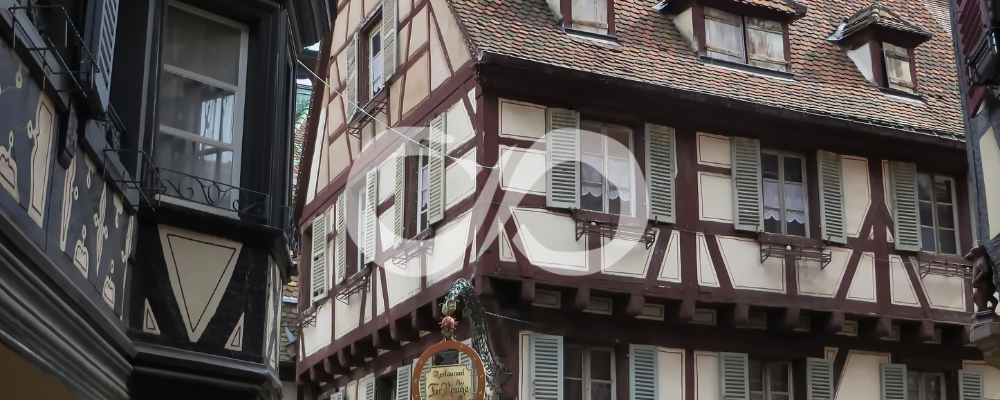
Imagine an Alsatian village in the 19th century. A cow is wasting away, the milk spoils, and the farmer's wife suspects a spell. Rather than relying solely on the doctor, people call on the local braucheur - the healer who recites prayers and knows the gestures needed to ward off the evil spell. By candlelight, he recites an incantation in a Germanic dialect while tracing the sign of the cross over the animal. Not far away, in the room of the son who has left for military service, someone has slipped a curious parchment covered in writing into his bag: a Letter from Heaven, meant to protect him from bullets and danger. These scenes illustrate the spirit of the magical-religious practices that endured in Alsace and the German-speaking regions of Lorraine. Between Braucherei (blessing and healing rituals) and Hexerei (malevolent witchcraft), an entire world of folk rites rooted in the local Christian faith developed. Discover a very local countryside magic.
A tradition in faith and everyday life
At the heart of these practices lies a worldview in which the sacred and the profane intertwine. Alsace and German-speaking Lorraine, lands of deep religiosity, saw the flourishing of a Christian folk magic inherited from the Middle Ages and renewed by the occult currents of the Reformation. In these rural communities, all of creation - family, livestock, fields, and home - was perceived as connected to a Christian cosmic order. Religion was not confined to church on Sundays: it permeated every gesture of daily life. People prayed for the health of their children, the protection of the farm, and the fertility of the crops. They blessed the house on major feast days and placed wooden crosses at the village boundaries to protect it. In short, spirituality was lived out in every act of domestic and agricultural life, through a multitude of brauches (rites) that gave meaning to both the joys and trials of existence.
This traditional magic draws its sources from the Christian faith while preserving older roots. Indeed, many rituals were ancient pagan formulas adapted into saints' prayers, passed down orally from generation to generation. Through repeated transmission, the original words became distorted: some incantations became almost unintelligible, a sacred jargon that can no longer be understood word for word - without this diminishing their prestige or perceived effectiveness. What matters lies elsewhere: it is the intention, the deep faith of the healer and the consultant, that activates the power of the rite. In the local worldview, God and invisible forces form a whole; using a special prayer or ritual gesture to heal is not seen as superstition opposed to religion, but rather as a natural extension of Providence. This integration of the sacred into everyday life was so deep that even religious transformations (the Protestant Reformation, the rise of science,...) did not eradicate these practices, which survived by adapting to the new context. Saints who were once officially prayed to continue to be invoked at home for specific needs (healing, protection of livestock,...), including among Protestants who, officially, no longer honor them. In other words, the people kept their secret "little ritual," alongside Sunday services.
Another notable feature of this tradition is its mode of esoteric transmission. The knowledge of the Braucher (a practitioner of Braucherei) is generally passed on informally, within the family or close community. Intriguingly, the rule of alternation is frequently observed: a man can learn these secrets only from a woman, and a woman from a man. Thus, a grandmother will teach her grandson, and a grandfather his granddaughter. This cross-gender transmission rule ensures balance and, in practice, gives women and men an equal role as traditional healers. Anyone, regardless of sex, can be the holder of the “secret” - provided they receive it seriously and with the sincere intention of helping others. For Braucherei is not learned for glory or intellectual curiosity: it is learned “for real,” with the aim of using it humbly in service to the community. The gift is considered sacred, and its abuse morally dangerous. As a result, the knowledge is jealously guarded: many practitioners have preferred to take certain secrets to the grave rather than disclose them to someone unworthy or a mere curiosity seeker. This discretion allowed the tradition to survive for a long time under the radar of religious or medical authorities. And when the line of transmission breaks for lack of a suitable disciple, it is sometimes necessary for a stranger or an apprentice from another village to come and inherit the tradition so that it is not lost.
Finally, it must be understood that these Alsatian and Lorraine magical practices are fundamentally Christian in their symbolism. They pray to the Trinitarian God and invoke Christ, the Virgin Mary, the archangels, and the saints. They use blessed objects (Palm Sunday branches, holy water, religious medals) and sacred texts (biblical verses, the Pater Noster, the Ave Maria). Although the institutional Church has sometimes condemned these “superstitions,” in the village mindset one does not serve the Devil by acting this way: on the contrary, one channels divine power to defend oneself against Evil. This is why people readily spoke of “good magic” in reference to Braucherei, as opposed to the satanic “bad magic” attributed to witches (Hexen). Thus, there is the benevolent Braucherei of the healer, and on the other hand the malevolent Hexerei of the sorcerer, without forgetting a key element of this magical heritage: the Himmelsbrief, the famous protective celestial letter.
Braucherei, or how to heal and protect through the sacred
The dialect term Braucherei refers to the collection of healing and blessing rituals traditionally practiced in these regions. In Pennsylvania, where many Alsatians and Lorrainers emigrated in the 18th century, Braucherei was translated as powwow, a term now commonly used for this system of Christian medicine. But long before its export across the Atlantic, Braucherei flourished in our countryside under various names: in French, people spoke of guérisseurs, faiseurs de secrets, désenvoûteurs, or, more poetically, leveurs de sorts. The role of the Braucher (the practitioner of Braucherei) was multifaceted: to heal ailments of the body and soul, protect people, animals, and crops, and attract luck and success in daily activities. This was a white healer-sorcerer (understood as acting with benevolent intent), doing good through occult but sanctified means.
Braucherei methods always combine spiritual and material elements. Prayer lies at the heart of the ritual: a particular prayer, transmitted by memory, that invokes God or a particular saint for the ailment concerned. But this prayer is accompanied by gestures and objects - for all of creation can serve as a channel for the divine. A common example is the sign of the cross traced three times above the ailing area, sometimes accompanied by a breath or a light spit (a symbol of expelling evil). Objects are also used: a piece of blessed bread, Candlemas oil to anoint a wound, or a Virgin's girdle worn by a woman in labor to facilitate childbirth. Medicinal plants also hold an important place, since many brauchers were knowledgeable about herbalism and combined natural remedies with prayers. This alliance of herbal medicine and spirituality is typical: the ailment is treated on every level at once, both physical and invisible.
What stands out in Braucherei is the attention paid to “signatures” and correspondences. Every ailment has its appropriate remedy, determined by analogy or sacred tradition. To treat a burn, one might invoke Saint Lawrence (martyred on a blazing gridiron) or the Virgin Mary under the title of Our Lady of Fire, and recite a “cooling” prayer while passing a damp cloth over it - the fire ailment thus being symbolically transferred into the water. Similarly, against Saint Anthony's fire (ergotism or shingles), one could recite the Gospel of Saint Anthony or apply oil consecrated on his feast day. Braucherei prayers are particularly beautiful, imbued with poetry: they speak to the elements and banish the illness as an entity commanded to leave. One such blessing prayer begins: “Today I rise and set out in the name of God the Father †, God the Son †, God the Holy Spirit †… May Jesus, Mary, Joseph, and the Three Holy Kings accompany me on the road and protect my home and my loved ones…”. As can be seen, the language of these rituals is steeped in Christian references (the Trinity, Saints, the Three Magi) while taking place outside the official liturgical framework. It is an unofficial liturgy of everyday life, passed down by the grandmother rather than the priest.

Sator Square, protection talisman. Source
Braucher act empirically and humbly. They do not proclaim themselves miracle workers with great powers, but rather instruments of God. The success of their interventions rests on faith: the healer's faith and the patient's faith. It is said that certain formulas “take effect” only if the person seeking help firmly believes in God - a sine qua non condition sometimes stated in the charm's text itself. An Alsatian formula for stopping hemorrhages begins with “Stop, blood, as Jesus Christ stopped in the Garden of Olives”, clearly alluding to Christ's Passion to give it efficacy. Thus, Braucherei presents itself as an extension of prayer, a more embodied prayer that uses words and gestures to seek immediate divine help.
Braucherei practices cover a wide range, from healthcare to preventative blessings:
-
Transferring illness into a tree: to cure a chronic ailment (persistent fever, “poverty” of the blood, exhaustion), a healer could perform a transfer ritual to a tree. The procedure was precise: he first collected a symbolic part of the patient's illness (for example, nail clippings or a few drops of blood), which he placed in a hollow object – a small goose feather trimmed into a tube. Then, on a Friday before dawn, during the waning moon, he would go and bore a hole in a wild tree (an oak or a barren pear tree) on the side where the sun rises, insert the feather containing the illness, and seal the opening with a wooden peg, striking it three times. The symbolism is powerful: Friday (the day of Christ's Passion) and the waning moon were supposed to draw the illness “downward and inward” – in this case, into the tree that would serve as its receptacle. Thus freed, the patient regained his strength while the tree was supposed to wither or dry out little by little as it carried the illness away. This practice of “plugging” (sealing the tree after enclosing the illness inside it) was still documented into the 19th century in the Rhineland region and in the United States among the descendants of these immigrants.
-
Bewitchment diagnosis: of course, the Braucher was consulted to determine whether a mysterious illness had a natural or occult cause. One method of magical diagnosis consisted of examining how the sick person's urine reacted on glowing embers. A 17th-century healer from Lorraine explained: “I would heat the urine on a red-hot poker: if it reddened and evaporated, it was a natural illness; but if it turned white and did not burn away, there was a spell”. If the test revealed a spell, the healer knew that he had to use additional spiritual remedies – prayers for deliverance, fumigations with blessed sulfur, or a counterspell – in addition to conventional medical remedies.
-
Protection of the home and livestock: Braucherei included a whole range of preventive measures to shield the house and farm from evil. For example, a sacred symbol - such as the C✝M✝B monogram (the initials of the Three Magi, Caspar, Melchior, Balthasar) accompanied by a blessing - was fixed to the stable door to prevent witches from “stealing” the cows’ milk. Likewise, a horseshoe was sometimes nailed above the threshold (a symbol of luck and an apotropaic symbol), or a cross was drawn with blessed chalk on every door at Epiphany. Some of these customs survive today, transformed into religious tradition: for example, the inscription of C✝M✝B on doors after Epiphany is still practiced in Catholic Alsatian villages, but originated in these household protection rites. The Braucher could also prepare small talismanic sachets containing consecrated herbs (vervain, St. John's wort), medals, and a written prayer, which people carried on themselves or buried in the foundations of the barn. The aim was, in a sense, to “armor” the living space against harmful influences - whether they came from a jealous neighbor, an evil spirit, or the Devil himself.
In all these benevolent practices of Braucherei, the guiding idea is the pursuit of harmony and health through the sacred. The Braucher sees himself as an intercessor, somewhat like an unofficial priest of the community, reconciling people with the forces beyond their control. He makes divine graces accessible for practical needs: healing a burn, bringing the bees back to the hive, or calming a family dispute. This is why people held him in respect and gratitude. However, this beneficial magic existed only because its malevolent opposite was feared: Hexerei, the evil witchcraft that casts spells. If the healer was indispensable, it was also because fear of the Hexen (witches) remained very much alive.
Hexerei, or the fear of malefices and counter-witchcraft
In Alsace as in Lorraine, the German term Hexerei refers to malevolent witchcraft, intended to cause harm in secret. It typically means the black magic attributed to Hexe (evil witches or warlocks). In the village mentality of old, many inexplicable misfortunes were blamed on these occult works: sudden livestock illnesses, devastating storms, a child wasting away for no apparent reason, or butter that would no longer set in the churn. People lived in dread of this invisible evil known as the curse, the malefice. Thus, an entire lore surrounding Hexerei developed, with its characters (the jealous old witch, the bonesetter who sells his soul) and its tales of enchantment.
Accusations of witchcraft wreaked havoc throughout the region’s history. At the end of the Middle Ages and especially in the early modern period (16th-17th centuries), Alsace and Lorraine were the scene of an intense witch hunt, fueled by fear of the Devil. Hundreds of people - mostly women - were tried and executed for witchcraft, based on mere suspicions or reported curses. This fierce repression, carried out by civil or religious courts, left a lasting mark on collective memory. Even after the great trials ended, the figure of the witch remained a bogeyman in the countryside. People avoided the company of an old woman reputed to “have the evil eye,” or of a local healer said to possess a diabolical grimoire for making a pact with Lucifer.
The powers attributed to witches were fearsome. They were believed to be capable of harming property and people in many ways. In Lorraine, it was said that witches could, on Walpurgis Night or at other opportune times, steal a field’s fertility by collecting the dew with a sheet, or divert cows’ milk by placing a broom handle in the cowshed and “milking” it like an imaginary cow. They could cast a spell on the wheat so that it would not sprout, put worms in the mill’s flour, or prevent a newlywed from consummating her marriage by hiding beneath her bed a needle that had been used to sew a shroud. The stories abound: one person found a black toad in his pigs’ trough one morning - a sure sign that a witch had cast a spell on the animals; another saw his cows fall ill one after another, doubtless because a witch had buried beneath the cowshed a cursed pouch containing toad bones and herbs from the witches’ sabbath. Even natural phenomena such as a sudden invasion of caterpillars could be attributed to witchcraft.

Hexerei arriving at the sabbath. Source
Faced with this omnipresent fear of bewitchment, rural society developed means of defense and counter-witchcraft - this is where Braucherei converges with the fight against Hexerei. The Braucher was the person people turned to when they suspected a spell. His role was not only to heal, but also to undo the evil caused by a witch. For example, he might be called upon to “lift” a spell weighing on a sick person: he would then use prayers of exorcism or deliverance, sometimes in Latin (such as the famous Exorcism Against Satan and the Rebellious Angels, or special prayers against harmful spirits). He could also advise the victim to perform apotropaic acts: place blessed salt in the four corners of the house, carry a “prayer against witches” written in Latin on parchment, or nail a hawthorn branch (a protective plant) above the door.
In many cases, simply declaring the spell “broken” through the healer restored the bewitched person's confidence - and that confidence contributed to the healing. The effectiveness of counter-witchcraft was as much psychological as sacred: once the victim was no longer afraid, the witch's power vanished. Moreover, the Braucher could try to identify the witch responsible by using traditional methods. One method consisted of melting lead or wax in a basin of water while reciting an incantation, then observing the solidified shapes: one might see the initial or silhouette of the evil person in them. At other times, three candles were lit in the name of the Trinity and the following words were spoken: “May the sorcerer who did this evil present himself at this house” - and if someone suspicious arrived soon afterward, he was considered the culprit.
It is interesting to note that the boundary between Braucher and Hexer was sometimes blurred. Officially, the Braucher denied using Hexerei: he saw himself as the antidote to the witch, not his accomplice. He healed where the other had intended to cause harm. In the Pennsylvania language derived from our dialects, people do indeed say: “Braucherei” for beneficial magic and “Hexerei” for harmful magic, and the two are generally considered opposites. The braucher (also called a Powwow doctor in English) is called upon to remove a spell cast by a hexer. Nevertheless, in the eyes of some, they all manipulated occult forces, and the boundary could be tenuous: a renowned healer could easily be accused of witchcraft if he aroused envy or fear. The difference often came down to the morality attributed to the person. As long as he worked for good and gave thanks to God, he was an acceptable good witch; if he began uttering curses or charging too much for his services, he was suspected of making a pact with the Devil. This ambiguity has followed the figure of the witch-healer into the modern era: people admire his knowledge, but they still remain somewhat wary of him.
The Himmelsbrief, the protective letter from Heaven
Among all the magical and religious practices of the region, the Himmelsbrief occupies a special place. This German term literally means “letter from Heaven”. It refers to a written document presented as being of divine origin - said to have been written by God himself, Christ, or an angel - that promises protection and blessings to whoever possesses it. The concept of the Himmelsbrief is ancient and is not limited to Alsace-Lorraine: traces of it can be found as early as the Middle Ages, with the legend of a letter from Jesus that fell from the sky to urge people toward piety and protect them from calamities. In the 13th century, the chronicler Joinville reported that a certain Jacob, leader of the Shepherds' Crusade (1251), brandished a letter supposedly given by the Virgin Mary to rally the crowds. This motif of the celestial letter reappears periodically throughout European history, in Orthodox, Catholic, and Protestant settings alike: each time, it is a sacred message that has miraculously descended from above, carrying promises of salvation but also strict conditions (often, an order to copy the letter and circulate it, under threat of divine punishment).

Himmelsbriefs. Source
In Alsace and Lorraine, the Himmelsbrief spread mainly during the modern and contemporary eras, in connection with popular printing and domestic devotion. These letters from God appeared as broadsides (printed posters) or manuscripts that were piously kept at home. They were sometimes hung on the wall, in the main room or in the stable, as a kind of spiritual amulet protecting the household and livestock. Others carried them on their person, folded into a small leather pouch, especially when they had to be away traveling or at war. The typical content of a Himmelsbrief combines biblical verses, prayers (such as the Lord's Prayer and excerpts from psalms), and formulas of divine assurance. The letter proclaims that “every bearer of this message will be protected from sudden death, bullets, lightning, plague,…”, listing a range of earthly perils from which one will be protected. Conversely, it warns that anyone who scorns it or fails to reproduce it faithfully will bring misfortunes upon themselves - for divine protection comes at a price. Most of these letters end with an injunction: “Copy this letter and share it with your fellow human beings” - making them genuine spiritual chain letters across generations.
The Himmelsbrief enjoyed particular success during troubled periods, when divine protection was ardently sought. In particular, during the First World War (1914-18), many German soldiers - including the Alsace-Moselle residents forcibly conscripted into the Kaiser's army - took letters of protection with them to the front. Mothers or wives would hand-copy a Himmelsbrief formula for their son or husband going to war, so that this talisman would make them invulnerable to bullets. One documented case is that of Marie Geffers, a farmer from Lower Saxony, who in August 1914 wrote, in her finest handwriting, a magic letter for her son-in-law Richard, who was leaving for combat. On a field-post letter form (Feldpostbrief), she wrote down biblical passages, invocations of the Trinity, and various assurances of protection against weapons - texts she had probably copied from models circulating among her neighbors. This trench Himmelsbrief, like so many others, would protect the soldier from danger, provided that he kept it reverently on his person and remained in a state of grace. The practice was so widespread that military authorities sometimes became concerned, viewing it as a superstition that could verge on insubordination (a soldier who believed himself invincible might take reckless risks). But for these men facing death every day, carrying a handwritten letter from their mother in their pocket, blending prayer and magic, must have provided real psychological comfort - and, of course, tangible protection in the eyes of faith.
The content of the Himmelsbriefe varies, but certain elements recur. In addition to prayers and blessings, they contain sacred symbols drawn or calligraphed: the name of Jesus in ornamental letters, crosses, the IHS monogram, and the three nails of the Crucifixion. Sometimes, the letter takes the form of a celestial dialogue (Jesus dictates the letter to an angel). Others include highly specific moral instructions: assisting the poor, observing Sunday,... making the text a reminder of the duties of a good Christian as much as a talisman. This dual nature is interesting: the Himmelsbrief offers “automatic” protection simply by its presence, but it also urges its owner to lead a virtuous life, an implicit condition of divine assistance. In this sense, one could say that it is an alliance: God protects the individual through the letter, and in return the individual commits to faith and righteousness.
In our Alsatian and Lorraine regions, people obtained a Himmelsbrief either by having it written by a respected practitioner, a renowned Hexenmeister or Braucher, or by buying a printed version during a pilgrimage or at a religious fair. Indeed, from the 18th century onward, peddlers sold inexpensive printed blessings and heavenly letters. However, many people preferred the handwritten version, considered more authentic and powerful, especially if it came from the hand of a healer known for his faith. Some Hexenmeister thus charged for their mystical writing skills, composing personalized Himmelsbriefe in exchange for a sometimes substantial sum. Others, by contrast, believed that this knowledge should not be sold: according to them, a true Himmelsbrief had to be given freely or in exchange for a symbolic donation, otherwise it would lose its virtue. In any case, these magical letters circulated widely. Even in the early 20th century, they can be found hanging in farmers’ homes in Moselle or Alsace, alongside crucifixes and devotional images, testifying to the enduring popularity of these religious talismans.
The Himmelsbrief can be seen as the culmination of this fusion between magic and faith that characterizes Alsatian-Lorraine witchcraft. It is nothing less than a sacramental originating among the people: a paper object bearing the Word of God and serving as a quasi-sacramental protection. Neither entirely approved by the Church, which often sought to suppress these “superstitious writings,” nor wholly foreign to Christian piety, since it is saturated with biblical texts and prayers, the Himmelsbrief navigates between orthodoxy and magic. It embodies the human wish to have a tangible contract with Heaven: a few written lines and the hope that God will sign at the bottom of the page to fulfill His promise to protect His children from danger.
Persistence and heritage
Alsatian and German-Lorraine magical practices constitute a rich cultural heritage. Of course, the context has changed radically: the traditional rural world has largely disappeared, taking with it part of these active beliefs. In the age of scientific medicine and technology, few people consult a spell lifter to heal livestock or slip a celestial letter under their pillow to ward off lightning.
In the countryside of Alsace and Lorraine (as well as in other regions of France), there are still people known as healers or keepers of the secret. These heirs of Braucherei continue to treat burns, shingles, warts, or “wildfire” exactly as their ancestors did. These practices benefit from social tolerance - including from some doctors who pragmatically observe improvements in patients combining both approaches. We are far from the persecutions of old: today's healer is no longer hunted down as a witch. But beyond that, there is a lesson to be learned: our ancestors, without diplomas or technology, had developed a knowledge of the soul and the heart to ease suffering and tame fear.
Sources:
-
Kriebel, David W. Powwowing Among the Pennsylvania Dutch: A Traditional Medical Practice in the Modern World. University Park, PA: Penn State University Press, 2007.
-
Donmoyer, Patrick J. Powwowing in Pennsylvania: Braucherei & the Ritual of Everyday Life. Kutztown, PA: Pennsylvania German Cultural Heritage Center, 2017 (exhibition catalog and study with primary sources).
-
Yoder, Don. “Hohman and Romanus: Origins and Diffusion of the Pennsylvania German Powwow Manual,” in American Folk Medicine: A Symposium, University of California Press, 1976, p. 235-248.
-
Hohman, John George. The Long Lost Friend [1820] (English ed. 1850, digitized text). Major primary source for Braucherei.
-
Bächtold-Stäubli, Hanns & Hoffmann-Krayer, Eduard (eds.). Handwörterbuch des deutschen Aberglaubens (HDA). Berlin-New York: de Gruyter, 1927-1942 (reprinted 1987). See entries “Himmelsbrief” (R. Stübe) and “C.M.B.” on the Epiphany blessing.
-
Stübe, Rudolf. “Himmelsbriefe and Chain Prayers,” Wissenschaftliches Jahrbuch des Tiroler Landesmuseums, 6 (2013), pp. 245-255 (historical-comparative synthesis).
-
Briggs, Robin. The Witches of Lorraine. Oxford: Oxford University Press, 2007, and associated documentary database (approx. 400 trial files).
-
Follain, Antoine & Simon, Maryse (eds.). Witchcraft and the City. Strasbourg: Presses universitaires de Strasbourg, 2018 (particularly A. Follain’s chapter on urban and rural Lorraine).
-
Simon, Maryse. Witchcraft Cases in the Val de Lièpvre (Sixteenth-Seventeenth Centuries). Strasbourg: Publications of the Société Savante d’Alsace, 2006 (review in Revue d’Alsace, 2007).
-
Diedler, Jean-Claude. “A Witchcraft Trial in Southern Lorraine at the Beginning of the Seventeenth Century,” Histoire & Sociétés Rurales, no. 7, 1997, pp. 133-172 (critical edition of judicial sources).
-
Rémy, Nicolas. Daemonolatreiae libri tres, 1595 (English trans. Demonolatry, 1929). Lorraine demonological treatise based on an extensive corpus of trials.
-
Roehrig, Jacques. Witchcraft Trials in the Sixteenth and Seventeenth Centuries in the Eastern Lands: Alsace, Franche-Comté, Lorraine. 2016 (BNU Strasbourg record).
-
Archives of the City and Eurometropolis of Strasbourg. “Witchcraft Trials in the Ban de la Roche” (presentation of archival documents, Alsatian context).
-
Wikisource (DE). “Himmelsbrief von 1864” (example of a nineteenth-century celestial letter, primary source).
-
Glencairn Museum. “Powwowing in Pennsylvania: Healing Rituals of the Dutch Country,” Newsletter, March 9, 2017 (transcription of manuscripts on transferring an illness to a tree).
-
Strasbourg Museums - Alsatian Museum. Press dossier (2024) and resources on devotional imagery and Alsatian household objects (relevant to Haussegen and household protections).

Par Olivier of Aeternum
Passionate about esoteric traditions and the history of the occult from the earliest civilizations to the 18th century, I share some articles on these topics. I am also co-creator of the online esoteric shop Aeternum.