















































































































































































































|
CONTENTS...
1. When does tarot become a divination tool? |
Divination tarot was not created to predict the future. In its early days, it had nothing magical about it. It was a game. A card game, like others that existed in Europe in the 15th century. It was called Tarot, Tarocchi, or Tarock, depending on the country. It entertained the Italian courts and served as a noble pastime, a strategic challenge, and a form of amusement. No sorcerers, no fortune-tellers. Just players.
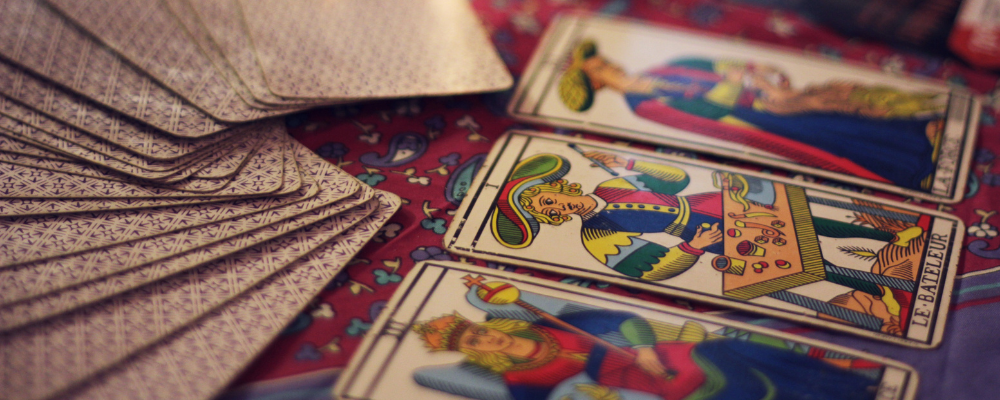
But this game has something distinctive: 22 named and illustrated cards that differ from the others. These cards, called the Major Arcana, depict scenes, characters, and symbols. The Magician, the High Priestess, Death, the Devil, the World. These figures speak without rules. They act on the imagination. They touch us more than they reveal. And little by little, they become something more than a game.
1. When does tarot become a divination tool?
It was not until the 18th century that tarot shifted toward divination. At that time, European societies were rediscovering esotericism, ancient symbols, and correspondences. People sought hidden systems in everything: letters, numbers, and shapes. Authors such as Court de Gébelin claimed that tarot came from ancient Egypt and contained forgotten knowledge. The idea was appealing, even though it was based on no historical evidence.
This was also when the first interpretations of the cards one by one appeared, no longer for playing, but for reading messages. Tarot fell into the hands of occultists, fortune-tellers, and seekers of meaning.
Then came the 19th century, with Papus, Eliphas Lévi, and Oswald Wirth. Each brought their own interpretation, system, and associations: with the Kabbalah, the elements, and the planets. Tarot became a tool for reading the world, a mirror of the soul, and an instrument for inner transformation.
2. What place does tarot take in the 20th century?
The 20th century dramatically expanded the uses of tarot. It was no longer limited to an esoteric elite. It entered bookstores, fortune-telling parlors, and specialty shops. It became popular without losing its aura. Tarot figures took on different faces and styles. The Rider-Waite tarot, illustrated in 1909, became a worldwide model. Its colorful, simple, direct images made tarot more accessible.
Psychologists also took an interest in it. Carl Jung, among others, saw it as a reflection of archetypes. Tarot ceased to be solely a divination tool. It also became introspective, evolutionary, and therapeutic.
Today, tarot is drawn for practical or spiritual questions. It accompanies decisions, sheds light on transitions, and helps us read the invisible. Its playful origin has not been lost. It reminds us that drawing cards is also a way of playing with reality.
3. What is the true origin of tarot?
Historically, tarot originated in 15th-century Italy. As a divination practice, it emerged from the imagination of the 18th century. Spiritually, it is born each time someone takes it seriously without trying to control everything. It is a game that has endured through the centuries because it leaves room for mystery, personal interpretation, and the encounter between what we experience and what we feel.
The origin of divination tarot is not a date. It is a transformation. And that transformation continues each time you draw a card.










Join the Aeternum community on our Facebook group: advice, tips, rituals, knowledge, products in a friendly atmosphere!
I'm going!