















































































































































































































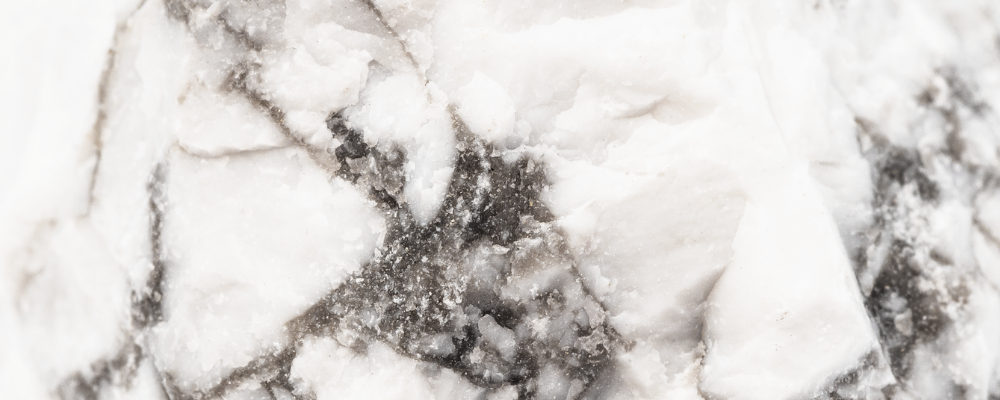
White, crossed by gray lines like a page already marked, Howlite belongs to the stones whose magic is recent. Discovered in the 19th century, it has neither an ancient temple nor a medieval legend. Its language took shape in the 20th century around silence, patience, sleep, and the anger one chooses not to let rule.
Its light color also makes it an excellent coloring material. Natural or dyed, it invites the same question: what do we want to inscribe on the white background, and which lines do we refuse to cross?
To place this stone among related minerals, compare it with Blue Agate, Apatite, and Zircon.
A White Stone Veined with Gray
Howlite is a hydrated calcium borosilicate. It forms white nodules marked by a gray or black network, and more rarely visible crystals. With a hardness of 3.5, it is pleasant to carve but more susceptible to scratches than Agate.
The Handbook of Mineralogy entry describes its structure and locations where it was discovered. For symbolic use, its contrast provides an immediate image: a clear space crossed by boundaries, paths, and forks.
Henry How and the 19th Century
The stone was described after a discovery made in Nova Scotia, Canada, in 1868. It was given the name Howlite in honor of the chemist and geologist Henry How. The Mindat historical record refers to the first description published that year. This date establishes a clear boundary: ancient authors and medieval lapidaries could not have named it under this identity.
Its porosity allows it to absorb dye, particularly blue dye. This quality has produced pieces of vivid blue crossed by dark veins. Their appearance evokes Turquoise, but their history and material remain those of Howlite.
A Contemporary Magical Tradition
Howlite’s associations with calm, patience, and sleep belong to contemporary traditions. They are based on its whiteness, the pattern of its veins, and the tactile experience of a light, matte stone. It is more accurate to present this current as a tradition in the making than to invent ancient priests for it.
In this reading, Howlite serves to slow the response, set agitation down, and prepare for the night. It does not induce sleep through a medical action. It gives shape to a choice: put down the phone, postpone a message, breathe, and let the body enter a restful routine.
White is not emptiness. In a rite, the light-colored surface can receive an intention, while the veins recall boundaries. Howlite thus becomes a stone of inhabited silence: staying silent long enough to choose words that will hurt neither oneself nor others.
Moon, Air, and pause time
The Moon suits its nighttime use, rhythms, and retreat. Air corresponds to breathing, language, and thought put back in order. White can be associated with Monday or a white candle, without claiming that any ancient attribution links Howlite to these frameworks.
Blue Howlite can receive a Mercurial accent for communication. Its acquired color does not erase the material; it simply shifts the ritual vocabulary toward speech, listening, and control of tone.
Patience, sleep, and boundaries
Place the Howlite on your desk when you need to respond to an irritating message. Touch it before sending, then reread your text and remove anything that is only trying to punish. Patience does not require giving up a boundary; it allows you to state it without adding unnecessary violence.
For sleep, place it on a table near the bed with a notebook. Write down what can wait until tomorrow, turn off the screens, and keep a regular bedtime. The stone marks the beginning of this sequence.
It can also support learning a habit. Draw one line for each day completed. Its veins become the image of a path that is not completed in a single leap.
The delayed-response rite
Place the Howlite on a blank sheet of paper. Write the message you would want to send in the heat of anger, but do not address it to anyone. Turn the stone and the sheet of paper facedown, then wait for the time decided in advance: an hour, a night, or a day.
When you return, write a second version around three elements: the fact, the boundary, and the desired next step. Tear up the first version, keep the second if it feels right, then say: “I do not give up my voice; I choose its form.”
Correspondences and reference points
| Reference point | Correspondence |
|---|---|
| Nature | Hydrated calcium borosilicate |
| Hardness | Approximately 3.5 on the Mohs scale |
| Magical period | Contemporary correspondence |
| Suggested planet | Moon |
| Suggested element | Air |
| Areas | Patience, rest, control of tone, boundaries, and consistency |
| Ritual image | The blank page crossed by paths |
| Ritual gesture | Delay a response, then choose its form |










