














































































































































































































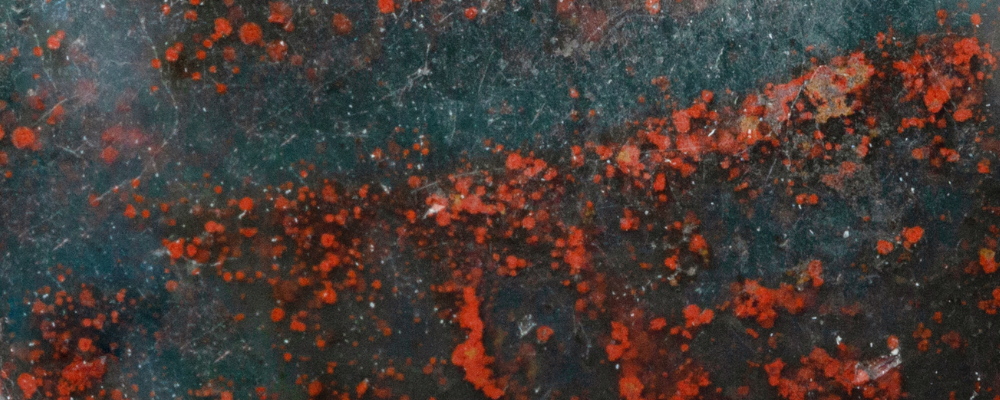
Marked with red, Heliotrope bears two names and two lineages. Its Greek name connects it to the Sun and light; its name Bloodstone places it within victory, courage, defense, and the Christian imagery of the Passion.
This stone therefore cannot be reduced to a modern association with the body. Pliny transmits a rite of invisibility, lapidaries make it a talisman of combat and rightful causes, while 20th-century magic retains Mars, Fire, business, and protection.
To place this stone among related minerals, compare it with Agate, Blue Agate, and Dendritic Agate.
A green Chalcedony speckled with red
Heliotrope is an opaque green Chalcedony marked with red dots or patches produced by iron oxides. It belongs to the Quartz family and has a hardness close to 7. The English name bloodstone, “blood stone,” directly describes its appearance.
The Gemological Institute of America lists it among the stones for the month of March. The spots vary from one specimen to another: some remain subtle, while others form distinct red marks on a dark green background.
The stone that turns toward the Sun
The name combines the Greek helios, “Sun,” and trepein, “to turn.” Pliny reports that Heliotrope placed in water reflects a red image of the Sun. He also conveys the magi’s claim that the stone, combined with the plant of the same name and certain formulas, makes its wearer invisible.
The passage in Book 37 of the Natural History attests to the rite’s circulation, while Pliny’s irony marks his distance from it. Invisibility therefore belongs to the stone’s ancient record without becoming a physical fact.
From Christ’s blood to talismans of victory
A later Christian legend recounts that drops of Christ’s blood fell onto a green stone at the foot of the Cross and left their marks there. This story explains the red through the Passion and makes Heliotrope a sign of sacrifice, salvation, and resistance.
Lapidaries attribute victory, defense, stopping bleeding, wealth, and favor in legal proceedings to it. Ancient medical uses belong to history and do not constitute healthcare advice. Their symbolic logic remains clear: the stone that represents blood receives the power to govern it.
To see without being seen. The rite transmitted by Pliny and the military color of Bloodstone converge in one function: acting without unnecessarily exposing oneself. Ritual invisibility thus means discretion, withdrawal, and protecting the undertaking before its completion.
Mars, Fire, and contained strength
Scott Cunningham places Bloodstone under Mars and Fire in his 1988 encyclopedia. He attributes courage, victory, wealth, business, legal matters, and agriculture to it.
Mars brings action, but the green core contains its red. The stone is better suited to disciplined strength than to directionless anger. Tuesday serves defense, competition, and litigation; an earthy emphasis suits agriculture and commerce.
Courage, justice, and withdrawal
Before a confrontation or hearing, keep the Bloodstone with the facts and documents in the case file. Consecrate it to firmness, precise speech, and refusal to be intimidated. The rite supports preparation; it does not replace legal advice.
To remain unnoticed, wrap the stone in a sheet of paper bearing what must remain discreet. Keep the bundle out of sight until it is time to act. This practice protects a project, undertaking, or personal retreat; it is not meant to conceal wrongdoing.
In a business, place the Bloodstone near the cash register or ledger to unite the green color of resources with the martial strength of work accomplished.
The Rite of Silent Courage
On a Tuesday, place the Bloodstone between a red candle and a green candle. Write down the ordeal you must face, the real fear, and the right action. Fold the paper toward you if you seek victory, and away from you if you seek to divert a threat.
Take the stone and say: “My courage needs no noise; my will knows its measure.” Carry it with you through the ordeal. Afterward, note what you defended and what you chose not to fight.
Correspondences and references
| Reference | Correspondence |
|---|---|
| Nature | Green chalcedony marked with red iron oxides |
| Hardness | Approximately 7 on the Mohs scale |
| Planet | Mars |
| Element | Fire |
| Day | Tuesday |
| Areas | Courage, victory, justice, defense, commerce, and discretion |
| Ritual image | The red of action contained within green |
| Ritual gesture | Naming the fear, the right action, and what is not worth fighting |










