















































































































































































































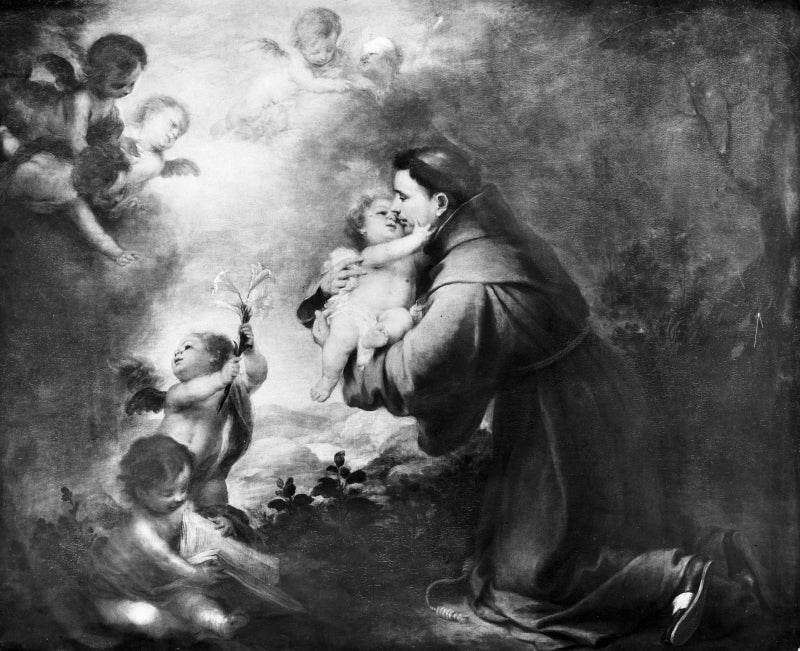
Saint Anthony of Padua is invoked in many families for lost objects, but this devotion tells only part of his story. Born in Lisbon in the 12th century and educated by the Canons Regular of Saint Augustine, he joined the Friars Minor and became one of the great preachers of his generation. His sermons reveal a theologian attentive to the meaning of Scripture, prayer, justice, and charity. The Child Jesus, the lily, and the book that artists give him bear witness to the different aspects of his memory in Catholicism.
| Life | c. 1195 – June 13, 1231 |
|---|---|
| Origin | Lisbon, Portugal |
| Congregations | Canons Regular, then Friars Minor |
| Works | Sunday Sermons and Sermons on the Saints |
| Feast | June 13 |
| Title | Doctor of the Church since 1946 |
Fernando of Lisbon and the Canons of Coimbra
Anthony was born under the name Fernando in Lisbon. He entered the Canons Regular of Saint Augustine at a young age and continued his studies at the Monastery of Santa Cruz in Coimbra, a major religious and intellectual center of medieval Portugal. This education gave him a solid knowledge of the Bible, the Fathers of the Church, and the methods of interpretation used in the learned circles of his time.
His early years did not resemble the life of a preacher traveling the roads. He first learned to work with texts, participate in communal prayer, and seek coherence between doctrine and religious life. This preparation would play a decisive role when his ministry took a new direction. His knowledge of Scripture explains much of his later reputation.
Joining the Friars Minor
In 1220, the remains of five Franciscan missionaries who had died in Morocco arrived in Coimbra. Their story moved Fernando, who decided to join the newly established order of the Friars Minor. He then took the name Anthony and wished to leave for Morocco himself to proclaim the Gospel. Illness quickly interrupted the journey and forced him to return to Europe.
The return journey took him to Italy. In 1221, Anthony attended the general chapter held at Assisi, where he encountered the movement organized around Francis of Assisi. After this assembly, he led a quiet life near Forlì. According to Franciscan tradition, a sermon delivered during a celebration revealed the extent of his knowledge and his oratorical talent.
His superiors then entrusted him with preaching missions. His vocation retained the initial desire to proclaim Christ, but it now followed the roads of Italy and France. This development shows how the first Franciscan communities used their members' abilities to respond to the needs of the Church.
Preaching and Teaching Theology
Anthony ministered in a world of rapidly growing cities, where different populations met and competing religious movements circulated. He preached on conversion, abuses, greed, and the duties of solidarity. Franciscan sources describe crowds coming to hear him. His teaching addressed concrete situations: the behavior of the rich toward the poor, the demands of justice, and fidelity to the Gospel.
He also taught theology to the friars, particularly in Bologna. A letter from Francis authorized him to undertake this task while asking him to preserve the community's spirit of prayer and devotion. This tension between study and evangelical simplicity was an important question for the Friars Minor. Anthony helped show that serious intellectual training could support preaching without replacing the spiritual life.
Anthony's ministry also included positions of leadership. His words therefore did not come from an isolated author: they were rooted in community responsibilities, travel, and the difficulties encountered in contact with the faithful.
The Sermons and the Four Senses of Scripture
The Sunday Sermons and the Sermons on the Saints constitute Anthony's major works. These texts were developed from the liturgical readings and intended to nourish preaching. They combine the study of the Bible, the tradition of the Fathers, and moral reflections. Their written form should not be confused with a word-for-word transcription of speeches delivered before crowds.
Anthony used the different levels of interpretation inherited from medieval Christian culture: the literal sense, the Christological sense, teaching for the conduct of life, and orientation toward hope. This method made it possible to bring widely separated biblical books into dialogue and to show how their reading could nourish religious life.
The theme of the Incarnation holds an important place in his teaching, as does contemplation of the Passion. Anthony invited people to see in Christ the measure of human dignity and the model of active charity. His reputation as a preacher must therefore be understood through his writings as well as through his devotional popularity.
Prayer for Finding Lost Objects
The patronage of lost objects developed in Catholic devotion around Saint Anthony. It gave rise to familiar prayers that accompany a material search. This custom belongs to the history of his cult; it does not summarize either his sermons or the role he held in the Franciscan order.
In the Catholic faith, invoking Anthony means seeking his intercession with God. This request may concern a lost object, a personal need, or a family situation, without turning prayer into a mechanism that produces a guaranteed result. The saint is also associated with helping people in difficulty, extending the place given to the poor in his preaching.
This closeness to everyday life explains part of the faithful's affection for Anthony. It should not obscure the fact that his texts speak above all of conversion of the heart, charity, and proclaiming the Gospel.
The Child Jesus, the Lily, and the Memory of Padua
Anthony died near Padua on June 13, 1231. He was canonized in 1232 by Pope Gregory IX, only one year after his death. The shrine preserving his memory became one of the most important pilgrimage sites in Italy. In 1946, Pius XII proclaimed him a Doctor of the Church, recognizing the significance of his theological work and preaching.
Iconography shows him dressed in the Franciscan habit and carrying the Child Jesus, a lily, or a book. The book evokes his teaching; the lily symbolizes purity; the Child Jesus refers to accounts from the hagiographic tradition and to the importance Anthony gave to the Incarnation. These attributes belong to different registers that are useful to recognize.
His feast, celebrated on June 13, brings together a very lively popular devotion. To discover his message, the sermons are a particularly illuminating source. They reveal a religious whose knowledge of Christian texts was placed at the service of speech and attentiveness to others.
The Assidua, the First Witness to His Memory
Historical knowledge of Anthony relies in particular on the Assidua, an early life written shortly after his death in 1231. This text belongs to the Franciscan hagiographic tradition and preserves information about his ministry and the emergence of his cult. The sermons attributed to the saint form another documentary collection: they reveal his attention to Scripture and teaching, beyond modern images of an intercessor entrusted with finding lost objects.
The Basilica of Padua preserves this memory in its architecture, reliefs, and tomb. The Franciscan tradition helps place Anthony among the preachers formed after the order's foundation. Reading the medieval sources and the sanctuary's documents together reveals a religious figure whose intellectual and pastoral activity mattered as much as the accounts of miracles.
Sources and References
Benedict XVI, general audience of February 10, 2010, devoted to Saint Anthony of Padua.
Anthony of Padua, Sunday Sermons and Sermons on the Saints, the main sources for his biblical teaching, his understanding of prayer, and his preaching.
Franciscan life: the context of the first generation of the Friars Minor and the legacy of Francis of Assisi.
Pontifical Basilica of Saint Anthony of Padua, historical chronology of his life, from Lisbon to Padua.
Illustration: Bartolomé Esteban Murillo, Saint Anthony of Padua with the Child Jesus (17th century), public domain document.










