










































































































































































































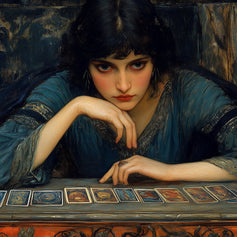




General description
Atropos is one of the three Fates (or Parcae in Roman mythology), the goddesses of destiny who control the life and death of every human being. Her name means "the inflexible" or "she who cannot be turned aside," reflecting her role as the one who cuts the thread of life. Atropos is the most feared of the Fates because she determines the death of each individual, marking the inevitable end of destiny that she shares with her sisters, Clotho and Lachesis. She is revered, or rather feared, as an inexorable force of nature, representing the finality of life and cosmic order.
Correspondence table
| Stones | Obsidian, onyx, hematite |
| Planets | Saturn |
| Day | Saturday |
| Deities | Thanatos, Hecate, Nyx |
| Creatures | Serpent, raven |
| Plants | Yew, cypress |
| Signs | Scorpio, Capricorn |
| Direction | West |
| Offerings | Wine, blood, bread |
Symbols and appearances
Atropos is often depicted as a stern and imposing woman, dressed in dark robes. She is usually shown holding scissors, the tool with which she cuts the thread of life, symbolizing the inevitable end of existence. Sometimes, she is portrayed with a thread wrapped around her fingers, showing her role in concluding fate. Dark colors like black and gray are associated with her, evoking the gravity of death and the mystery of the unknown.
Genealogy
| Parents | Nyx (goddess of the night) and Erebus, or Zeus and Themis (according to some traditions) |
| Brothers and Sisters | Clotho (spinner of the thread of life), Lachesis (measurer of the thread of life), the Erinyes, Nemesis (in some traditions) |
| Consorts | No specific mention |
| Children | No specific mention |
Myths
Atropos, as one of the Fates, appears in several Greek myths where fate plays a central role. Her power is absolute, and even the gods cannot change what she has decided. In the Iliad, for example, Achilles' fate is inevitable: despite his bravery and battle skills, he cannot escape the death decreed for him by the Fates, and especially Atropos.
Another example is the myth of Oedipus, where Atropos plays an indirect role in the unfolding of Oedipus's tragic fate, where every action seems inevitably to lead to the final outcome woven by the Fates. Atropos embodies the ultimate end of every destiny, regardless of the efforts or prayers of mortals or gods.
Spiritual message
Atropos embodies the inevitability of death and the finality of fate. She teaches us the importance of accepting the natural end of life, symbolizing the need to recognize and respect the limits imposed by the cosmos. Atropos reminds us that life is a fragile thread that can be cut at any moment, encouraging us to live fully and consciously.


