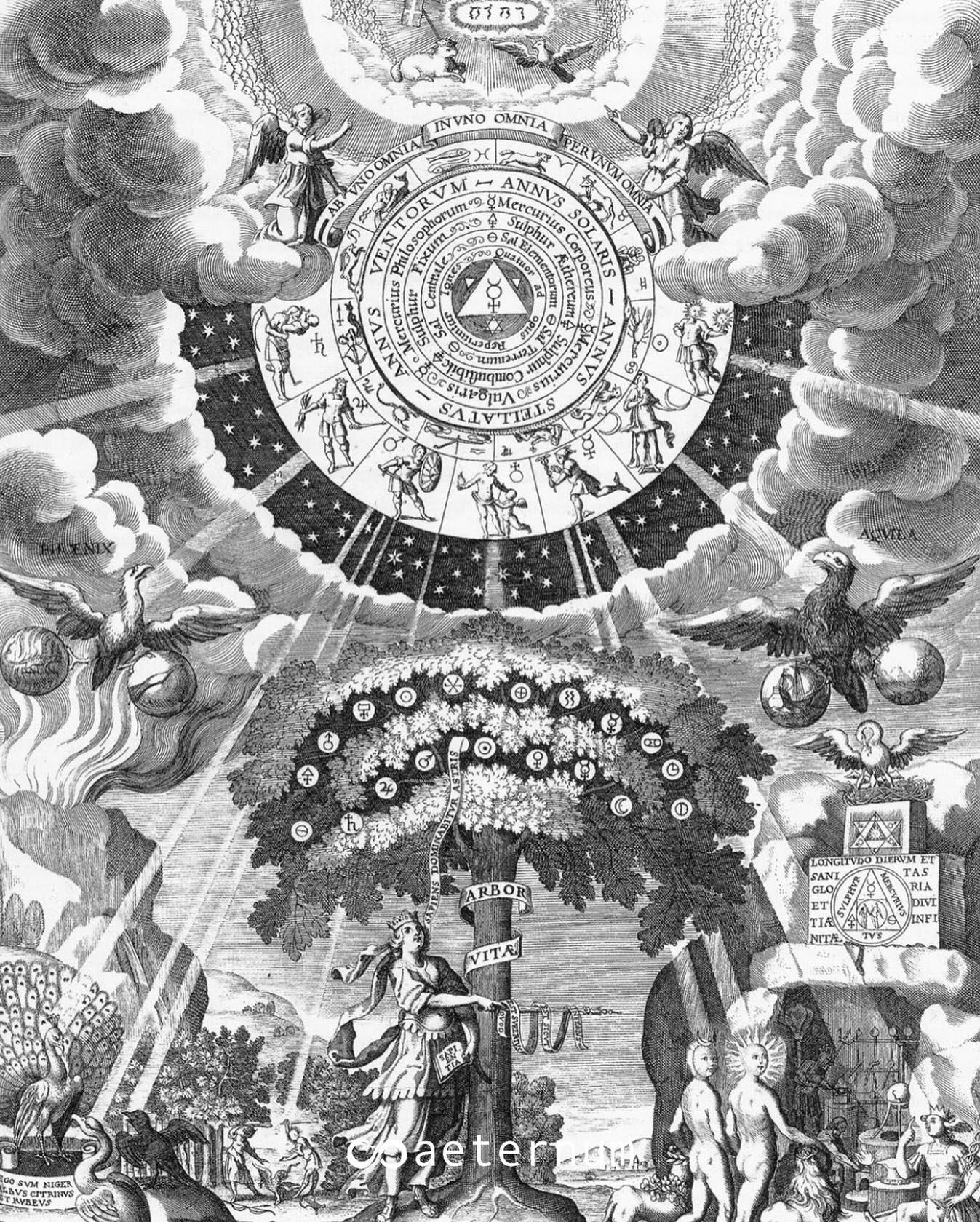

























































































































We all agree that there is only one magic. Thus, red, green, or black magic actually stems from the way it is used. It is therefore essential to define each magical intention to understand its limits but also its historical origins, unfortunately increasingly overlooked. Let us embark on a (somewhat philosophical) exploration of the famous so-called black magic and its stakes.
1. Magic, between good and evil
At first glance, the term "black magic" evokes an occult practice charged with dark and harmful connotations. Throughout history, the notion of "darkness" associated with magic has acquired varied meanings depending on cultural, religious, and philosophical contexts.
In early civilizations, magic was not categorized as "black" or "white" as sharply as it is today. In ancient Egypt, for example, magic, or heka, was considered a divine gift, allowing the maintenance of universal order. Priests and magicians invoked forces for healing and protection but could also use practices that today might be seen as manipulative or harmful. The boundary between "good" and "evil" in magic was then fluid and mainly depended on the intention behind magical acts.
With the rise of Abrahamic religions, the perception of magic began to polarize. "Black magic" was gradually associated with practices deemed heretical or contrary to divine laws, while "white magic" became linked to purity and beneficial intentions. In the Middle Ages, this distinction was reinforced by the influence of the Catholic Church, which saw "black magic" as a threat to religious doctrines and a danger to souls. Practices perceived as belonging to "black magic," such as demon invocation or curse creation, were severely condemned and often repressed through witch hunts.
In Asia, notably in India, magic was also omnipresent in spiritual practices. The terms "black Tantra" (or Aghori Tantra) referred to occult practices used for domination or destruction purposes. Unlike other forms of magic, black Tantra aimed to manipulate the destructive forces of the universe and was often misunderstood by Western observers who equated it with "black magic" in the European sense, although it is not harmful in itself.
2. Magical Manichaeism
The dichotomy between black and white magic partly originates from Manichaeism, a dualistic thought of Persian origin, still present today, which conceived the universe as a constant struggle between light and darkness. This concept influenced Western thought, popularizing the idea of a battle between good and evil. In magic, this duality translates into the opposition between supposedly beneficial forces (white magic) and supposedly harmful or dangerous practices (black magic).
White magic is thus seen as a force of harmony, healing, and protection, often associated with the practices of healers, shamans, or religious figures. Black magic, on the other hand, is attributed to witches and magicians who invoke entities considered malevolent or who seek to manipulate others' will for personal gain. In this opposition, "darkness" takes on a moral connotation: it represents the transgression of natural or divine laws, excessive ambition, and recourse to occult forces for domination purposes.
3. The quest for personal power...
At the heart of black magic lies, a priori, the quest for personal power and control over invisible forces. Magicians seek to manipulate energies considered dark to influence the material world according to their desires. This approach involves invoking entities or supernatural forces perceived as malevolent or dangerous. For example, the texts of Cornelius Agrippa explore rituals aimed at summoning spirits or demons to obtain specific knowledge or powers.
Black magic is also associated with the exploitation of the dark forces of human nature and the universe. Rather than rejecting these energies, magicians integrate them into their rituals to explore deeper aspects of existence. In some African cultures, for example, the distinction between black and white magic is less marked, and the use of forces perceived as negative can be considered an integral part of magical practice.
4. ...or a tool of rebellion?
Transgression is a central element of the philosophy of black magic. It involves breaking established moral, religious, and social norms. Historically, black magic practices were often seen as acts of rebellion against religious and social authorities. In the Middle Ages, for example, the Catholic Church severely condemned practices associated with black magic, considering them heresies and threats to social order. But it is worth asking: was black magic a pretext to condemn magic itself? And by extension, all its followers whose thinking was far from religious dogma.
Psychologically, black magic can be seen as a means of liberation from social conventions with which the magician does not identify. It allows each person to explore repressed aspects of their psyche, confront their fears and forbidden desires. This exploration is sometimes considered a path to self-knowledge and personal transformation. In some shamanic traditions, for example, the use of rituals perceived as transgressive aims to restore balance between the individual and the universe.
5. Black magic and moral perspective
The distinction between good and evil has been at the heart of many philosophical reflections throughout time. In the context of black magic, this duality becomes particularly complex because it touches on practices perceived as marginal. To explore whether good is truly "good" and evil intrinsically "bad," we can draw a parallel with two of the most famous philosophers of our time whose reflections apply well to our subject (although their work did not focus on magic).
5.1. Kant and the "radical evil" "
Emmanuel Kant, in Religion within the Bounds of Bare Reason, proposes the concept of "radical evil." For him, evil is not merely the absence of good but constitutes an inclination inherent to human nature. He asserts that each individual has a tendency to prioritize personal interests and desires at the expense of moral laws. In this view, evil is part of the human condition, while good requires a conscious choice and a will to overcome.
Applied to black magic, this Kantian insight could suggest that some practices, apparently transgressive, reflect this natural tendency toward evil. Nevertheless, Kant reminds us that reason and moral will allow transcending this inclination, emphasizing that good is defined by the ability to make moral choices despite personal desires.
5.2. Nietzsche and social constructions
Friedrich Nietzsche, in Beyond Good and Evil, criticizes traditional morality and argues that notions of good and evil are social and cultural constructs. For him, these categories are means to maintain order and contain individuals within collective norms. Nietzsche proposes instead to go beyond these moral distinctions to evaluate actions based on their capacity to affirm the individual's will and life force.
In the context of black magic, a Nietzschean perspective leads to reevaluating practices labeled as "bad" or "harmful" according to their affirmation of personal will. Nietzsche invites a redefinition of usual moral judgments, questioning whether black magic is also a way to explore facets of individual power.
6. The neutrality of energies
One established fact we have not yet addressed: magical energies are neutral by nature. Magic is perceived as an interaction with universal forces that possess neither intrinsic morality nor predetermined orientation. These forces, often described as natural currents, vibrations, or cosmic energies, respond to the intentions of the one who channels them without moral distinction. This view is shared by several philosophies and spiritual practices.
In shamanism, for example, the spirits and natural forces invoked during rituals are neither good nor bad in themselves. Their role depends on how the shaman interacts with them, whether to heal, protect, or influence a particular situation. Similarly, Taoist philosophy offers a worldview where yin and yang, representing opposing but complementary forces, embody a fundamental balance. In this framework, light and darkness are not morally opposed but coexist in harmony to maintain universal order. Finally, in Western Hermeticism, magical energies are seen as universal natural laws that humans can understand and influence, without being fundamentally good or bad.
In Vodou, energies are not influenced by the priest or priestess but by the lwa, who themselves are not defined by fixed morality. They embody forces of nature, aspects of the human condition, and universal archetypes. Each lwa has varied attributes, including "light" and "dark" traits, reflecting their role in the universal cycle. The Petro lwa, associated with more intense or coercive magical practices, are not inherently malevolent. They represent energies of transformation, raw power, or defense, which can be invoked for specific needs.
7. Magic or black magic?
Our approach shows that the forces mobilized in black magic are not "bad" by nature. They are neutral and become a tool shaped by intentions. Just as a knife can be used to nourish or to harm, magical energies adjust to the will of the one who manipulates them. Thus, a ritual aimed at protecting a loved one or neutralizing a threat can rely on so-called "dark" practices without being morally condemnable. Conversely, these same energies, used to manipulate or cause harm, take on a negative connotation.
If we had to explain the existence of black magic, we could simply say it exists because humans exist. When magical work calls for manipulation, control, curses of all kinds, revenge, attack, you unknowingly transform neutral energy into black energy.
8. Is black magic condemnable?
For a mistreated person, the desire to defend or react is a natural response to aggression or injustice. In this context, casting a curse can be seen as a form of reclaiming power, especially if the person feels powerless against traditional justice systems that may not meet their need for protection or reparation. It is a way for them to symbolically or magically restore balance.
However, this reaction, though understandable, can be influenced by emotions such as anger, pain, or despair. These intense emotional states can affect judgment clarity and push the person to act without fully considering the consequences, both on themselves and on others.
In Wicca, every magical action, whether beneficial or malevolent, is accompanied by karmic consequences. These systems remind us that the energy sent into the universe, whether good or bad, returns to the sender. Thus, even if a curse is justified in the moment, it can lead to spiritual repercussions for the caster, who might suffer an unexpected energy backlash.
This invites reflection on alternatives: instead of casting a curse, wouldn't it be better to strengthen oneself rather than focus on this external cause? Food for thought...