































































































































|
IN SUMMARY...
1. The Roman Saturnalia before Epiphany |
Every year at the beginning of January, Epiphany returns with its well-known traditions: king cake, hidden bean, golden crown… But do you really know the history of this January 6th celebration? Today associated with Christianity and the appearance of Jesus, this celebration was born long before in pagan traditions, especially among the Romans. Explanations.
If you are interested in this type of topic, you can read our article on the pagan origins of Candlemas.
1. The Roman Saturnalia before Epiphany
Before addressing Epiphany, and to better understand the context, it is necessary to talk about the famous Saturnalia, one of the most emblematic festivals of ancient Rome, in honor of Saturn, the god of agriculture and time. These festivities took place between December 17 and 23, around the winter solstice, a key moment marking the end of the decline of light and the beginning of its gradual return (the equivalent of the Yule sabbat). Originally, and as often, this festival was timed with agricultural cycles, celebrating the end of the harvest and paying tribute to Saturn to protect and ensure abundance and crops.

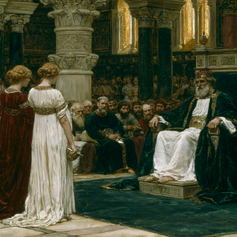
Source: Ancestralisme
During Saturnalia, Roman society, usually very hierarchical, experienced a special period of suspension of social norms. Slaves were temporarily freed from their obligations; they could even take a seat at their masters' table, in a symbolic role reversal. This festive break honored equity and reminded that earthly hierarchies were ultimately not immutable. The rituals took the form of lavish and alcohol-fueled banquets, gift exchanges, games, but also sex, with an atmosphere of freedom and collective joy that united all social classes. This type of festivity is also found among the Greeks in honor of Dionysus.
One of the highlights of Saturnalia was the election of a "king" or more precisely a "prince of Saturnalia." This character was chosen at random, thanks to... a bean hidden in a cake (or more rarely by a draw). In fact, before being ceramic, the bean was originally the legume (which kept the same name), to maintain the connection with the fertility of the coming harvests. It is this tradition that later gave birth to the Epiphany we know today.
The ultimate privilege, this king for a day, wearing a crown of holly or ivy, had the right to impose decisions (while remaining moderate of course): being served by his masters, forcing guests to drink in a specific order, etc. However, his role remained playful and temporary, like a joyful break from the usual constraints of daily life.
And you are probably wondering: but why do all this? This temporary reversal of social hierarchies offered Roman society a kind of "pressure valve" allowing the release of tensions inherent in the rigid structures of the time and preventing possible rebellions, a kind of social catharsis that was very avant-garde.
Saturnalia was also marked by an abundance of decorations and luminous symbols. The Romans decorated their homes with green branches, and torches lit the streets, symbolizing the triumph of light over the darkness of winter. It should be remembered that these celebrations take place in December, at the heart of the darkest period of the year.
2. Epiphany in Christianity
The Christian feast of Epiphany is celebrated on January 6 and commemorates the manifestation of Jesus to the Magi who came to worship him. The term "Epiphany" comes from the Greek epiphaneia, meaning "manifestation" or "appearance." In this context, it is the revelation of God incarnate in Jesus Christ to the pagan nations, represented by the Magi.

Source: Villages & Heritage
The Gospels describe these Magi as wise men from the East, guided by a star, who bring symbolic gifts to the child Jesus: gold, frankincense, and myrrh. Their visit emphasizes the universality of the Christian message, indicating that Jesus came for all peoples, beyond the Jewish context alone.
Over the centuries, the Church integrated and transformed certain pagan traditions to facilitate the acceptance of Christianity by local populations. The Roman Saturnalia were thus reinterpreted within the framework of Epiphany, emphasizing the divine light brought by the birth of Christ, and replacing the beans with figurines or religious icons.
3. The Symbolism of Epiphany
3.1. Light as a universal symbol
Light is an archetype present in many spiritual traditions, symbolizing truth, knowledge, and inner illumination. In the context of Epiphany, the star that guides the Magi to the child Jesus embodies this divine light that illuminates the path of the soul in search of truth. This star can be seen as a manifestation of higher consciousness, guiding the individual toward a deeper understanding of their own nature and connection to the divine.
3.2. The role of the Magi
The Magi, coming from the East, bring three gifts to the child Jesus:
-
Gold: symbol of royalty and solar light, gold represents the purity of the spirit and the quest for perfection. From an esoteric perspective, it embodies spiritual realization and illumination achieved through inner alchemy.
-
Frankincense: used in sacred rites, frankincense symbolizes prayer and connection with the divine. It represents the elevation of the soul toward spiritual realms, purification, and devotion.
-
Myrrh: associated with funerary rites, myrrh evokes mortality and human suffering. It also symbolizes transformation and spiritual rebirth, reminding that awareness of finitude is essential to inner evolution.
These three gifts reflect the fundamental aspects of human existence: the royalty of the spirit (gold), spirituality and prayer (frankincense), and the recognition of mortal condition (myrrh).
3.3. The number 3
The number 3 has spiritual significance, associated with the divine triad and the balance of forces. In Epiphany, the presence of the three Magi highlights this trinitarian symbolism. The number 3 represents the union of body, soul, and spirit, as well as the balance between the physical, mental, and spiritual aspects of being.