















































































































































































































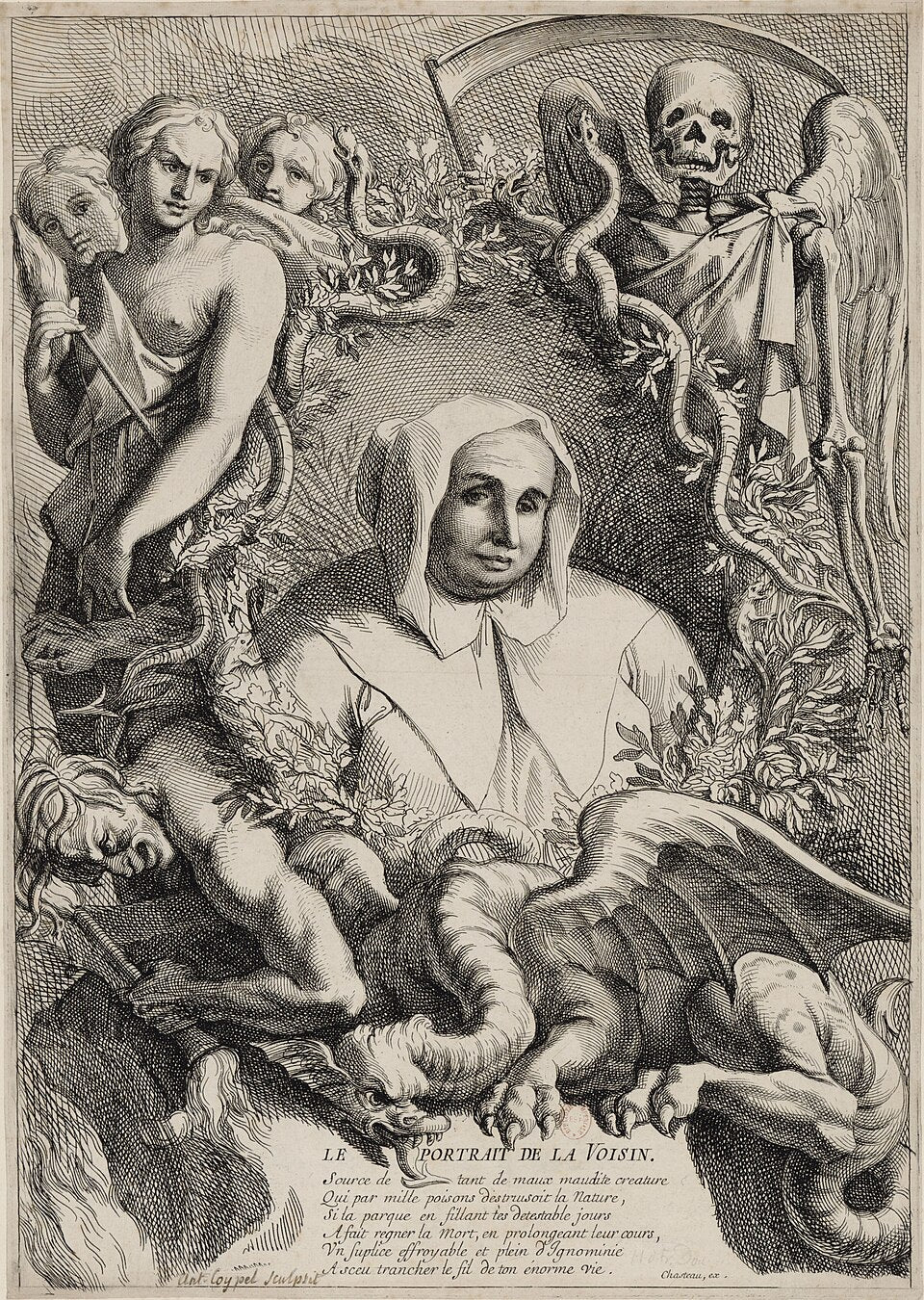
Catherine Deshayes, known as La Voisin, is one of the most famous figures in the Affair of the Poisons during the reign of Louis XIV. Born around 1640 and executed in Paris in 1680, she worked as a fortune-teller, palm reader, face reader, and supplier of preparations, while being accused of selling poisons and organizing magical operations for a clientele ranging from the popular classes to the high aristocracy.
Her legacy turned her into an almost legendary “witch,” surrounded by black masses, sacrifices, potions, and plots at Versailles. The judicial archives present a more complex picture. Some activities are well documented: palmistry, physiognomy, the sale of powders, participation in a poisoning network, and relationships with several fortune-tellers, midwives, and compromised priests. Other accounts are based on denunciations, interrogations, interested testimonies, or statements made after her death by her daughter and other accused individuals.
La Voisin can therefore be understood neither as an innocent victim transformed into a witch by the court nor as the demonic figure portrayed in sensational accounts. She belongs to a Parisian world in which divinatory consultations, empirical medicine, the trade in toxic substances, love magic, clandestine abortion, and crime could intersect within the same networks.
Catherine Deshayes, a poorly documented birth
Catherine Deshayes is born around 1640. The Bibliothèque nationale de France likewise places her birth around that date and her death in 1680. The details of her childhood remain very poorly known. The traditions attributing to her training in herbalism, alchemy, or family witchcraft practices therefore reach into this obscure period of her life, which the judicial archives illuminate only once she is already a renowned practitioner.
Nevertheless, during the interrogations she claims to have learned palmistry and physiognomy at a very young age. The records of the Affair of the Poisons show that these two practices occupied a genuine place in her activities. Catherine marries Antoine Monvoisin, whose name becomes the one under which she will be known.
The sources describe him as a jeweler or merchant. His business declines financially, and Catherine explains to investigators that she begins earning an income from palmistry when her husband can no longer support the household properly. The name “La Voisin” therefore derives from her married name, Monvoisin, in accordance with the common practice of the time.
Palmistry and physiognomy
Judicial archives clearly document La Voisin's palmistry and physiognomy. She read the lines of the hand and interpreted facial features. In 17th-century Paris, these practices lay at the boundary between divination, knowledge of the body, and the reading of character.
Cartomancy does not appear to have occupied the place in her practice that it would later hold among fortune-tellers in the following century. Sources on the Affair of the Poisons speak mainly of palmistry, physiognomy, recipes, powders, and magical operations. Our article Understanding Divination Through the Ages places these practices in their chronology.
La Voisin did not receive clients only from the lower classes. As her reputation grew, members of the bourgeoisie and then the aristocracy came to consult fortune-tellers to learn the future of a relationship, gain a romantic advantage, win back a lover, or drive away a rival.
A consultation could lead to the sale of powders, potions, talismans, or preparations intended to influence a situation. This transition from prediction to intervention is crucial. The client no longer asks only what will happen, but what they can do to obtain the desired outcome.
La Voisin received clients in the Villeneuve-sur-Gravois area, in the Bonne-Nouvelle district of Paris. Sources place her surroundings near what is now rue Beauregard. Her house became a meeting place for clients, distressed women, people seeking remedies, fortune-tellers, alchemists, compromised priests, and intermediaries.
Her financial success was substantial enough to allow her to maintain a household and organize receptions. This prosperity shows that fortune-telling and related services could be highly lucrative in Louis XIV's Paris.
Midwife and clandestine abortions
La Voisin was also involved in obstetric activities and clandestine abortions. The interrogations reveal several women working as midwives or intermediaries, notably Catherine Lepère. The spectacular figures attributing thousands of abortions or the burning of children's bodies in her garden to La Voisin should not be repeated as certain facts. These claims appear in hostile testimonies, and the investigation provided no accounting records to confirm a precise number.
It is therefore more serious to acknowledge the existence of clandestine abortion practices without turning sensational figures into established statistics. The same networks that sold love potions, remedies, and powders could also provide toxic substances.
Poison offered an obvious advantage to a 17th-century assassin: it could be administered from a distance, pass for an illness, and avoid direct confrontation. Arsenic would become known in popular memory as the “inheritance powder,” but the judicial files also mention other mineral and plant-based substances.
La Voisin was accused of acting as an intermediary and supplier for clients seeking to kill a spouse, a rival, or an inconvenient person. In La Voisin’s world, poison, charms, and diverted prayer could all form part of the same request.
A client might want to obtain someone’s love, strengthen an attachment, remove a rival, and then seek a more dangerous solution if the initial operations failed. The judicial files thus show a continuity between consultation, powder, conjuration, talisman, and crime. This continuity explains why the authorities simultaneously investigated poisoning, magic, abortion, blasphemy, and sacrilege.
A network, but not a perfect organization
La Voisin did not act alone. Marie Bosse, Marie Vigoureux, Catherine Trianon, Adam Lesage, several midwives, and several priests appear in the investigation. The term network is more accurate than that of a perfectly hierarchical organization. The participants exchanged clients, substances, information, and services. The proceedings held at the Arsenal Library show numerous confrontations between the accused, enabling investigators to gradually reconstruct their relationships.
The affair took on a new dimension in 1678-1679. Marie Bosse, another Parisian fortune-teller, boasted during a meal about the profits she made from poison. The information reached the men working for Nicolas de La Reynie, lieutenant general of police in Paris.
The police set a trap: a woman linked to the investigators posed as a wife wishing to poison her husband and obtained a substance. Marie Bosse was arrested on January 4, 1679. Her statements led investigators to several people, including Catherine Deshayes.
La Voisin was arrested on March 12, 1679. The French Ministry of Justice places her arrest on that date and recalls that the investigation led by La Reynie then uncovered a network far larger than the initial isolated cases.
An exceptional document held by the National Library of France bears Catherine Deshayes’s handwritten signature and the date March 12, 1679. Tradition has it that she was arrested after attending Mass at Notre-Dame-de-Bonne-Nouvelle. Gabriel Nicolas de La Reynie led the investigation, paying constant attention to contradictions in the witnesses’ testimony. The judicial files held at the Arsenal show interrogations, confrontations, seizures, orders, and successive statements.
This documentation makes it possible to move beyond pamphlets and fictionalized accounts. It also shows the difficulty of the case: several defendants lied, contradicted one another, sought to save their lives, or tried to compromise rivals.
The Chambre ardente
Given the scale of the scandal, a special commission was tasked with judging cases of poisoning and magic. It became known as the Chambre ardente. The Affair of the Poisons took place mainly between 1679 and 1682. The National Library of France preserves this period as a major judicial episode of the reign of Louis XIV. Historian Arlette Lebigre has shown the scale of the phenomenon: several hundred people were involved or mentioned over the course of the proceedings.
Popular accounts present La Voisin as the head of a perfectly structured criminal organization. This image is too neat. She did occupy a central position in several client networks and knew a large number of compromised individuals. But the archives point instead to overlapping groups, temporary complicity, and exchanged services rather than a formal hierarchy. Her reputation and network nevertheless explain why her arrest became one of the turning points of the affair. Several ecclesiastics appear in the files. Priests supplied consecrated hosts, recited formulas, took part in magical operations, or celebrated ceremonies that diverted elements of Catholic liturgy.
The most famous is Étienne Guibourg, an elderly priest whose statements become central to the construction of the "black masses" narrative. The archives clearly show compromised priests, sacrilegious ceremonies, and operations in which religion, magic, and transgression intertwine. Posterity would bring them together under the striking image of the "black mass," giving the affair a more clearly defined ritual coherence than the interrogations seem to suggest.
The term "black mass" has become inseparable from La Voisin. Testimonies collected after her arrest describe diverted masses celebrated with amorous or hostile intentions, as well as sacrilegious uses of the host and Catholic ritual.
The most extreme accounts speak of infants sacrificed during certain ceremonies. These accusations call for great caution. They stem in part from co-defendants subjected to judicial pressure and from testimonies collected in a climate where blasphemy and witchcraft themselves are crimes. It is therefore possible to establish the existence of sacrilegious operations involving several protagonists without presenting every sensational detail as a proven fact.
Madame de Montespan
The name that gives the affair its political dimension is that of Françoise-Athénaïs de Rochechouart de Mortemart, Marquise de Montespan, former favorite of Louis XIV. Several people arrested claimed that intermediaries connected to Madame de Montespan had turned to La Voisin and other members of the network.
The most serious accusations - black masses, requests targeting rivals, and attempted poisoning - appear mainly in statements made after La Voisin’s execution, particularly those of her daughter Marguerite Monvoisin and Abbé Guibourg. Anne Somerset notes that Madame de Montespan was never formally tried in this affair and that the actual extent of her involvement remains disputed.
The case was politically explosive. Madame de Montespan had been the king’s mistress and the mother of several of his children. Once the interrogations began implicating her, Louis XIV sought to limit the publicity given to accusations targeting his close circle. Some of the most sensitive papers were removed from the ordinary justice system, and the king would later order the destruction of certain compromising documents. Not everything disappeared, however: La Reynie’s notes and several judicial files survived.
The accusations of child sacrifice
Child sacrifices occupy a central place in the black legend of La Voisin. The archives contain accusations of infanticide and testimonies linking infants to ritual practices. But the records combine clandestine abortion, newborn deaths, accusations of sacrifice, and denunciations among suspects. The rigorous formulation is therefore to speak of accusations and testimonies, rather than present a precise number of sacrificed victims as a certain statistic.
No. The interrogations show an accused woman who acknowledged some activities and disputed others. She spoke of palmistry, physiognomy, clients, preparations, and relationships with several people in the network. She did not give the judges a complete confession matching the later account of a high priestess of a Satanic cult. After her death, her daughter and other detainees added several major accusations that had not been fully established during her own trial. Accounts of her final days are contradictory.
An authorization for “questioning” existed in the procedure, but La Reynie indicates that La Voisin did not undergo the extreme tortures attributed to her in some accounts. Madame de Sévigné, who reported her execution in a famous letter, describes a woman who was still very energetic on the day of her death.
It is therefore preferable not to repeat without qualification the image of prolonged torture that produced all her confessions. La Voisin was tried in February 1680. She was found guilty in connection with the poisoning affair and the witchcraft practices prosecuted by the Chambre ardente. The sentence imposed was burning at the stake.
This conviction was not that of a simple fortune-teller persecuted for trying to help. The judicial proceedings directly linked her to criminal activities and to a trade in substances intended to kill.
La Voisin was burned alive at the Place de Grève in Paris on February 22, 1680. Madame de Sévigné described her execution in a letter written to her daughter the following day. Her account emphasizes La Voisin’s refusal to cooperate with the confessor and her resistance until the stake. This letter is one of the accounts closest to the event, although it reflects Madame de Sévigné’s aristocratic and moral perspective.
Catherine Deshayes’s death did not put an end to the revelations. Her daughter, Marguerite Monvoisin, was questioned in turn. During the summer of 1680, she gave statements that linked Madame de Montespan more directly to her mother’s operations. Other defendants, notably Guibourg, provided accounts that converged on certain points.
These statements became so sensitive that they changed the way the king handled the affair. As the accusations reached the royal entourage, Louis XIV preferred to remove certain proceedings from public view. Some suspects were no longer brought before the Chambre ardente but were imprisoned by lettres de cachet. The Chamber was finally abolished in 1682.
That same year, a royal edict reinforced the campaign against fortune-tellers, poisoners, and practices classified as superstitious. Historical research reveals an important development here: the state increasingly tended to treat magic as fraud, superstition, or criminal activity when it was accompanied by other offenses.
Was La Voisin really a “witch”?
The word should be used with caution. La Voisin practiced divination, sold charms, and took part in operations described as magical. In this sense, she did belong to the world of occult specialists in 17th-century Paris.
But the word “witch” also carries all the imagery of the sabbath, the demonic pact, and organized worship of the Devil. La Voisin nevertheless exceeds this caricature: as a fortune-teller, supplier of preparations, intermediary, networked woman, and ritual practitioner, she belongs to a magical world far broader than the single figure of the poisoner.
The presence of prominent names in the interrogations explains the affair’s exceptional reach. Clients did not necessarily seek poison on their first visit. They came for a marriage, an affair, a favor, an inheritance, a rivalry, or a prediction. The consultation could then lead to more serious requests. The Affair of the Poisons thus reveals the circulation of occult services between working-class neighborhoods and court elites.
La Voisin’s Paris was home to astrologers, fortune-tellers, healers, alchemists, midwives, and sellers of charms. Demand came from people of every social background. The success of these activities does not mean that all of 17th-century society accepted their effectiveness. It shows that a significant portion of the public was willing to pay for information, protection, or intervention in an uncertain future. Our article Occultism, a History of France places this service market within a broader history.
Popular memory associates La Voisin with belladonna, arsenic, hemlock, and other dangerous substances. The records of the Affair of the Poisons do attest to a trade in toxic substances, but the precise recipes reported in later accounts are not all equally reliable.
It is also important to avoid turning “witches’ plants” into a coherent botanical category: some plants have a historical medicinal use, others are toxic, and several change effect depending on the dose. Our article on witches’ plants distinguishes history, folklore, and toxicity. Necromancy is regularly attributed to her in modern accounts. The legal sources document her much more clearly as a palm reader, physiognomist, and intermediary for ritual operations.
It would therefore be an exaggeration to make communication with the dead one of her main specialties. Our article on the history of necromancy helps distinguish this tradition from the vast range of magical practices of the early modern period.
Several engravings depict her around the time of her trial or in the following decades. One of the most famous portraits is attributed to Antoine Coypel and shows Catherine Deshayes at the center of a setting filled with symbols of death, crime, and witchcraft.
This image is not a neutral document of her appearance. It is an engraving of moral condemnation, produced in the context of her criminal reputation. Nevertheless, it remains an authentic document of how her public image was constructed at the end of the 17th century.
From Court Dossier to Legend
After 1680, La Voisin became a literary character. Nineteenth-century historians, novelists, theater, cinema, and television revisited the affair and amplified its most spectacular scenes.
The black mass, poisons, Madame de Montespan, and the stake form an almost perfect narrative for historical fiction. This popularity explains why some imaginary details eventually come to be repeated as facts.
Catherine Deshayes genuinely practiced a profitable divination business. She knew several people involved in selling poisons and other clandestine services. She was arrested on March 12, 1679, questioned as part of an exceptional proceeding, and then executed on February 22, 1680. The links between her network and people close to the court are well established.
What remains much more difficult to measure is the exact extent of the murders to which she contributed, the number of abortions, the veracity of each ritual account, and the precise degree of Madame de Montespan's involvement.
Sources and reference points
The Bibliothèque nationale de France classifies Catherine Voisin, born around 1640 and deceased in 1680, among the central figures of the Affair of the Poisons of 1679-1682. The BnF also preserves biographical files and autograph documents related to Catherine Deshayes.
The judicial manuscripts of the Bibliothèque de l’Arsenal preserve the interrogations and confrontations of 1679: La Voisin, Marie Bosse, Catherine Lepère, Catherine Trianon, and other suspects appear there directly.
The French Ministry of Justice traces the beginning of the investigation led by La Reynie, the arrest of Marie Bosse and then La Voisin on March 12, 1679, as well as the gradual discovery of a Parisian poisoning network.
Arlette Lebigre, L’Affaire des Poisons, 1679-1682, places the protagonists within the proceedings of the Chambre ardente rather than reducing the affair to accounts of black masses alone.
Anne Somerset, The Affair of the Poisons: Murder, Infanticide, and Satanism at the Court of Louis XIV, uses letters, archives, and earlier research to examine the accusations that reached the high aristocracy, notably Madame de Montespan.
Finally, the letter from Madame de Sévigné dated February 23, 1680 constitutes a major contemporary account of La Voisin's execution the previous day, on the Place de Grève.

Par Olivier of Aeternum
Passionate about esoteric traditions and the history of the occult from the earliest civilizations to the 18th century, I share some articles on these topics. I am also co-creator of the online esoteric shop Aeternum.













