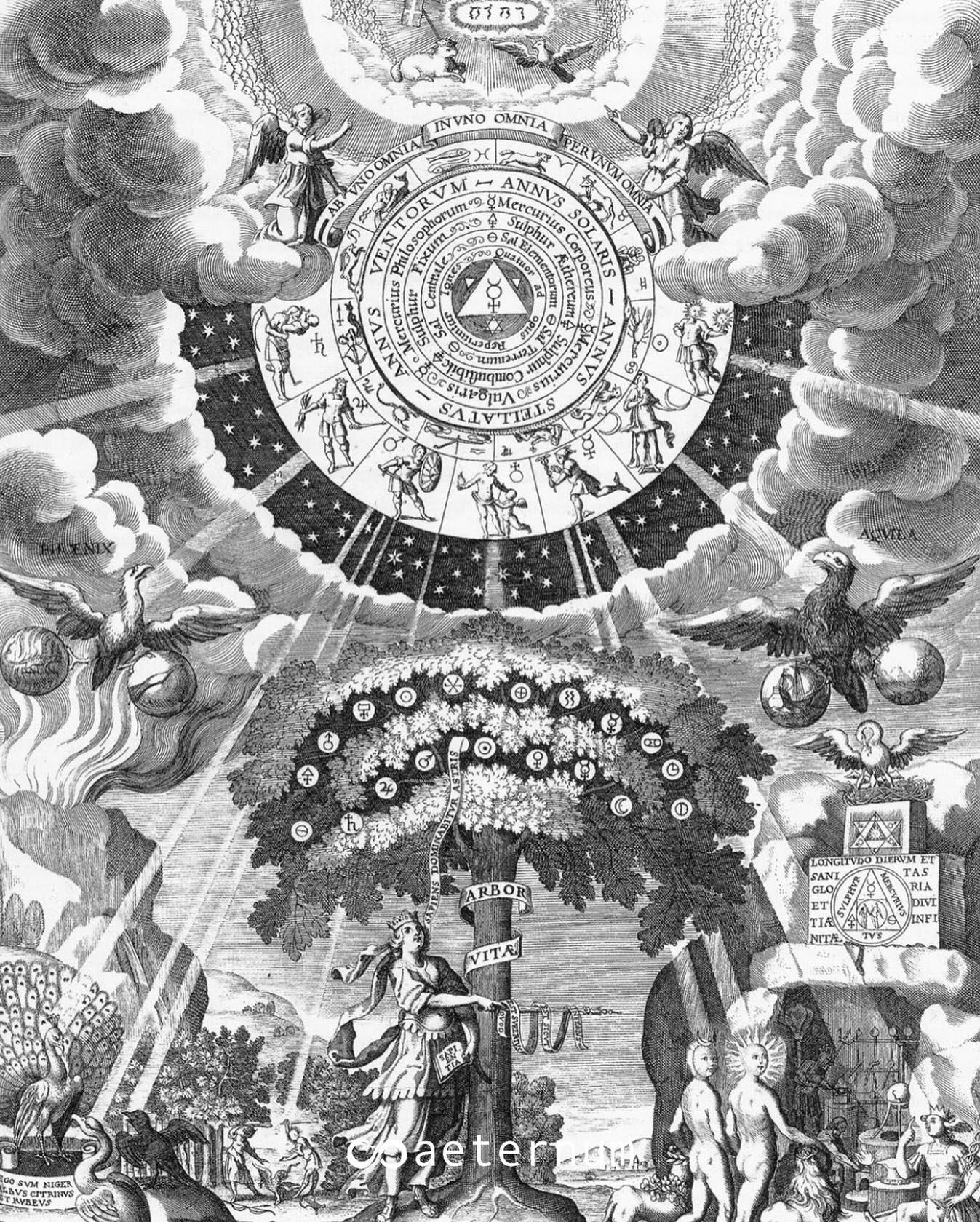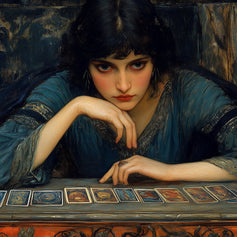




Occultism has long maintained a discreet but tenacious relationship with French haute couture. In France in particular, numerous fashion figures have been fascinated by astrology, witchcraft, and lucky talismans. Here is their story.
Mysticism at the French Court
As early as the Renaissance, the French nobility showed an interest in esotericism that already foreshadowed certain links between fashion and occultism. Catherine de’ Medici, Queen of France in the 16th century, regularly consulted astrologers and seers, including the famous Nostradamus, to guide her decisions. Nicknamed by some “the Black Queen” because of her reputation as a poisoner and an initiate of the occult arts, Catherine introduced an Italian fascination with astrology and alchemy to the court. Although her clothing choices mainly reflected Florentine artistic influence, her taste for predictions and talismans spread among the elite. A century later, under the reign of Louis XIV, this fascination took a darker turn with the Affair of the Poisons. This sensational scandal revealed that part of the aristocracy—despite being the epitome of refinement—was secretly engaging in black masses and making pacts with witches. The famous Marquise de Montespan, the Sun King’s favorite and an influential fashion figure of the time, was accused of taking part in satanic rituals to retain the king’s love. With the complicity of the witch La Voisin, she allegedly attended occult ceremonies involving sacrifices and demonic invocations. These revelations, though terrifying, show that at the height of power and good taste, the temptation of the supernatural was very real. In the decades that followed, the esoteric craze endured in more socially acceptable forms: during the Enlightenment, many French aristocrats joined Freemasonry and its lodges with codified rituals, where ceremonial dress and symbols—decorated aprons, embroidered stars, and eyes—were already creating a distinctive esoteric aesthetic. The late 18th century also saw mysterious figures such as the Comte de Cagliostro and Franz Mesmer pass through Paris, captivating high society with their occult sciences. In elegant salons, séances were held in which ladies and gentlemen in exquisite attire attempted to contact the afterlife around tables that spun on their own. Thus, long before the modern era of haute couture, occultism was part of the cultural landscape of the French elite, in the shadow of brocades and silks.
Esotericism in Vogue and Symbolist Inspirations during the Belle Époque
At the end of the 19th century, as the first great Parisian couturiers emerged, a powerful mystical current swept through the arts and literature. The Belle Époque became the scene of an occult revival: Theosophical societies, spiritualist circles, Rosicrucian orders, and other hermetic groups attracted intellectuals and socialites. This esoteric climate also permeated the era’s aesthetic. Fashion designers—still working within emerging couture houses—drew on this enthusiasm to enrich their creations. From its beginnings, haute couture has known how to incorporate the allure of esotericism, reusing its symbols and imagery in prestigious pieces. In 1892, writer Joséphin Péladan organized the Salon de la Rose+Croix in Paris, exhibiting Symbolist works steeped in occultism, where female participants wore airy dresses reminiscent of ritual garments. Orientalism, highly fashionable at the time, also brought its share of mystical references: Egyptian, Persian, and Hindu motifs—associated with occult knowledge—adorned textiles and jewelry. After the opening of the Suez Canal in 1869, Empress Eugénie launched the fashion for Oriental-themed evenings, where guests wore costumes inspired by ancient Egypt. These sumptuous celebrations, offering an opportunity to display extravagant outfits, blurred the boundaries between costume, fashion, and esotericism—the fascination with pharaohs and their secrets merging with high society’s desire for exoticism. Around 1900, the sun itself became a fashion motif: the famous actress Sarah Bernhardt, passionate about occultism, posed in mage costumes and mystical allegories, inspiring stage outfits and accessories such as sun- or moon-shaped pendants. Fashion thus subtly drew from the spiritual atmosphere of the time: zodiac motifs, stars, and amulets became elegant ornaments, appearing on everything from fans to brooches. This period also saw the rise of lucky jewelry among the great jewelry houses: four-leaf clovers, horseshoes, and gold scarabs set with gemstones answered the wealthy clientele’s need for protection. The Belle Époque therefore established a first explicit bridge between the prevailing esotericism and the world of luxury clothing: appearance became a messenger for hidden symbols, and the pursuit of beauty joined the search for occult meaning.


Inspired and Superstitious Couturiers
At the beginning of the 20th century, occultism continued to attract designers and clients, but it manifested itself in a more artistic and playful manner. The Roaring Twenties saw the triumph of Coco Chanel and Elsa Schiaparelli, two brilliant couturiers whose legendary rivalry was accompanied by a pronounced interest in lucky charms and astral symbolism. Gabrielle “Coco” Chanel, notoriously superstitious, surrounded herself with talismans and even crystal balls. Born under the sign of Leo—the fifth sign of the zodiac—she made this animal a true signature: lion sculptures adorned her Paris apartment, and the feline motif appeared regularly in Chanel jewelry and buttons. Her lucky number, 5, directly inspired the name of her famous perfume Chanel N°5, launched in 1921—the fifth sample selected out of superstition—and later that of the 2.55 bag, launched in February 1955. Chanel saw signs everywhere: she attributed a protective function to camellias and wore them constantly, convinced that these white flowers kept evil spirits away, in keeping with Buddhist tradition. Her great rival, Elsa Schiaparelli, meanwhile, had a genuine passion for astrology and the occult. Bold and imaginative, Schiaparelli was one of the first designers to give her collections a theme, readily drawing from mystical imagery. Her Haute Couture collection for winter 1938–1939, titled Astrology, remains a landmark of the genre. Its most emblematic piece is the famous Zodiac Jacket: a midnight-blue velvet evening jacket embroidered with constellations, planets, and sparkling stars by the Lesage house. Twelve glyphs representing the astrological signs line the chest, while the constellation of Ursa Major shines on the left shoulder, chosen by Schiaparelli as her personal lucky charm. The inspiration behind it is touching: as a child, Elsa admired her astronomer uncle Giovanni Schiaparelli, who pointed out that the beauty marks on her cheek formed the shape of the Great Bear. From then on, the couturier considered this constellation her protective sign, incorporated it into her logo, and reproduced it in her most intimate creations. Beyond the zodiac, Schiaparelli collaborated with Surrealist artists—Salvador Dalí and Leonor Fini—and incorporated a wealth of dreamlike and occult imagery into her dresses and accessories: embroidered eyes on fabrics, lucky hands in jewelry, and alchemical symbols concealed in prints. Her perfume Shocking (1937) was presented in a bottle shaped like a woman’s bust, inspired by Mae West’s silhouette, but adorned with a dressmaker’s measuring-tape necklace evoking a magical fashion ritual. During the 1920s and 1930s, fashion readily entered into dialogue with mysticism: the Surrealist movement, fascinated by dreams and irrationality, encouraged the use of mysterious symbols. Fashion magazines of the period did not hesitate to stage models posing as modern priestesses or Pythias of Delphi, dressed in flowing veils and starry crowns. This decade thus saw French haute couture weave an imaginary world blending chic and magic, under the guidance of legendary personalities whose meaningful eccentricities shaped the era.
The Golden Age of Couture: Rituals, Stars, and Talismans of the Great Couturiers
After the Second World War, Paris reclaimed its status as fashion capital, and the great couturiers of the era—Christian Dior, Yves Saint Laurent, Christian Lacroix, and others—continued the tradition of personal superstition and occultism. Christian Dior, in particular, was renowned for his extreme superstition and unwavering faith in divinatory arts. Before opening his couture house in 1946, Dior consulted a fortune-teller who predicted that he would “succeed through women”—a prophecy that marked him for life. Indeed, this shy couturier became the magician who elevated the feminine silhouette with the New Look. But he did nothing without consulting his personal card reader, Madame Delahaye, who was present backstage to choose the dates of his shows or even the right moment to change the arrangement of a bouquet of flowers. Pierre Cardin, who worked at Dior, later stated: “Without her, he did nothing. Nothing, nothing, nothing.” Dior filled his life and work with protective symbols: he founded his house on October 8, 1946, in the 8th arrondissement, seeing a sign in the repeated number 8, which he considered auspicious. Intriguingly, he also liked the number 13—usually shunned—to the point of always sending 13 models down the runway for each collection, so that it would bring him luck. Before every presentation, he slipped a sprig of lily of the valley into the lining of his creations, the quintessential French good-luck flower. He carried a veritable collection of lucky charms: a metal star he had picked up in the street in 1946, which he interpreted as destiny’s green light to launch his house; a four-leaf clover; a silver heart given to him by his sister; a piece of wood to touch to ward off bad luck; and more. These rituals coexisted with the modern luxury of his collections, as if to better court fortune. Even Dior’s favorite flower, lily of the valley, inspired the perfume Miss Dior, which he used to scent his showrooms, convinced that the lucky fragrance would contribute to his success. The past proved him wrong only once: in 1957, going against his fortune-teller’s advice not to travel, Dior went to a health retreat in Italy—where he died suddenly of a heart attack at the age of 52, leading those close to him to say that he had ignored his written destiny.
Dior was not alone in looking to the stars for inspiration. His young protégé and unofficial successor, Yves Saint Laurent, also cultivated a taste for the irrational. The “prince of fashion,” although rational in his art, regularly consulted fortune-tellers and read cards to reassure himself in the face of collection-related stress. He even attributed mystical powers to his dog, Moujik: if the bulldog settled on a fabric or sketch, Yves saw it as a sign of future commercial success. In 1976, Saint Laurent went so far as to create a collection with cosmic accents titled Opéra – Les Ballets russes, saturated with mysterious colors and Byzantine ornamentation, which caused a sensation. Other emblematic figures also displayed esoteric quirks. Christian Lacroix, the Provençal couturier of the 1980s, accumulated so many lucky charms that “he could no longer fit them all in his pockets,” he joked. Fascinated by the number three and its multiples, he arranged to present 36 or 63 silhouettes per show, a cabalistic practice followed by many of his peers. From a clover embroidered on a lining to star-shaped earrings, Lacroix scattered his collections with lucky winks, hoping destiny’s benevolence would rub off on his clients. Karl Lagerfeld, Chanel’s artistic director for more than 35 years, once confided that a prophetess had foretold his late success: “For you, success will begin when it is over for everyone else,” she allegedly predicted in his youth—a prediction fulfilled, he said, since Lagerfeld did not become an icon until after Chanel’s death. He later sprinkled Chanel shows with astrological symbols—a 2018 Métiers d’Art collection dedicated to the zodiac—and lucky camellias, perpetuating Mademoiselle’s obsession. Esotericism became almost an unofficial code of the atelier: people avoided sewing on a button made of a certain metal on Friday the 13th, and never placed a black veil on a mannequin on the eve of a presentation, for fear of attracting misfortune.
The Witch’s Grand Return
At the dawn of the 21st century, occultism appeared on the runways more than ever—not secretly anymore, but as a genuine aesthetic and cultural movement. In the 1990s, the Gothic trend and interest in the New Age entered fashion. Avant-garde couturiers, sometimes from abroad but influential in Paris, staged the occult spectacularly. This was the case with British designer Alexander McQueen—trained at Givenchy in Paris—who, in 2007, drew a blood-red pentagram on the floor of his runway show as a tribute to the witches of Salem, with his models moving like enchantresses across this powerful symbol. France also has its own leading figure in this field. Paco Rabanne, the “enfant terrible” of Parisian couture, embodies the most extreme example of this fascination. A visionary in fashion, known for his futuristic metal dresses of the 1960s, Paco Rabanne was also an avowed esotericist. Throughout his career, he provoked and dazzled in equal measure by revealing his mystical beliefs. In 1999, he made headlines by predicting nothing less than the apocalypse in Paris on August 11, the day of a solar eclipse, imagining the Mir space station crashing into the capital. Although the prophecy did not come true, it left a lasting impression and drew attention to the designer’s occult world. Paco Rabanne even published his visions in a book (1999, le feu du ciel), describing himself as a medium familiar with prophecies of the future. He also publicly revealed his belief in reincarnation, claiming to have lived several colorful past lives: a high priest in ancient Egypt who plotted the assassination of Tutankhamun, then a prostitute at the court of Louis XV, among others. “My earliest memories go back 78,000 years,” he declared seriously, adding that he had been visited by divine entities and even extraterrestrials over the course of his existence. These extravagant statements, mocked by some, also helped shape the couturier’s almost shamanic aura, while his bold creations—blending metal, plastic, and futurism—took on the retrospective appearance of a galactic mage’s robes.
Today, the younger generation of designers is once again embracing esoteric imagery, from a feminist or playful perspective. Maria Grazia Chiuri, Dior’s artistic director since 2016, has made exploring tarot and witchcraft a recurring theme in her collections. For her first show—Dior Spring–Summer 2017—she drew directly on Monsieur Dior’s fondness for astrology: tulle dresses embroidered with sparkling constellations and tarot-card motifs were combined with tailored suits in an atmosphere that was both romantic and mystical. In 2021, when the pandemic prevented public runway shows, Chiuri designed a Dior haute couture collection devoted entirely to the arcana of the Tarot, unveiled in a dreamlike short film titled Le Château du Tarot. The same theme has continued more recently: Dior’s Spring 2024 collection centered on the figure of the witch throughout history—women once persecuted whom Chiuri reinterprets as symbols of emancipation. “It’s the idea of transformation,” she explains, taking Joan of Arc, Medea, and the bewitched women of Arthur Miller’s The Crucible as her muses. The show, resembling a glamorous sabbath, featured cabalistic inscriptions and austere silhouettes recalling the witches of Salem. Other French houses have shown a similar enthusiasm: the Schiaparelli house, revived in 2014, fully embraces Elsa’s esoteric legacy. Under the artistic direction of Daniel Roseberry, it multiplies references to the stars and myths: recent collections have featured the return of giant evil-eye brooches, trompe-l’œil golden skeletons—a nod to the surrealist skeleton dress of 1938—and silhouettes topped with horns or halos. Fascinated by mystery, Roseberry says he draws inspiration from “the mystical universe that inspired Schia” to create pieces filled with magical winks. Esoteric accessories have also made their way into luxury ready-to-wear: Chanel continues to play with the lion motif—its high-jewelry collection Under the Sign of Leo—and regularly offers zodiac jewelry in tribute to Mademoiselle. Saint Laurent—now under Italian leadership but still a Parisian house—has launched jewelry and sweaters featuring astrological signs, appealing to a clientele devoted to horoscopes.
Thus, haute couture, the supreme art of staging oneself, has always flirted with the invisible in order to magnify the visible. Ultimately, occultism and fashion share the same power of fascination: the power to re-enchant everyday life.