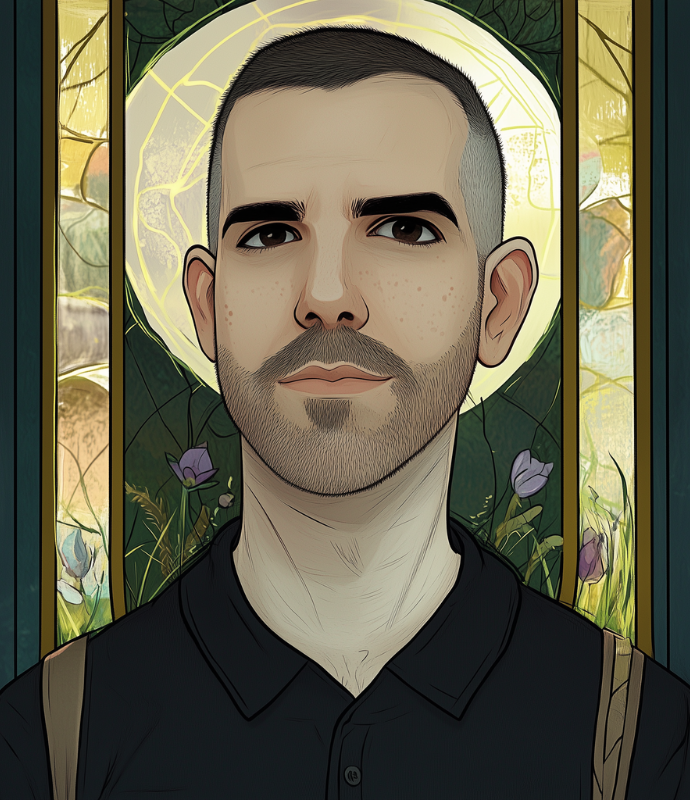
Nostradamus, a figure you have likely heard of at least once for his predictions that have resonated even in our modern era. But did you know he was a doctor before he was a prophet? That he developed a remedy against the plague? Or even that his collection was one of the first best-sellers of his time? Portrait.
1. The youth of Michel de Nostredame
First fact: Nostradamus is a pseudonym; his real name was Michel de Nostredame. He was born on December 14, 1503, in Saint-Rémy-de-Provence, in southern France. He was the eldest of five siblings in a family of Jewish merchants who had converted to Catholicism (which is why their family name became De Nostredame). His maternal grandfather, Jean de Saint-Rémy, was a renowned doctor and scholar who introduced young Michel to the basics of science and languages, including Latin, Greek, and Hebrew.
At the age of 14, Nostradamus left Saint-Rémy-de-Provence for Avignon, where he studied the arts. He then attended the University of Montpellier, one of the most renowned medical institutions of the time, where he deepened his knowledge of medicine. His training was interrupted by the plague epidemic ravaging Europe at that time. Nostradamus left the university to care for the sick and gain practical experience as a traveling doctor. He eventually earned his medical degree in 1529 and returned to Montpellier to teach.
2. Nostradamus, the doctor
When Nostradamus began practicing medicine, Europe was frequently struck by waves of bubonic plague (after the Black Death epidemic of the 14th century). Nostradamus gained a reputation for his innovative treatment methods and pragmatic approach to disease management.

Rather than following the conventional treatments of the time, which often included bloodletting and remedies based on superstitions, Nostradamus advocated strict hygiene measures. He encouraged his patients to wash regularly and drink clean water. He also prescribed herbal remedies and specific diets to strengthen the immune system.
Nostradamus also contributed to the evolution of medical practice through his observations and treatments. He used medicinal herbs, infusions, and specific mixtures to treat the symptoms of the plague. His advanced understanding of the disease and its modes of transmission allowed him to save many lives at a time when medicine was still largely empirical and rudimentary.
In addition to his medical practice, Nostradamus left an important written legacy through several works. One of his most notable books is the Treatise on Cosmetics and Preserves, published in 1555, which contains recipes for cosmetics, preserves (understood as methods of conservation), and medicinal remedies. This treatise demonstrates his expertise in pharmacology and practical medicine, with advice on the preparation and use of various substances to treat diseases and improve health.
For example, he proposed a preparation made from cloves to be applied on the body to protect against the plague during treatment.
3. The tragedy that changed his life
In 1531, Nostradamus married a woman whose name remains unknown in some sources, although others name her Henriette d'Encausse. They had two children. However, his family life was marked by tragedy when his wife and children died of the plague in 1534.
After the death of his family, Nostradamus spent several years traveling across France and possibly Italy, continuing to practice medicine and deepen his knowledge of astrology and occult sciences. In 1547, he remarried Anne Ponsarde, a wealthy widow from Salon-de-Provence, with whom he had six children. This period marked a turning point in his life, as he began to focus more on astrology and prophecies.
4. Nostradamus, the astrologer
Nostradamus created detailed horoscopes to interpret the movements of celestial bodies and their influences on earthly events. He firmly believed that the positions of planets and stars at the time of someone's birth could reveal information about their destiny. These horoscopes served as the foundation for many individual prophecies.

To better understand his method, one must trace back Nostradamus's family tree: his family comes from the tribe of Issachar, one of the twelve tribes of Israel, descending from Jacob and his wife Leah. In the Bible, Issachar is described as a hardworking and scholarly tribe, renowned for its wisdom and knowledge of the times. Its members were considered experts in astrology and time calculation, which gave them a special role in making important decisions for the community.
Judicial astrology, which concerns the prediction of future events on a global or national scale, was another technique used by Nostradamus. By studying planetary alignments, eclipses, and other celestial phenomena, he sought to foresee major trends and upheavals to come, sometimes several centuries in advance.
5. Nostradamus, the prophet
It is as a prophet that Nostradamus wrote the work that would mark the world. The Centuries are a collection of 942 quatrains (four-line poems) organized into ten groups called "centuries," although some centuries do not contain exactly 100 quatrains. First published in 1555, these prophecies are written in cryptic language, mixing French, Latin, Greek, and sometimes even regional dialects. The structure of these quatrains is deliberately vague and ambiguous, allowing for various interpretations over the centuries.
6. Nostradamus's famous predictions
Although their interpretation has never been proven and they are not all accurate, some quatrains raise questions due to their disturbing coincidence.
His most famous prediction, which earned him his entire reputation, is the death of Henri II, then king of France:
"The young lion will overcome the old,
In battlefield by singular duel,
In the golden cage his eyes will be pierced,
Two classes one, then die, cruel death."

And indeed, Henri II was wounded in the eye during a tournament in Paris and died from his injuries a few days later. If we analyze the quatrain below in detail, it is even more disturbing:
| The young lion will overcome the old | This line is interpreted as describing a duel between a young lion and an old lion, symbolizing King Henri II (the old lion) and his opponent, Gabriel de Montgomery (the young lion), during a tournament |
| In battlefield by singular duel | It refers to the tournament (battlefield) where the duel (singular duel) took place |
| In the golden cage his eyes will be pierced | Henri II wore a golden helmet (golden cage) during the tournament. Montgomery's lance pierced the helmet's visor and wounded Henri II in the eye |
| Two classes one, then die, cruel death | The two men (two classes) clashed, and the king succumbed to a painful death after ten days of agony |
Not to mention his other quatrains that have echoed in historical events:
|
The French Revolution (1789-1799) |
"From the homeland of the deceased, they will appear, The spirit of death from tongues will begin again, The new government, of great renown, Of sacred orders, ruined, pursued, driven out of court." |
|
The Rise of Napoleon Bonaparte (1769-1821) |
"An emperor will be born near 'Italy, Who will be sold dearly to the empire, They will say with which people he allies, Who will be found less prince than butcher." |
| The Great Fire of London (1666) |
"The blood of the just in London will cause fault, Burned by lightning twenty-three the six, The ancient lady will fall from a high place, Many of the same sect will be killed." |
|
The Rise of Adolf Hitler (1889-1945) |
"From the 'west of 'Europe, a young child will be born, Who by his language will seduce a great troop, His renown will grow toward the kingdom of 'Orient, The wild beasts of hunger will drag rivers." |
7. An end of life... and a final prophecy
Nostradamus saw his health deteriorate in the last years of his life. He suffered from severe arthritic pain and gout, which greatly affected his mobility and quality of life. In 1566, his condition worsened with the appearance of congestive edema, a fluid buildup in the body that increased his suffering. These health problems led to a rapid decline in his overall condition.
According to legend, Nostradamus predicted his own death. It is said that he told his secretary, Jean-Aimé de Chavigny, "You will not find me alive at sunrise." True to his prophecy, he died during the night of July 1st to 2nd, 1566, in his house in Salon-de-Provence. The next morning, he was found dead by his servants, thus confirming his prediction.

Nostradamus was buried in the Cordeliers church in Salon-de-Provence. His tomb has attracted many visitors over the years and has been moved several times, especially during the French Revolution, to protect it from destruction.
But his true prediction, true or not, was during one of the relocations of his remains. When his skeleton was discovered by the National Guard, it is said that he was holding a copper plate inscribed with the date his tomb would be opened...
Additional source: Geo