



Summary...
|
1. Alchemical Origins |
In this article, I propose to introduce you to Homunculi, also called Homunculus (Latin word meaning "little being"), by exploring their origins and how they have been perceived and used throughout history, mainly in the alchemical context. Homunculi, although often relegated to fantasy tales, have their roots in alchemy. Even if they may seem frightening, I find this subject fascinating for those interested in this practice.
1. Alchemical Origins
One of the most influential alchemists who wrote about Homunculi was Paracelsus, a Renaissance physician and alchemist. In his works, he details procedures for creating a homunculus, involving the incubation of a specific mixture of human semen, hair, blood, and various chemical substances, placed in a glass vessel to simulate an artificial womb. After a 40-day gestation, a Homunculus would thus come to life.
In his own words: "Human semen is left to rot in a sealed vessel subjected for forty days to biological temperature — until a movement is perceptible. At that moment, the substance will have taken on a vaguely human form but will be transparent and without a body. At this stage, it must be fed for forty weeks with the Arcanum of human blood. After which, it will develop into a true child possessing all its limbs, simply smaller than a normal child."
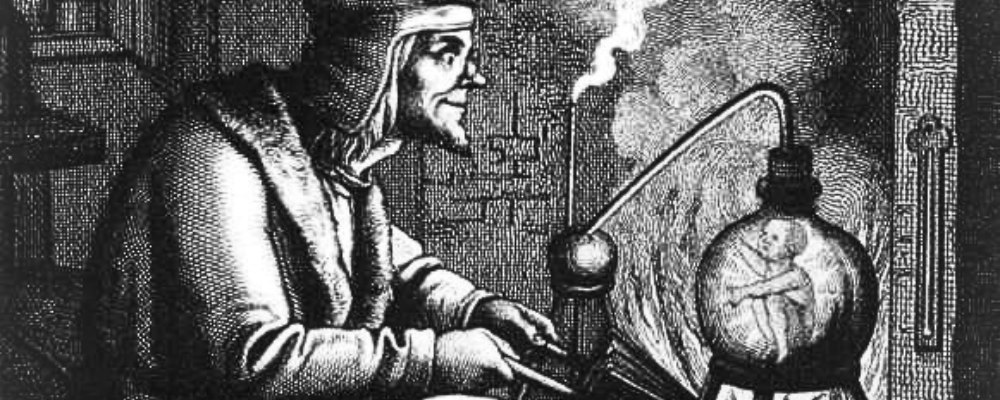
For alchemists, homunculi represented the pinnacle of manipulating prima materia, namely the possibility of creating life from the inanimate. This endeavor was seen not only as a scientific triumph but also as a spiritual quest, seeking to imitate divine creative power.
Thus, through this living being born of transmutation, alchemists could access fundamental laws and answers to all the mysteries of life, matter, and the whole in its entirety. Before being a being or a creature, the Homunculus was therefore seen as a tool.
2. Description of a Homunculus
Physically, a Homunculus is often depicted as a small humanoid being, although its precise features can vary greatly depending on alchemical texts. Sometimes, they are described with grotesque, disproportionate traits, perhaps reflecting the inherent imperfections of their artificial creation. It is also described as hermaphroditic, capable of reproducing itself, similar to the Philosopher's Stone. Other times, they seem almost perfect, tiny replicas of humans, evoking the ideal of alchemical mastery over the natural and supernatural.
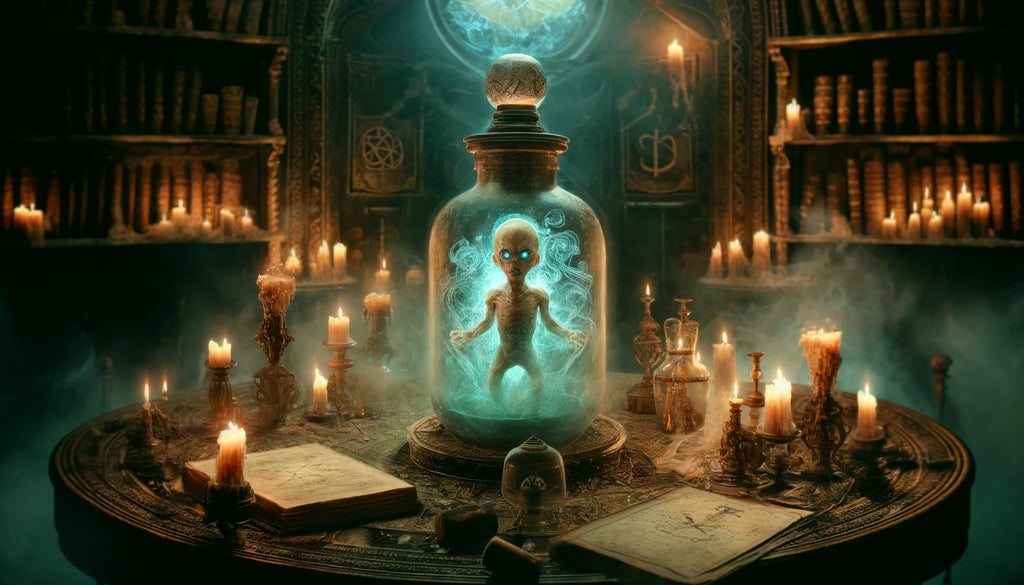
The roles assigned to homunculi are as varied as their appearance. In some stories, they serve as faithful assistants to alchemists, performing tasks, guarding alchemical secrets, or acting as protectors of esoteric knowledge. There can thus be many "variants" of a Homunculus depending on how it was created: it can represent matter in transmutation but can also have specific roles.
There are few accounts of the life and use of a Homunculus. However, according to Joseph Kammerer's testimony in his Book of Accounts from 1890, Count Jean-Ferdinand Kueffstein created ten homunculi in 1773 in Calabria: a king, a queen, an architect, a monk, a miner, a nun, a seraph, a knight, as well as a blue spirit and a red spirit. Moreover, Paracelsus also describes his homunculus as a little king holding his scepter and dressed in a red toga.
3. Is a Homunculus a Living Being?
The creation of a homunculus immediately raises the question of the soul: does an artificially created being possess a soul? And if so, what is its origin? In alchemical traditions, the answer is not simple. Some texts suggest that homunculi are animated not by a human soul but by a captured or created spirit, a kind of vital essence different from the traditional human soul. Others suggest that the soul of a homunculus could be a reflection or emanation of its creator's soul.
Linked to the question of the soul is that of identity: a homunculus, although possessing human traits and intellectual abilities, is it therefore human? This question engages a philosophical debate about what constitutes the essence of humanity. Is it biology, intellect, the capacity to feel emotions, or something more intrinsic and ineffable? Homunculi, as "synthetic" creatures, defy traditional categorizations and force us to reconsider the boundaries of human identity.
Indeed, alchemists perceived matter not as an inert substrate but as a dynamic entity, imbued with potential and vital force. This conception is at the heart of their transformative endeavor, whether it be the transmutation of metals or the creation of life through Homunculi. Matter, in alchemical thought, was a puzzle to decode, and every element, every substance, contained a spirit or essence that could be released or transformed. This holistic approach rejects sharp divisions between the physical and the spiritual, suggesting that everything in the universe is interconnected and interdependent.
4. Homunculi and the Preformation Theory
The Homunculus is at the center of the preformation theory, which came later, according to which the living being is actually already formed either in the sperm or in the egg.
The preformation theory partly arose as a response to the mysteries of reproduction and embryonic development. It proposed that each individual was fully formed from a tiny but complete homunculus located in the sperm or egg, which simply grows larger during gestation. This view replaced older ideas of spontaneous generation and suggested a divine order and design, each life already "written" in the tiny homunculus.
Philosophically, the preformation theory and the idea of the homunculus reflect worldviews where life and its origin are considered intrinsically mysterious but ordered and predestined. Scientifically, although these ideas were later refuted by discoveries in developmental biology and genetics, they served as a bridge between ancient magical or mystical conceptions of life creation and the more empirical and experimental approaches that emerged later.
5. The Foundations of Biotechnology?
I attempt to venture into the field of science. The historical quest to create homunculi, artificially shaped beings, offers a striking parallel with the advances in biotechnology we know today.
Ultimately, isn't alchemy a primitive precursor to modern biotechnology? Alchemists, in their desire to manipulate and transform living matter, used techniques that, although rudimentary and empirical, foreshadow our current experiments in genetics. For example, the methods described by Paracelsus to create homunculi strangely resemble some embryonic manipulation and tissue culture techniques we use today.
Modern cloning and genetic engineering, just like the alchemical creation of Homunculi, involve manipulating life at a very fundamental level. Cloning, which consists of creating a genetically identical copy of an organism, and genetic engineering, which allows modifying an organism's DNA to give it new properties, reflect the same desire for control and transformation of life expressed by alchemists through their Homunculi. However, while alchemists sought spiritual or transcendental answers, our current motivations tend to be more pragmatic, focused on medical, agricultural, or industrial applications.
Thus ends my portrait of Homunculi. And yes, alchemy still holds many surprises for us!
[bloctwist]