



|
IN SUMMARY...
1. The Origins of the Sacred Circle |
Since the dawn of time, drawing a circle around oneself has been an instinctive, almost universal gesture. To protect oneself, focus, or mark a sacred space, the magic circle has never lost its symbolic power. It is a space where the visible and invisible meet, where ordinary time no longer exists. But why this particular shape? What are its true roles? Exploration.
1. The Origins of the Sacred Circle
Long before the invention of writing, ancient peoples erected circular monuments. The stone circles scattered across Europe – such as Stonehenge in England – required colossal efforts, proof that the figure of the circle held major ritual significance. Their mystery remains intact, but it is certain that this veneration was passed down to later cultures, as the symbol of the circle seems universal. In these early open-air sanctuaries, the circle appears to mark an extraordinary space, conducive to communion with the powers of nature and the cosmos.
 Stonehenge, one of the most famous prehistoric stone circles
The oldest written traces of magic circles lead us to Mesopotamia. The Sumerians practiced the zisurrû, literally “magic circle drawn with flour.” Encircling a space with flour or salt served to purify it and protect it from evil. Already, more than four thousand years ago, circles were drawn on the ground to guard against harmful forces. A Sumerian text even describes the ritual: the magician scattered ground grains all around the sacred area to counter threats, turning this powder circle into a beneficial barrier. Further north, the Assyrians continued this practice. They called the protective circle uṣurtu (“ring”) and drew it with lime or a mixture of water and flour, substances offered to local deities. Once drawn, the circle was consecrated by a solemn incantation designating it as a “barrier that no one can cross, barrier of the gods that no one can break.” In these ancient civilizations, the two essential functions of the magic circle are already visible: to contain the summoned energies and to repel any evil influence outside.
Elsewhere, other peoples independently discovered the symbolic power of the circle. In ancient India, a famous episode from the Ramayana (dated around the 5th century BCE) tells how a circle drawn around a woman protected her from a demon – until she stepped out and was immediately taken by the evil spirit. This story illustrates the same idea: the circle drawn on the ground creates an invisible boundary that supernatural forces cannot cross. An echo of this concept is found in Jewish tradition: the legend of Honi, “the circle drawer,” tells of a 1st-century BCE sage who drew a circle around himself to pray to God to send rain, pledging not to leave it until his request was granted. Drawing the circle was also creating a privileged space for negotiation between human and divine. Thus, whether in Mesopotamian temples, Indian myths, or Near Eastern tales, the circle appears from Antiquity as a ritual tool full of symbolism: it defines a protected inside, separated from the uncertain outside.
2. Conjuration Circles in the Middle Ages
In the Middle Ages, as esotericism took on Christian hues, the magic circle remained at the heart of occult practices. Medieval grimoires – these manuscripts of learned magic – abound with mysterious circles and cabalistic diagrams. The magician is instructed to draw a circle around himself before calling a spirit. Thus, in the Heptameron, a 16th-century magic treatise, it is written that “the greatest power is attributed to circles; they are true fortresses protecting the operator from evil spirits.” The practitioner inscribed divine names, sacred symbols, and invocations around the circle’s perimeter, creating an invisible wall reinforced by faith and sacred geometry. Outside the circle, a triangle or another space could be drawn to manifest the summoned presence – a way to contain the invoked entity so it could not reach the officiant. One can easily imagine the scene: the mage, armed with chalk or sword, slowly describing a perfect circle on the stones while whispering prayers in Latin, then standing at the center of this makeshift sanctuary to safely call angels or demons.

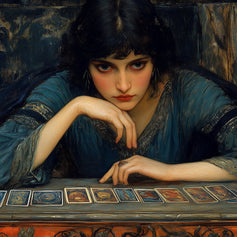
Magicianess drawing a blazing circle around her ritual fire (painting, 1886)
This vision of the conjuration circle was not limited to isolated scholars. It permeated popular culture and the fears of the Middle Ages. In villages, it was said that witches drew circles in clearings for their nocturnal sabbaths, or that they drew powder circles at crossroads to cast curses. A British folklore chronicle reports that an old witch, offended by her neighbor, drew a circle across the path the neighbor took every morning and cast a spell on it. Simply stepping on this cursed circle was said to bring bad luck to the victim. While some claimed one had to stay outside the circle where the spell was trapped to avoid its effects, most traditions agreed that the sorcerer protected himself by remaining inside the circle, leaving the curse outside. In any case, the circle drawn with chalk, charcoal, or even the blood of a sacrificial animal was a recurring ingredient in witchcraft stories. It materialized the boundary between the profane world and the enchanted space of the ritual, onto which everyone projected their fears or hopes: divine protection for some, diabolical pact for others. The magic circle of the Middle Ages, whether a symbol of piety or witchcraft, actually extended a much older heritage adapted to Christian imagination. It testified to a constant: faced with the unknown, man draws a circle around himself to feel safe in the universe.
3. The Circle in Modern Magical Practices
After centuries of secrecy, magical knowledge about the circle experienced a revival in the modern era. At the end of the 19th century, European occultists – such as those of the Hermetic Order of the Golden Dawn – rehabilitated these ancient rituals. They taught a new generation how to “take the circle,” that is, create a purified ritual space before any magical operation. This tradition found a particularly strong echo in Wicca in the 20th century. Wicca, a neo-pagan movement based on European witchcraft practices, places the circle at the center of its ceremonies. Before any ritual, Wiccan practitioners draw a magic circle to create a sacred space, separate from the profane world. Inside this circle, they invoke the elements at the four cardinal points – air to the east, fire to the south, water to the west, and earth to the north – thus erecting a temporary temple to commune with the divine. The Wiccan circle, usually drawn with a dagger (the athame) or simply visualized, serves both as a shield and a crucible: a shield isolating from outside influences, and a crucible in which spiritual energy is concentrated and then directed toward the ritual’s intention. Leaving the circle without caution breaks this force field, which is why covens (groups of witches and wizards) learn to “open the door” of the circle and then close it to enter and exit without dissipating its power.

Far from the woods of Europe, the use of the circle is also found in Afro-American magical traditions. Hoodoo, an esoteric practice born from the syncretism between African cultures and the New World, illustrates this continuity well. One of its simplest rituals consists of writing a prayer or wish in a circle on paper – called a circle petition. By writing without lifting the pen until forming a perfect round, the practitioner symbolically “traps” their request in a circle of energy, ready to be released into the universe to manifest. Moreover, some Hoodoo witchcraft recipes literally use a circle drawn on the ground. A custom of African origin involves placing magical powders in patterns – a circle – on the path of the targeted person, then “activating” the trap by spitting on it. When the enemy steps on this circle, the spell triggers and they are “poisoned at the feet”, victim of a curse that will bring bad luck and illness. Through Hoodoo, we see how African slaves deported to America preserved and adapted the ancient power of the circle: it is no longer a place where the officiant protects themselves, but a hidden trap set for another. Nevertheless, the principle remains close to that of European grimoires – using a circular drawing to concentrate a magical intention, whether to heal or to bewitch.

Finally, it should be noted that the figure of the magic circle goes beyond the strict framework of Western witchcraft or occultism. It appears, sometimes in very different forms, in other contemporary spiritual practices. The drum circles of shamans, where participants and musicians form a rhythmic ring to enter trance, stem from the same intuition: creating a circular space to channel collective energy. Likewise, in some neo-shamanic or modern Wicca rituals, people dance in a circle around a fire or a Maypole at Beltane to celebrate unity with nature. Even healing or talking circles, where everyone speaks in turn, remind us that the circle confers a form of sacred equality and promotes the harmonious flow of speech or energy among participants. In Afro-Caribbean churches or during voodoo ceremonies, it is also common to see worshippers move in a circle around a sacred central point, thus continuing the tradition of the protective and communal circle. These modern practices testify to one thing: the magic circle, far from being an archaic relic, remains a living and polymorphic tool, reinvented according to cultural contexts but always charged with intense spiritual aura.
4. A Universal and Timeless Symbol
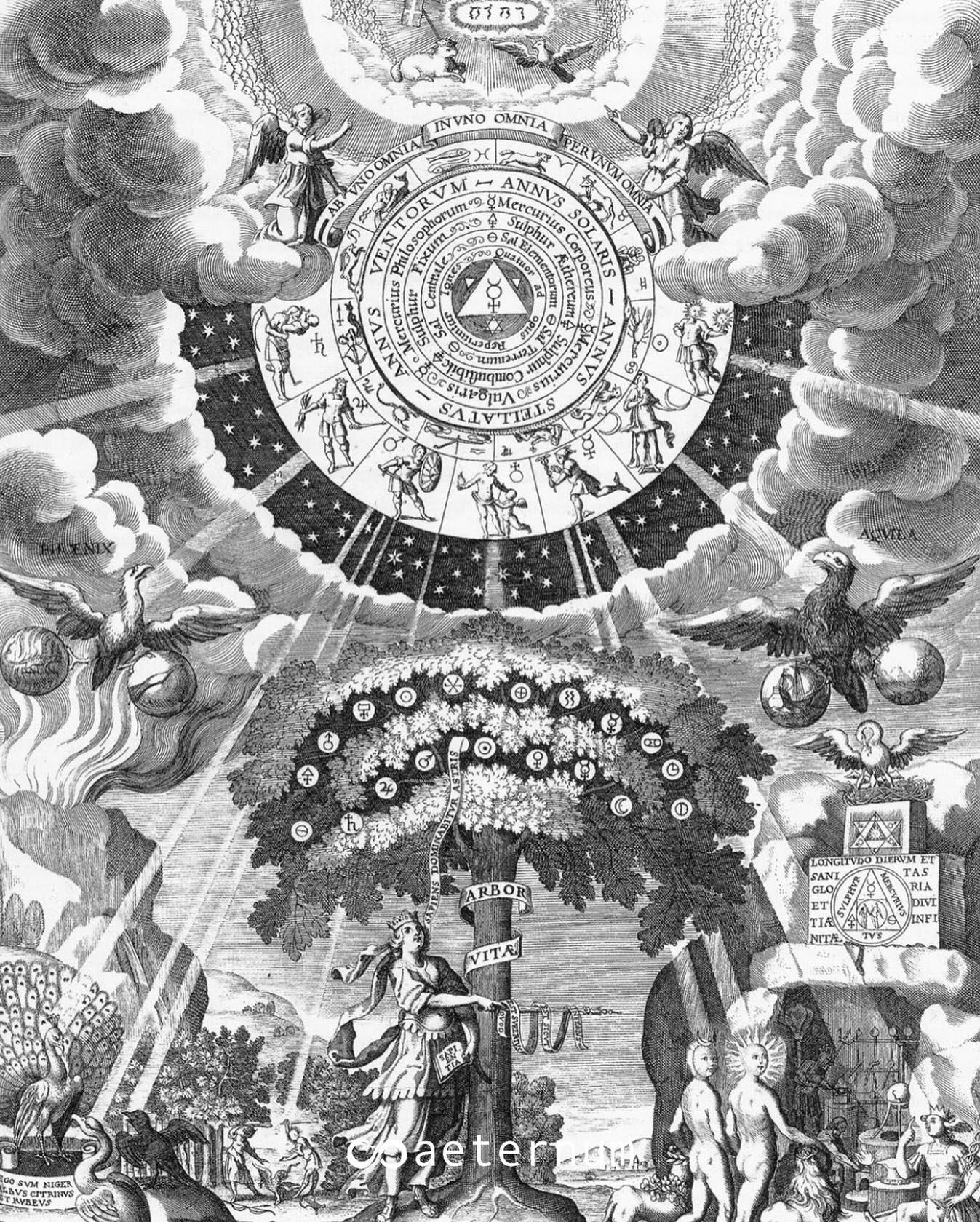
At the end of this journey through history and continents, the circle emerges as a universal symbol of magic and the sacred. Carved in stone, drawn in dust, or simply imagined by the mind, it answers the same human need: to delimit a cosmos within chaos, a reassuring order in the face of the world’s mysteries. By encircling a space, the practitioner defines a “world in miniature” of which they become the temporary master, like ancient astrologers drawing the circular zodiac to understand destiny. The circle unites opposites: it is both opening and closing, protection and invitation. Protection, because it repels external disorder – whether medieval demons or feared negative energies today. Invitation, because inside its borders, anything becomes possible: invoking a deity, communing with nature spirits, projecting a wish dear to the heart.
If the circle fascinates so much, it is probably because it evokes the infinite cycles of life and time. The Ouroboros serpent (the symbol of our Aeternum esoteric shop) biting its tail to form a circle – an alchemical symbol of eternity – is a beautiful illustration. The mandalas of Asia, those meditative circular diagrams, are another: by contemplating a mandala, the Hindu or Buddhist adept immerses themselves in a sacred space reflecting the order of the universe, just as the Western mage stands at the center of their circle seeking cosmic harmony. Through all these variations, one discerns the same spiritual thread. The magic circle separates the sacred from the profane, yes, but ultimately it mainly serves as a bridge between the two. It creates a place where man can dialogue with the invisible, connect to something greater than himself. From the prehistoric shaman to today’s neo-pagans, drawing a circle on the ground or in the mind is to declare entering a time outside time and a space outside space, where ordinary rules are suspended. It is a simple gesture in appearance – turning around oneself while sowing a continuous line – but whose symbolic scope resonates powerfully through the ages. The magic circle remains the silent guardian of mysteries, the faithful ally of anyone seeking to invoke protection, knowledge, or transformation. Ultimately, the circle continues to encircle magic itself, defining and protecting it in the same infinite movement. That is what makes this shape more powerful than any other.
Sources:
-
Jake Stratton-Kent (occult historian), cited in Geosophia (2010) – on the function of the circle as an intentional ritual space.
-
Heptameron (Pseudo-Peter of Abano, 1565) – importance of the circle as a protective “fortress” for the mage.
-
Wikipedia Encyclopedia – Magic circle, sections on definition and historical uses (Sumer, Judaism, Wicca).
-
Seo Helrune Blog – Why Circles are Awesome… (2017), Stephen Skinner’s research on circles in India (Ramayana) and Assyria.
-
Lucky Mojo (Catherine Yronwode) – Crossing and Foot-track Magic in Hoodoo, explanation of powder circle drawings to cast bad luck spells.
-
Dartmoor Legends (Ruth St. Leger-Gordon), cited by Tim Sandles (2016) – on prehistoric stone circles and their reuse by local witches over time.