





























































































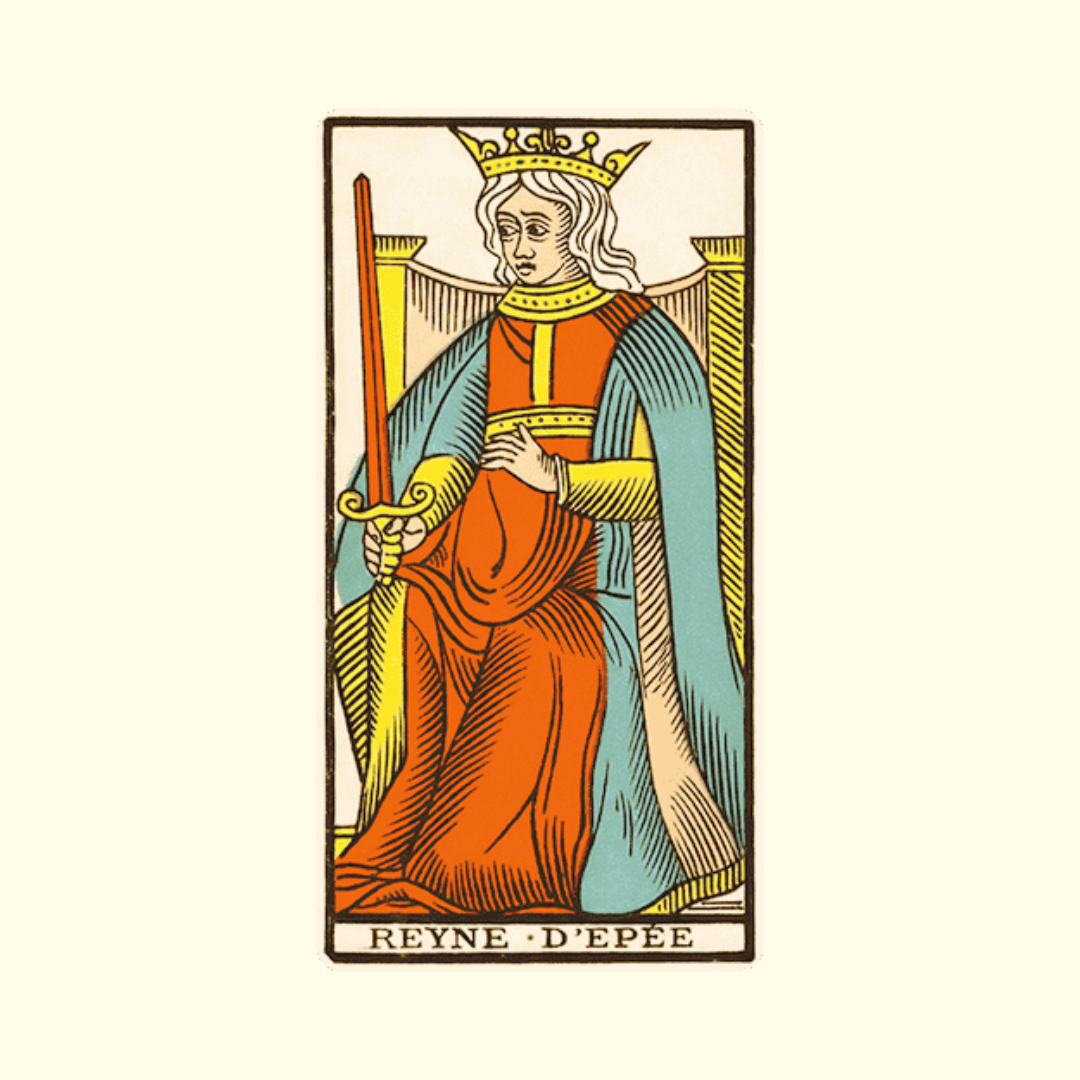

The Queen raises the sword and extends her other hand. In the Tarot de Marseille, she belongs to the court of the weapons and holds the blade with the authority of her rank. In the Waite-Smith, her stern face appears marked by sorrow, while her left hand opens before her. The Queen of Swords judges from the experience of separation: she knows what must be named, cut away, or protected, but her clarity loses its value when it becomes prejudice, cruelty, or suspicion.
Modern commentaries present this Queen as an independent woman who would always choose reason over emotion. The sources say nothing so simple. Mathers and Waite emphasize widowhood, absence, loss, and separation. The Golden Dawn highlights perception, keen observation, confidence, and perseverance. Her discernment therefore does not come from an absence of feeling: it was formed through contact with sorrow.
A court card may represent a person, a role, or a way of acting. The Queen does not necessarily indicate a woman, a widow, or someone of a particular age. She may show that a decision calls for a clear statement, a necessary boundary, or the perspective of someone who already knows the cost of a rupture.
From the armed sovereign to the outstretched hand
In French tarot decks, the Queen is seated, crowned, and richly dressed. She holds the sword as the emblem of her suit. The position of the blade, gaze, and hands varies by workshop, but the card remains a figure of rank without a narrative landscape. Nothing requires us to attribute coldness, widowhood, or solitude to her from the image alone.
Smith depicts a seated sovereign in profile beneath a sky filled with clouds. Her right hand raises the sword, while her left extends forward, palm open. Winged motifs adorn her crown and throne. Waite describes a stern face, shaped by adversity, that knows sorrow. He specifies that the figure does not embody mercy and that the weapon alone is not enough to make her a symbol of power.
Iconographic reference. The outstretched hand, the profile, the sky, and the pronounced expression belong to the Waite-Smith. The Marseille Queen already carries the sword, but without a narrative of mourning. The reading of separation comes from 19th-century divinatory catalogs, not from a hidden scene in the French card.
Divinatory transmission
In The Tarot of 1888, Mathers assigns widowhood, loss, deprivation, absence, and separation to the Queen of Swords. Reversed, she becomes a wicked, irritable, and intolerant woman, then associates wealth with discord, abundance with anxiety, and joy with sorrow. He adds that the card should not be read in isolation and that it may describe the person represented by a neighboring card.
Mathers also reproduces an older way of making the Queen an omen of the loss of a spouse. A responsible reading preserves this document as historical evidence without announcing a death. The card may speak of absence, mourning, celibacy, rupture, or deprivation, but none of these situations should be imposed on the person seeking guidance.
Book T calls her the “Queen of the Thrones of Air” and assigns her Water of Air. A crowned sovereign holds a sword and a severed head above gray clouds. The text describes her as highly perceptive, subtle, quick, self-assured, persistent, and attentive, but above all exact in matters of appearance. Poorly surrounded, she becomes cruel, cunning, deceptive, and unreliable beneath a beautiful exterior. Her domain extends from the 20th degree of Virgo to the 20th degree of Libra.
Waite includes widowhood, sadness, absence, mourning, deprivation, and separation, then adds embarrassment and sterility. This last notion belongs to his divinatory vocabulary and permits no medical or family-related conclusion. Reversed, the Queen receives malice, intolerance, artifice, prudery, misfortune, and deception. The card therefore requires distinguishing rigor, pain, and the desire to cause harm.
Meaning in a spread
In a favorable reading
The Queen of Swords brings speech informed by experience. She may show someone who acknowledges grief without letting it decide everything, sets a clear boundary, or expresses a difficult truth with restraint. Her open hand reminds us that firmness can still listen to a response.
It favors reviewing a case, stepping back after a separation, defending autonomy, or making a decision that ends ambiguity. Her authority is expressed less through rank than through the ability to name exactly what has been lost, what remains, and what will no longer be accepted.
In a tension reading
Pain turns into harshness, discernment into suspicion, and a boundary into condemnation. Someone uses their experience as proof that they are always right, judges before listening, or protects themselves with words that humiliate. The card may also describe a reputation for coldness imposed on someone who is simply refusing a request.
The Queen proves neither malice nor deception. Nor does she announce widowhood, infertility, or solitude. Look for the facts, the nature of the loss, and the purpose of the boundary being set. A fair boundary protects without inventing fault in the other person.
Love, work, and finances
The Queen brings separation, perception, and clear speech. The area indicates what she must distinguish, while the neighboring cards show whether the boundary protects or punishes.
| Area | Favorable reading | Face of tension | Question to ask |
|---|---|---|---|
| Love | Relationship clarified, autonomy respected, honest speech after an ordeal. | Punitive distance, judgment of the partner, old wound applied to the current relationship. | Does the boundary respond to a present fact or to past pain? |
| Work | Clear-sighted decision, demanding review, person in charge capable of saying no. | Dry criticism, intolerance of mistakes, authority based on fear. | Does the judgment set out understandable criteria? |
| Finances | Clear separation of accounts, refusal of a poorly defined commitment, review after a loss. | Decision dictated by fear, deprivation imposed without necessity, suspicion without documentation. | What figure or clause justifies the decision? |
| Social life | End of a harmful relationship, confidentiality protected, speech freed from ambiguity. | Isolation, reputation attacked, group judged as a whole after a disappointment. | Who is actually affected by the breakup? |
| Decision | Difficult choice accepted, withdrawal from what clouds judgment. | Conclusion reached too soon, harshness mistaken for lucidity. | What response remains possible after the decision? |
Reading associations
The Queen distinguishes, separates, and formulates. The associated card shows what her sword protects, what her hand can still receive, and how experience influences her judgment.
| Association | Possible dynamic | Point of caution |
|---|---|---|
| Queen of Swords + Justice | Reasoned decision, regulated separation, words placed within a legal framework or contract. | An exact rule can still be applied harshly. |
| Queen of Swords + Three of Swords | Pain acknowledged and put into words, lucidity gained after a breakup. | The wound risks becoming the sole criterion of judgment. |
| Queen of Swords + Queen of Cups | Balance between emotional listening and a clear boundary. | Avoid assigning the roles of sensitive person and cold person. |
| Queen of Swords + Hermit | Thoughtful withdrawal, independent advice, patient examination after a loss. | Solitude can harden a conclusion not confronted with the facts. |
| Queen of Swords + Seven of Swords | Strategy examined, secret questioned, information carefully sifted. | Suspend the accusation until concealment is established. |
| Queen of Swords + Star | Clear speech that makes rebuilding possible after sorrow. | Hope does not require abolishing the boundaries already established. |
Correspondences according to the schools
The old table brought together Saturn, autumn, amethyst, sage, and Vav. None of these elements constitutes the common historical attribution of the Queen of Swords. The Golden Dawn assigns her Water of Air and a zodiacal area extending from Virgo to Libra.
| Reference | Attribution | Historical scope |
|---|---|---|
| Suit | Minor Arcana, court figure, Queen of Swords | Rank found in French tarot decks. |
| Marseille Tarot | Crowned sovereign holding a sword | Court figure with no imposed mourning scene. |
| Mathers, 1888 | Widowhood, loss, deprivation, absence, separation | Reversed: irritable character, intolerance, discord mixed with abundance. |
| Golden Dawn | Queen of the Thrones of Air, Water of Air | Title and elemental formula from Book T. |
| Element | Air for the color; Water of Air for the figure | English occult attributions. |
| Astrology | From the 20th degree of Virgo to the 20th degree of Libra | Zodiacal domain of the figure in Book T. |
| Waite-Smith | Profiled queen, upright sword, left hand extended, clouded sky | Composition published in 1909. |
| Hebrew letter | No letter specific to the card | Vav belongs to the Hierophant in the Golden Dawn system. |
| Stone, plant, season | No common historical consensus | Amethyst, sage, and autumn do not come from the cited sources. |
| Reading keywords | Separation, perception, boundary, experience, clear speech, mourning | Context distinguishes discernment, protection, and harshness. |
Reading advice
First ask what experience speaks through the Queen. Has she already experienced a comparable rupture, does she possess a skill, or is she projecting an old grief onto the situation? Then name the boundary in a sentence that describes an expected action, without defining the whole person.
Also observe the open hand. What response, evidence, or correction could still be received? If no response is admitted, judgment may have become condemnation. The Queen of Swords can close a necessary door; she is more accurate when she knows which one and why.
Sources and reference texts
For the history of decks and figures: Victoria and Albert Museum, A History of Tarot Cards; British Museum, reproduction of Nicolas Conver’s Tarot of Marseille.
For divinatory and occult texts: S. L. MacGregor Mathers, The Tarot, 1888, card meanings; Liber LXXVIII, “The Queen of the Thrones of Air,” publication of material from Book T; Arthur Edward Waite and Pamela Colman Smith, The Pictorial Key to the Tarot, Queen of Swords, 1911.