




























































































The Knight carries the sword on the road. In French tarots, he advances on horseback as a court figure, armed and mobile, without taking on the turmoil of the English landscape. In the Waite-Smith, the horse surges beneath trees bent by the wind, while the rider brandishes his blade forward. The Knight of Swords puts thought into action: dexterity, courage, and promptness can defend a cause, but the same speed becomes domination, recklessness, or war when the goal and the limit disappear.
Reducing this card to speed and determination strips it of its difficulty. Mathers sees a soldier, dexterity, and promptness in it. The Golden Dawn describes an active, intelligent, and courageous figure, but one inclined to dominate and exaggerate minor matters. Waite brings together bravery, ability, and defense with enmity, anger, war, destruction, and resistance.
The Knight therefore does not announce that the action will succeed. It shows a force in motion, an offensive argument, urgency, defense, or confrontation. The reading must establish the mission, the opponent, the acceptable speed, and the human or material cost of the charge.
From the courtly knight to the charge beneath the wind
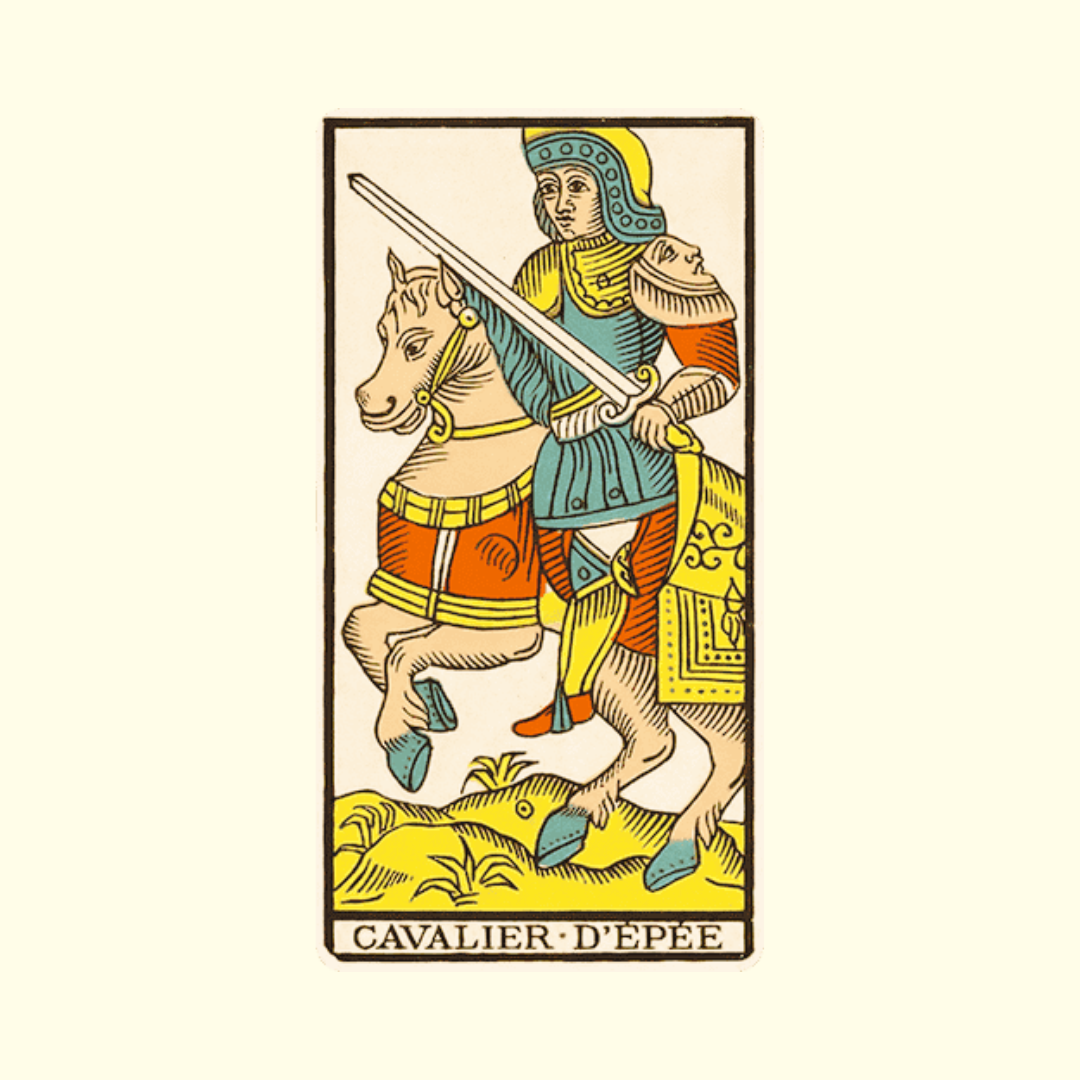
In a Tarot de Marseille, the Knight of Swords rides a richly harnessed horse and holds his weapon. The posture, direction of travel, and costume details vary according to the model. The figure belongs to a court hierarchy and primarily signals mobility, armed service, and rank. Windblown blades, torn clouds, and violent momentum are not present as a fixed narrative.
Smith transforms movement into a charge. The white horse leaps, the rider leans forward, and raises his sword. Clouds race across the sky and the trees bend. Waite compares the figure to a hero of romantic chivalry, almost a Galahad whose weapon would be swift and sure thanks to the uprightness of his heart. Yet he also adds war, opposition, destruction, and ruin to the list.
Iconographic reference. The furious charge and the wind-swept landscape belong to the Waite-Smith. The Marseilles knight may appear mobile without being hasty. In both decks, the weapon and the movement pose the same question: what cause justifies the intervention, and who risks being struck along the way?
Divinatory transmission
In 1888, Mathers describes a soldier or a man whose profession is connected with weapons. He adds skill, ability, dexterity, and promptness. Reversed, it indicates senseless vanity, ingenuity, and simplicity. This list combines a social function with a way of acting. In a contemporary reading, the card can represent anyone tasked with defending, challenging, intervening, or deciding quickly.
Book T calls him “Lord of the Winds and Breezes” and “King of the Spirits of Air.” A winged warrior rides beneath dark clouds. The text describes him as active, intelligent, subtle, ardent, courageous, and skillful, but inclined to dominate and attach too much importance to small things. Poorly surrounded, he becomes deceptive, tyrannical, and cunning. His formula is Fire of Air, and his zodiacal domain extends from the 20th degree of Taurus to the 20th degree of Gemini.
Waite attributes skill, bravery, ability, defense, and dexterity to the Knight, but also enmity, anger, war, destruction, opposition, resistance, and ruin. He accepts death as a possible meaning only alongside other cards he considers ominous. Reversed, the card becomes imprudence, incapacity, and extravagance. Its lesson lies in this proximity between courage and devastation.
Meaning in a spread
In a favorable reading
The Knight makes it possible to intervene quickly when an objective and a rule are clear. It favors a well-reasoned defense, a response to a crisis, an energetic negotiation, or a decision that can no longer wait. The mind cuts through the nonessential, states the disagreement, and puts itself at the service of action.
Bravery does not consist of charging ahead without restraint. The card becomes constructive when the person knows their mandate, accepts contradiction, and plans a way to slow down. The charge then serves to open a path or protect, not to prove superiority.
In a reading of tension
Speed becomes haste, skill becomes attack, and defense turns into a personal war. Someone responds before reading, treats every disagreement as a threat, exaggerates a detail, or imposes their pace on the group. The Knight may still show a brilliant intervention that wins the exchange and destroys the relationship needed for what follows.
This card authorizes neither violence nor putting anyone in danger. In a situation involving real conflict, prioritize safety, evidence, mediation, and appropriate recourse. Tarot can help examine a strategy; it never decides on an action that exposes others to harm.
Love, work, and finances
The Knight introduces speed, confrontation, and the ability to intervene. The spread seeks the point where momentum still serves the goal, before it becomes collateral damage.
| Area | Favorable reading | Tension aspect | Question to ask |
|---|---|---|---|
| Love | Frank conversation, defense of the bond, quick decision in the face of a clear boundary. | Cutting words, ultimatum, conflict treated as a battle to win. | Are you seeking a solution or a victory over the other person? |
| Work | Crisis management, solid argument, urgent mission carried out competently. | Imposed decision, rivalry, team exhausted by a relentless pace. | What mandate authorizes the intervention, and who can call for it to stop? |
| Finances | Rapid response to an error, firm negotiation, verified precautionary measure. | A purchase or sale made under pressure, a risk taken to avoid losing face. | What minimum verification must precede the action? |
| Social life | Defense of an attacked person, contradiction expressed directly. | Escalation, public humiliation, group divided by an excessive response. | Does the response protect you, or add another adversary? |
| Decision | A deliberate choice, an obstacle faced, a short deadline met methodically. | Haste, magnified detail, lack of a fallback plan. | What signal will require you to slow down or change course? |
Reading associations
The Knight sets neighboring cards in motion and into confrontation. They indicate the cause being defended, the framework of the action, and the consequence of speed.
| Association | Possible dynamic | Point of caution |
|---|---|---|
| Knight of Swords + Justice | Defense, appeal, decision, or argument submitted to a rule. | Firmness must remain proportionate and grounded in evidence. |
| Knight of Swords + Chariot | Rapid advance, focused determination, operation conducted without detour. | Plan for a brake, a route, and a limit to your power. |
| Knight of Swords + Five of Swords | Charge into a conflict where winning may cost the relationship or reputation. | Assess the damage before the next attack. |
| Knight of Swords + Temperance | Regulated momentum, lively but contained negotiation, mediation that maintains its pace. | Do not confuse moderation with giving up the right to defend yourself. |
| Knight of Swords + Tower | Brutal intervention in an already unstable structure. | Prioritize safety and damage limitation. |
| Knight of Swords + Page of Swords | Information quickly converted into action or response. | Check the data before launching the charge. |
Correspondences according to the schools
Jupiter, autumn, sapphire, chestnut, and He appeared in the old chart without belonging to a common lineage. The Golden Dawn assigns Fire of Air and a zodiacal zone ranging from Taurus to Gemini. Mathers and Waite emphasize dexterity, defense, and the dangers of confrontation.
| Reference | Attribution | Historical scope |
|---|---|---|
| Suit | Minor Arcana, court figure, Knight of Swords | Mobile rank in the 78-card tarot. |
| Tarot of Marseilles | Mounted knight holding a sword | Court figure without an imposed narrative storm. |
| Mathers, 1888 | Soldier, skill, ability, dexterity, promptness | Reversed: senseless vanity, ingenuity, simplicity. |
| Golden Dawn | Lord of the Winds and the Breezes, Fire of Air | Title and elemental formula from Book T. |
| Element | Air for the suit; Fire of Air for the figure | English occultist attributions. |
| Astrology | From the 20th degree of Taurus to the 20th degree of Gemini | The figure’s zodiacal domain in Book T, not an isolated planet. |
| Waite-Smith | Charging knight, raised sword, white horse, clouds, and bent trees | Scene published in 1909. |
| Hebrew letter | No letter specific to the card | He belongs to the Emperor in the Golden Dawn system. |
| Stone, plant, season | No shared historical agreement | Sapphire, chestnut, and autumn do not come from the cited sources. |
| Reading keywords | Intervention, speed, defense, courage, opposition, domination | The purpose and consequences determine the value of the charge. |
Reading advice
Prepare the charge in four sentences: the objective, the mandate, the limit, and the stop signal. Then ask who is in the path. An action may be right in principle and wrong because of its pace, tone, or lack of a fallback route.
In a discussion, state the desired outcome before the argument. In an emergency, retain a minimal verification and name the person capable of challenging the decision. The Knight gives force to movement; it is up to the reader not to confuse speed with truth.
Sources and reference texts
For the history of decks and figures: Victoria and Albert Museum, A History of Tarot Cards; British Museum, reproduction of Nicolas Conver’s Tarot of Marseille.
For divinatory and occult texts: S. L. MacGregor Mathers, The Tarot, 1888, card meanings; Liber LXXVIII, “The Lord of the Winds and the Breezes,” publication of material from Book T; Arthur Edward Waite and Pamela Colman Smith, The Pictorial Key to the Tarot, Knight of Swords, 1911.