

















































































































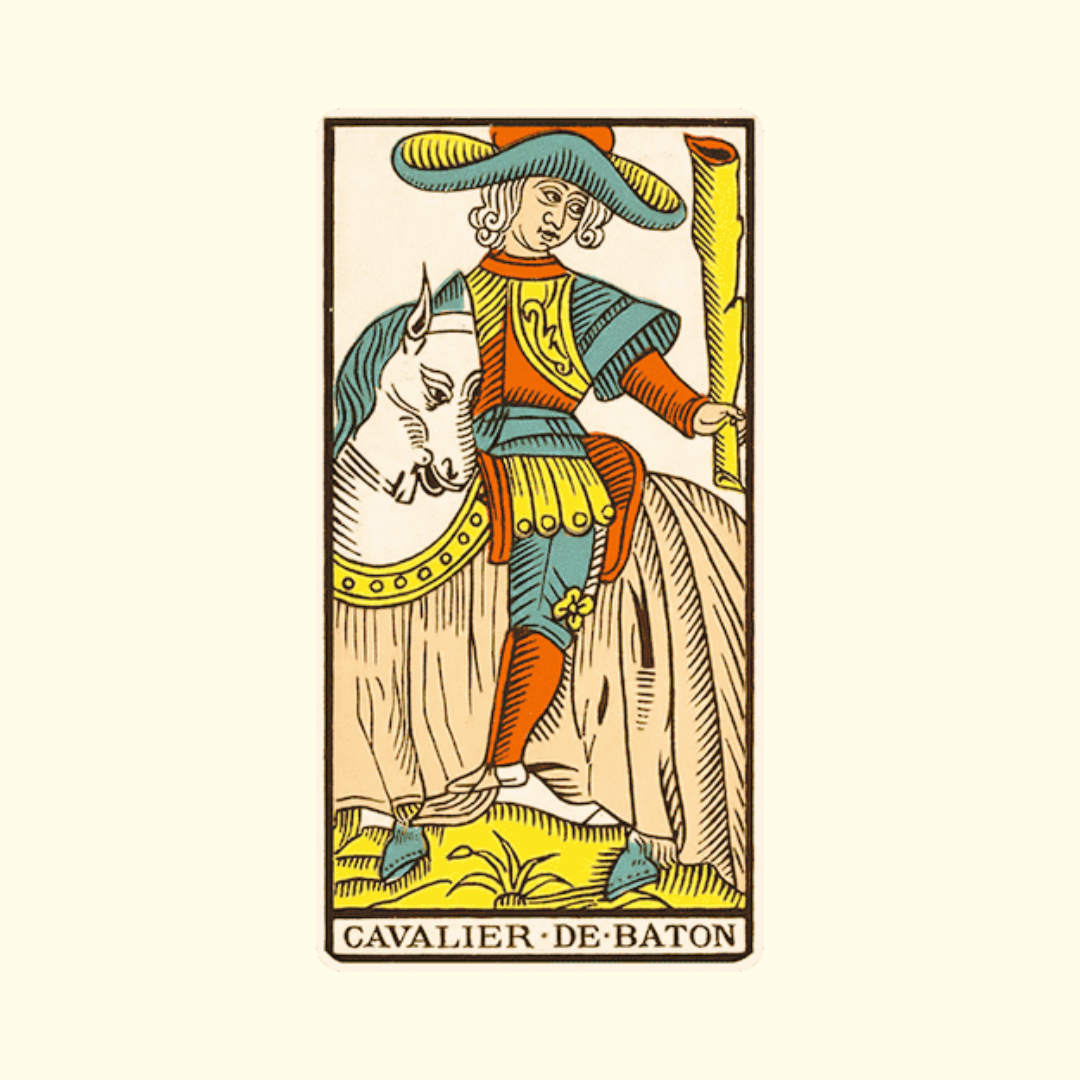

The Knight of Wands carries Fire along the road. In the Tarot de Marseille, a mounted man presents his staff while his horse advances through the card's narrow space. In the Waite-Smith, the mount leaps before arid ridges and the rider holds a short staff. The card speaks of departure, movement, initiative, and rapid change—with the risk that an overly sudden impulse may break what it only meant to move.
The Knight is not a promise of stability. It sets a situation in motion, leaves a place, carries a will, or accelerates a decision. Its presence can be favorable when a departure was expected, a project requires courage, or someone needs to break free from inertia. It becomes difficult when action comes before any agreement on the destination.
Mathers emphasizes departure, separation, and disunion. Waite adds travel, absence, escape, emigration, and a change of residence. The Golden Dawn describes a mounted figure, “Lord of the Flame and the Lightning,” active, generous, fierce, and sudden. The three sources converge on a mobile force whose effect may be intense but brief.
From the Marseille Knight to the hasty journey
In a Tarot de Marseille, the Knight is a mounted figure carrying the emblem of his suit. The horse, clothing, and staff vary among workshops, but the card combines a court rank with movement. There are neither pyramids nor a desert setting imposed by French tradition.
Smith depicts a rearing or bounding horse facing right. The rider wears armor, a tunic decorated with salamanders, and a feathered helmet. Ridges rise in the distance. Waite specifies that he is traveling, armed with a short staff, and has no military mission. In his view, the horse's movement reveals a hasty temperament.
Iconographic reference. The horse and the rank of Knight belong to both card traditions. The salamander, arid landscape, and spectacular appearance come from the Waite-Smith. The winged figure on a black horse from Book T belongs to the Hermetic tradition and should not be taken as a description of a Marseille card.
Divinatory transmission
Mathers associates the Knight of Wands with departure, separation, and disunion. Reversed, the card takes on rupture, discord, and quarrels. He adds a reading rule from his system: the Knight indicates the departure of the card that follows it. This detail shows that the meaning depends heavily on the order of the spread.
Book T names the mounted figure “Lord of the Flame and the Lightning” and “King of the Spirits of Fire.” It corresponds to Fire of Fire and governs an area extending from the end of Scorpio through the first two decans of Sagittarius. The text describes an active, generous, fierce, sudden, and impetuous force; poorly surrounded, it becomes cruel, brutal, or intolerant.
Waite depicts a traveler and associates the card with departure, absence, escape, emigration, a friendly person, and a change of residence. Reversed, the card becomes rupture, division, interruption, and discord. A current reading may therefore refer to a move, a work-related trip, a quick initiative, a discontinuous relationship, or someone who enters and leaves a situation without promising to settle there.
Meaning in a spread
In a favorable reading
The Knight of Wands provides the momentum needed to leave a setting that has become too narrow. It may announce a journey, a move, a mission, a campaign, a lively encounter, or an anticipated decision. The querent acts courageously, accepts change, and quickly mobilizes the available resources.
The card favors situations where the energy of departure matters more than the perfection of the plan: making contact, exploration, a short trip, relaunching, or a pilot phase. Its success increases when the destination, duration, and person responsible for the return are known.
In a tension reading
Movement becomes agitation. The person changes direction at the first frustration, makes promises before knowing their availability, or causes a breakup to regain the feeling of moving forward. The Knight can show an intense but intermittent relationship, an impulsive decision, a poorly prepared move, or a manager who launches something without ensuring follow-up.
The interruption of the old lists invites you to look at what remains behind. Does the departure really free up the situation, or does it move the same conflict elsewhere? The useful question becomes: where am I going, for how long, and who will take responsibility for the consequences of my passage?
Love, work, and finances
The Knight sets the situation in motion. The area indicates the destination, the duration of the passage, and what risks being interrupted.
| Area | Favorable reading | Tension aspect | Question to ask |
|---|---|---|---|
| Love | Lively encounter, initiative, travel for two, a relationship energized by a project. | Intermittent presence, excitement, sudden departure, intensity without continuity. | Do both people want the same pace and the same destination? |
| Work | Mission, launch, mobility, a salesperson opening up new ground or a team that acts quickly. | Project launched without follow-up, constant change of priorities, leader absent after the announcement. | Who will ensure continuity after departure? |
| Finances | Opportunity linked to travel, mission income, rapid and prepared business decision. | Hasty expenditure, underestimated mobility costs, gain dependent on a brief passage. | Does the budget include transportation, delays, and the return trip? |
| Movement | Travel, relocation, confirmed departure, exploration of a new place. | Incomplete itinerary, fleeing from a problem, forced change of residence. | What conditions make the arrival truly possible? |
| Creation | Energetic campaign, performance, mobile project, idea carried to an audience. | Repeated beginnings, seeking novelty at the expense of completion. | What system will preserve the result after the initial momentum? |
Reading associations
The Knight brings departure, speed, and intensity. The neighboring card shows what is traveling, the reason for the change, and the possibility of building after the passage.
| Association | Possible dynamic | Point of vigilance |
|---|---|---|
| Knight of Wands + Chariot | Decisive movement, mission carried out with determination, relocation or rapid progress. | Mastering the route matters as much as speed. |
| Knight of Wands + Eight of Wands | Very rapid travel or launch, exchanges that immediately trigger action. | Check dates, addresses, and means before departure. |
| Knight of Wands + Four of Wands | Arrival in a welcoming place, travel linked to a celebration, or settling in after the movement. | Check whether the stay is temporary or permanent. |
| Knight of Wands + Lovers | Departure linked to an emotional or professional choice, relationship requiring a shared direction. | Attraction does not resolve questions of distance and commitment. |
| Knight of Wands + Tower | Hasty departure, plan disruption, movement triggered by upheaval. | Secure the facts and the people involved before restarting the action. |
| Knight of Wands + Hermit | Exploration that subsequently requires study, distance, or a search for direction. | Alternate movement and assessment to avoid aimless wandering. |
Correspondences according to the different schools
The mounted Knight appears in French tarot decks. The Fire of Fire figure comes from the Golden Dawn. The hurried traveler before the arid landscape was developed by Smith and Waite.
| Reference | Attribution | Historical scope |
|---|---|---|
| Family | Minor arcana, court figure of the Wands | Rank of the Knight in 78-card tarot decks. |
| Tarot de Marseille | Mounted figure carrying a staff | Court figure with no prescribed landscape. |
| Mathers, 1888 | Departure, separation, disunion | Reversed: rupture, discord, quarrel. |
| Golden Dawn | Lord of Flame and Lightning, Fire of Fire | Title and attribution from Book T. |
| Element | Fire of Fire | Hermetic court formula for the mounted figure. |
| Astrology | 20° Scorpio to 20° Sagittarius | Celestial zone assigned by the Golden Dawn, rather than a single decan. |
| Waite-Smith | Traveling knight, rearing horse, short wand, rugged landscape | Scene published in 1909. |
| Age and gender | No mandatory identity | The card may represent a person, a role, or a dynamic. |
| Stone and plant | No common historical agreement | Recent additions remain distinct from the quoted texts. |
| Reading keywords | Departure, travel, initiative, mobility, haste, interruption | The context determines whether movement opens or breaks. |
Reading advice
Ask the Knight about his itinerary. The starting point, destination, duration, and responsibility for the return should be nameable. If one element is missing, the card describes more of a push than a project. Also look at the next card: it indicates what is moved, left behind, or carried away.
For a relationship, do not turn intensity into lasting commitment. For work, plan the handoff after the launch. For a trip or move, check the actual conditions rather than reading movement as a certainty. The Knight succeeds when he directs Fire somewhere, not when he runs to avoid stopping.
Sources and reference texts
For the history of playing cards and suits: Victoria and Albert Museum, A History of Tarot Cards; British Museum, reproduction of Nicolas Conver’s Tarot of Marseille.
For divinatory and occult texts: S. L. MacGregor Mathers, The Tarot, 1888, card meanings; Liber LXXVIII, “The Lord of the Flame and the Lightning,” publication of material from Book T; Arthur Edward Waite and Pamela Colman Smith, The Pictorial Key to the Tarot, Knight of Wands, 1911.










