



















































































































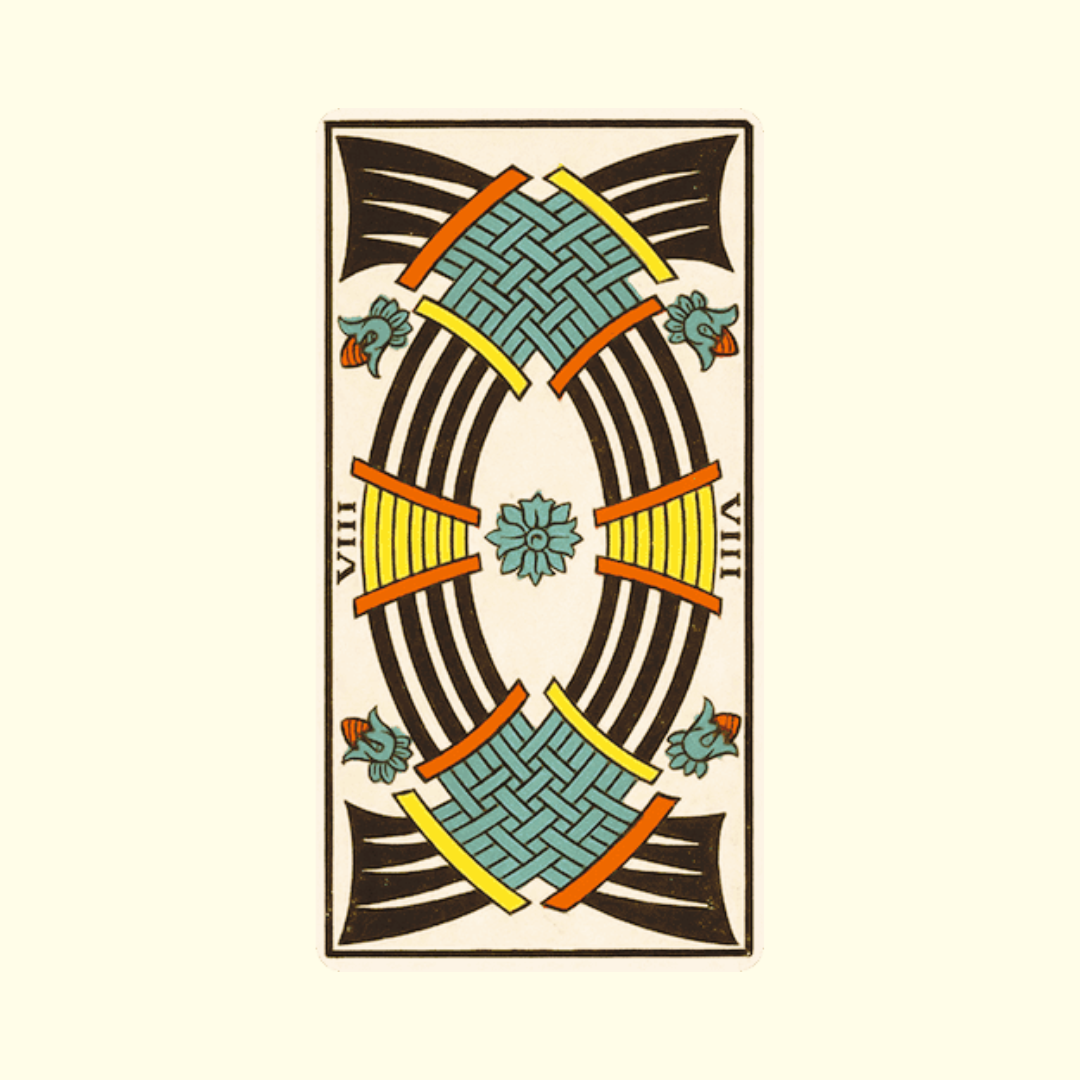

Eight swords almost completely close off the space. In the Tarot de Marseille, the curved blades form a regular framework around a plant-like center. In the Waite-Smith, a blindfolded and bound woman stands among eight swords on wet ground, far from a dwelling. The Eight of Swords describes hindered or poorly distributed force: a captivity that Waite calls temporary, but whose way out requires identifying the real obstacles instead of attributing everything to fear.
The Eight speaks of restriction, criticism, censorship, difficulty, and attention scattered among secondary details. Smith’s scene allows for an inner reading, but it does not prove that the querent creates their prison alone. Bonds, an institution, a debt, a contract, a threat, or a lack of information may genuinely limit action.
The card therefore calls for a precise inventory. What is forbidden, what is risky, what is merely feared, and what help remains accessible? A named constraint can be addressed. A vague formula about “blockages” leaves the person alone with a disturbing image.
From the enclosure of the eight blades to temporary captivity
In French tarot decks, eight curved blades cross in regular bands and surround a central flower or shoot. The composition is dense, symmetrical, and closed. No bonds, blindfold, or figure appear on the card. The number eight gives it a powerful structure, whose regularity can represent mastery or confinement depending on the context.
Smith depicts a woman whose eyes and body are bound. Eight upright swords surround her without forming a continuous fence. The ground is wet, and a structure stands in the distance. Waite specifies that this is more a temporary detention than irreversible enslavement. He associates the card with bad news, crisis, censorship, hindered power, conflict, slander, and illness.
Iconographic reference. The bound woman, the distant dwelling, and the muddy ground belong to the Waite-Smith. The Marseille shows only an architecture of blades. The idea of a visible way out between the swords can illuminate the English deck, but it must not be used to deny the concrete constraints described by the question.
Divinatory transmission
In 1888, Mathers attributed illness, slander, criticism, and blame to the Eight of Swords. Reversed, he cited past betrayal, an event, an accident, and a remarkable incident. He specified that deception situated in the past must be explained by the neighboring cards. His text associates restriction with social pressure or an event, not merely with a state of mind.
Book T calls the card “Lord of the Shortened Force” and assigns it Jupiter in Gemini. Eight swords converge near the top. The text criticizes force applied to small matters and attention given to details at the expense of the main issue. It mentions patience in study, great care in some areas and disorder in others, followed by narrowness, restriction, and imprisonment.
Waite describes temporary detention. He gives bad news, intense sorrow, crisis, censorship, obstructed power, conflict, slander, and illness. Reversed, the card receives worry, difficulty, opposition, accident, betrayal, the unexpected, and fatality. These severe lists are not literal predictions. They provide a vocabulary of pressure, limitation, and adverse events to be assessed through the spread.
Meaning in a spread
In a favorable reading
The Eight of Swords can make a constraint legible. The querent distinguishes a real prohibition from fear, identifies the person capable of loosening the situation, or understands that their energy is being lost on secondary tasks. The card supports auditing limits, asking for help, and returning to the main issue.
Its constructive aspect does not consist in claiming that escape is easy. It shows that an opening may exist: a physical movement, advice, a procedure, a document, or a change to the framework. The first step is to regain a clear view of the situation, not to run between the blades.
In a tension reading
The restriction can become paralysis, self-censorship, an accumulation of details, or submission to a critical narrative. A person no longer distinguishes what they can change from what depends on an external authority. They devote all their energy to avoiding small mistakes and lose sight of the main objective, or accept blame as proof of their inability.
The Eight allows neither diagnosis nor accusation. When the constraint involves violence, health, debt, legal matters, or employment, qualified help may be necessary. The useful question becomes: which limits are material, which are negotiable, and which person can confirm the difference?
Love, work, and finances
The Eight describes an obstructed force, criticism, or a temporary restriction. It does not reduce the difficulty to a “mental prison.” The layout distinguishes external constraints, fear, and dispersed energy.
| Area | Favorable reading | Tension aspect | Question to ask |
|---|---|---|---|
| Love | Named boundaries, stepping back before acting, asking for help when faced with a constraining relationship. | Silence imposed, fear of speaking, control, feeling of having no choice. | Which options remain genuinely accessible in safety? |
| Work | Rules clarified, problem brought back to the main issue, support requested. | Micromanagement, constant criticism, position with no leeway, overload of details. | Which rule is written, and which is merely assumed? |
| Finances | Inventory of obligations, advice on restructuring, priority given to the major constraint. | Debt, restrictive clause, fear of numbers, small expenses concealing the real problem. | What amount and deadline truly limit action? |
| Social life | Withdrawal from a critical environment, protection from rumor. | Slander, censorship, fear of judgment, isolation produced by the group. | Who can testify to the facts without spreading the rumor? |
| Decision | Identifying room for maneuver and missing information. | Paralysis, closed scenario, energy wasted on details. | What small, safe movement would make an option visible? |
Reading associations
The Eight brings restriction, censorship, and scattered force. The associated card shows the origin of the ties, the help available, or the event that transforms provisional detention.
| Association | Possible dynamic | Point of caution |
|---|---|---|
| Eight of Swords + Ace of Swords | Information, a rule, or a decision makes the constraint more legible. | The truth must open a path, not add another verdict. |
| Eight of Swords + Three of Pentacles | Competent assistance, collective work to resolve a technical blockage. | Define everyone’s role and protect confidentiality. |
| Eight of Swords + Justice | Contractual or legal restriction, procedure, arbitration required. | Have the rule checked instead of interpreting it alone. |
| Eight of Swords + Devil | Control, dependence, constraint reinforced by fear or self-interest. | Seek appropriate outside help if the danger is real. |
| Eight of Swords + Tower | Broken restriction framework, crisis that opens an exit or destroys a protection. | Ensure the person’s safety before celebrating the breaking of the framework. |
| Eight of Swords + Star | Recovered reference points, calm assistance, gradual restoration of confidence and direction. | Calming must be accompanied by concrete options. |
Correspondences according to the schools
The old chart associated Jupiter, summer, citrine, lavender, and Teth. Jupiter in Gemini belongs to the Golden Dawn. The stone, plant, season, and letter do not form, with it, a table transmitted by the same sources.
| Reference | Attribution | Historical scope |
|---|---|---|
| Family | Minor arcana, Eight of Swords | Eighth numbered card of the suit. |
| Tarot of Marseilles | Eight curved blades in a dense structure around a botanical motif | Unillustrated card with no associated woman. |
| Mathers, 1888 | Illness, slander, criticism, blame | Reversed: past betrayal, event, accident, incident. |
| Golden Dawn | Lord of Shortened Force | Title of Book T. |
| Element | Air | Occult attribution to the suit of Swords. |
| Astrology | Jupiter in Gemini | First decan of Gemini in the Golden Dawn framework. |
| Waite-Smith | Blindfolded and bound woman, eight swords, damp ground, and distant dwelling | Scene published in 1909. |
| Hebrew letter | No letter specific to the card | Teth belongs to Strength in the Golden Dawn system. |
| Stone, plant, season | No common historical attribution | These recent additions should remain distinct from dated correspondences. |
| Reading words | Restriction, censorship, criticism, detail, help, room for movement | The context distinguishes a material obstacle from incomplete perception. |
Reading advice
Make three columns: proven constraints, negotiable constraints, and fears without confirmation. For each line, note the person or document capable of verifying the situation. Then return to the main issue: what detail is absorbing energy that should be devoted to it?
Avoid telling the querent that they are holding themselves back when external obstacles exist. Also avoid presenting every limitation as absolute. The Eight invites them to regain perspective, ask for help, and choose a safe movement, even a small one, before deciding what comes next.
Reference sources and texts
For the history of decks and suits: Victoria and Albert Museum, A History of Tarot Cards; British Museum, reproduction of Nicolas Conver’s Tarot of Marseille.
For divinatory and occult texts: S. L. MacGregor Mathers, The Tarot, 1888, card meanings; Liber LXXVIII, “The Lord of Shortened Force,” publication of material from Book T; Arthur Edward Waite and Pamela Colman Smith, The Pictorial Key to the Tarot, Eight of Swords, 1911.










