






























































































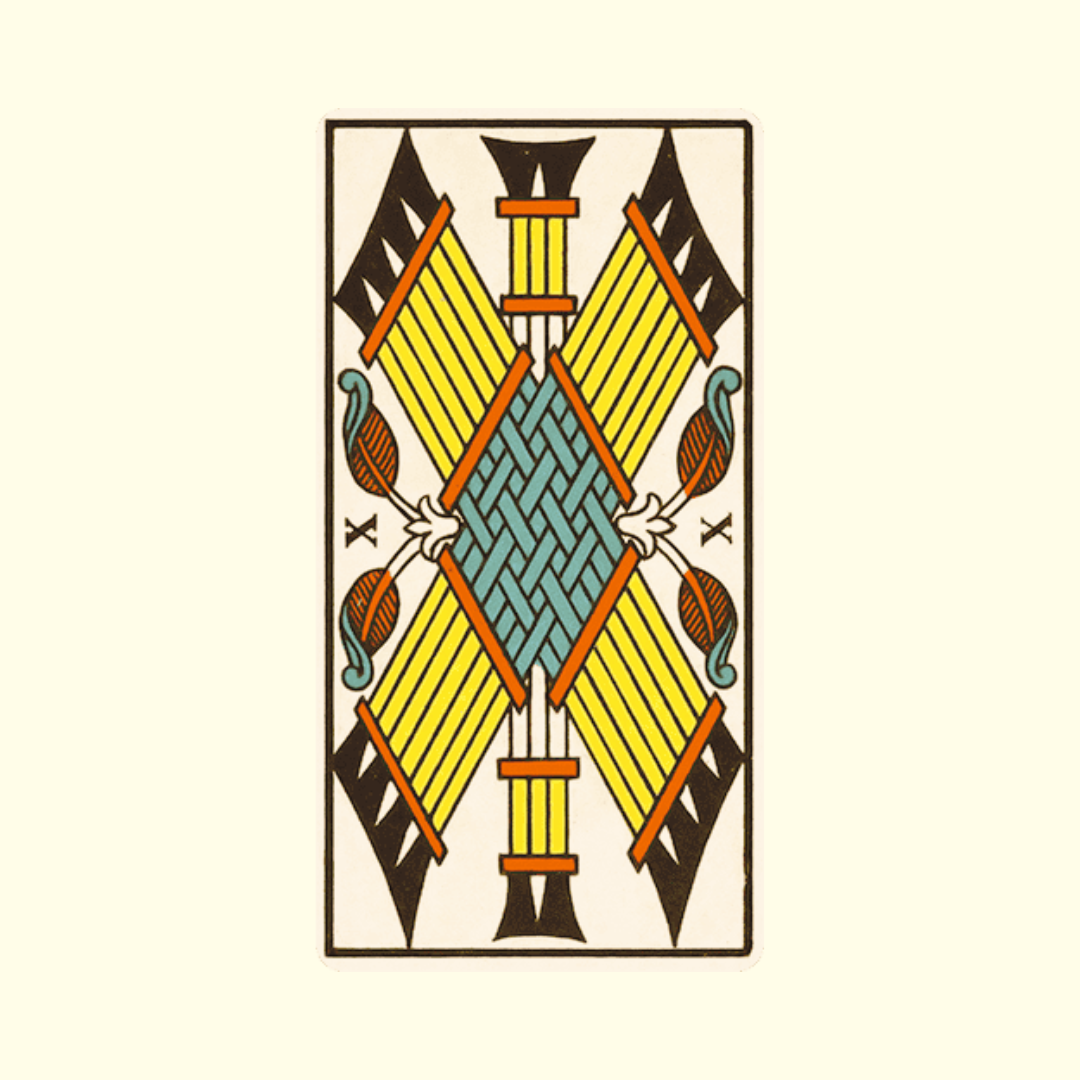

Ten wands carry the suit to saturation. In the Marseille Tarot, they fill the space in a tight interweaving. In the Waite-Smith, a man moves toward a city with the ten wands gathered in front of him, his back bent under their weight. The Ten of Wands speaks of completion, responsibility, and an achieved result—and then asks whether the burden required to reach the goal remains bearable.
The Ten does not say that every effort is oppression. It can represent a demanding period, an accepted responsibility, or the final delivery before a project ends. The difficulty appears when success adds obligations without removing the old ones, when no one shares the work, or when the goal becomes invisible behind what must be carried.
The sources preserve an interesting tension. Mathers gives confidence, security, honor, and good faith. The Golden Dawn calls the card “Lord of Oppression” and assigns it Saturn in Sagittarius. Waite acknowledges contradictory meanings: fortune, gain, and success, but also the weight produced by those same things. The card can therefore show the price of success as much as failure under overload.
From ten wands to the burden carried
In a Marseille Tarot, ten wands occupy the card without a figure or destination. Eight form a crossed framework, and two additional axes pass through the center. The multiplication closes almost every available space. The image does not indicate who carries the force; it shows a structure that has reached the maximum of its numerical series.
Smith depicts a man clutching ten branches in a bundle. His face disappears behind them, his back is bent, and a city lies a short distance away. The wands have not fallen: they are being carried toward a specific place. This destination prevents us from reducing the card to failure. The load may be heavy and close to its end, provided the bearer knows where to set it down.
Iconographic reference. The bent figure and the city belong to the Waite-Smith. The Marseille shows ten emblems in a completed composition. In both decks, density reaches its limit; only the English scene transforms that density into a human burden and a journey.
Divinatory transmission
In 1888, Mathers attributed confidence, security, honor, and good faith to the Ten of Wands. Reversed, the card takes on betrayal, subterfuge, duplicity, and obstacle. This vocabulary reminds us that a heavy burden can also be a responsibility entrusted to someone because they seem capable of carrying it through to completion.
Book T gives the Ten the title “Lord of Oppression” and assigns it Saturn in Sagittarius. Two upright wands cross eight intersecting torches. The text speaks of a harsh and dominating force applied to material or selfish aims, followed by opposition that has become too strong. Yet it preserves generosity, selflessness, and self-sacrifice when the card receives favorable surrounding cards.
Waite himself acknowledges that the meanings do not entirely agree. He retains oppression, fortune, gain, success, and the burden of these achievements, followed by false appearance, disguise, and treachery. Reversed, the card indicates setbacks, difficulties, and intrigue. The Ten therefore asks us to consider the amount of work, the goal being pursued, the distribution of responsibilities, and the loyalty of those who benefit from them.
Meaning in a reading
In a favorable reading
The Ten of Wands can announce the final phase of demanding work. The resources are assembled, the destination is visible, and the person still has the capacity to deliver. The card values focused effort when its duration, outcome, and the moment to set down the burden are known.
It can also represent a trustworthy responsibility: leading a project, protecting a group, managing a busy period, or fulfilling a promise. Success then depends on organization, delegation, and abandoning tasks that no longer contribute to the goal.
In a tension reading
The person carries too much, for too long, or for someone else’s benefit. Priorities disappear, every request becomes urgent, and the role of the person who knows how to get things done turns into a permanent obligation. The overload may conceal difficulty saying no, a system that rewards sacrifice, or a success whose cost was never calculated.
The Ten can also reveal a burden used to control, a promise that has become a trap, a mission without the means to accomplish it, or an accumulation of tasks intended to delay the conclusion. The useful question becomes: what really needs to reach its destination, and who must take over the rest?
Love, work, and finances
The Ten shows a capacity that has reached its limit. The area specifies what must be completed, shared, renegotiated, or abandoned.
| Area | Favorable reading | Tension aspect | Question to ask |
|---|---|---|---|
| Love | Responsibilities taken on together, with a final effort to organize a shared change. | Unequal emotional burden, with one person handling everything and duty taking the place of connection. | Who carries what, and does everyone still freely consent to this arrangement? |
| Work | Delivery close at hand, demanding mission carried through to completion, trust given. | Overload, accumulation of roles, goals without resources, credit taken by someone else. | What task can be delegated or removed right now? |
| Finances | A budgetary effort limited in time, debt on its way to being paid off, income tied to intense activity. | Excessive fixed costs, commercial success without margin, a commitment that has become burdensome. | Does the net result justify the total burden? |
| Project | Final phase, resources gathered, determination to deliver. | Ever-expanding scope, refusal to simplify, objective lost behind the tasks. | What precise definition makes it possible to declare the project complete? |
| Daily life | A demanding period managed through priorities, responsibilities assumed methodically. | No room for rest, help refused, personal worth measured by sacrifice. | What can be set down without serious consequences? |
Reading associations
The Ten brings weight, completion, and responsibility. The neighboring card shows the source of the burden, its destination, and how to set it down.
| Association | Possible dynamic | Point of caution |
|---|---|---|
| Ten of Wands + World | A heavy phase is coming to an end and can be publicly closed. | Plan for what comes afterward instead of immediately filling the space that has been freed. |
| Ten of Wands + Nine of Wands | Endurance pushed to the point of overload, defense without support. | The final effort requires a time limit. |
| Ten of Wands + Three of Pentacles | The burden becomes manageable through distributed skills. | Name the roles, deadlines, and compensation. |
| Ten of Wands + Justice | Contractual responsibility, an obligation to fulfill, or a burden to renegotiate within a framework. | Check the clauses and evidence before accepting more. |
| Ten of Wands + Devil | Compulsive work, debt, control through duty, or success that becomes a trap. | Identify who benefits from the sacrifice and what exit exists. |
| Ten of Wands + Temperance | Gradual lightening, better distribution of tasks and resources. | Moderation must modify the bearer’s organization, not just their pace. |
Correspondences according to the schools
The ten crossed staffs belong to the Tarot de Marseille. Saturn in Sagittarius and Oppression come from the Golden Dawn. The man carrying the load toward the city is a composition by Smith, commented on by Waite.
| Reference | Attribution | Historical scope |
|---|---|---|
| Family | Minor Arcana, Ten of Wands | Tenth and final numbered card of the suit. |
| Tarot de Marseille | Ten staffs in an almost saturated pattern | A suit card without a figure or city. |
| Mathers, 1888 | Trust, security, honor, good faith | Reversed: betrayal, subterfuge, duplicity, obstacle. |
| Golden Dawn | Lord of Oppression | Title from Book T. |
| Element | Fire | Occult attribution to the suit of Wands. |
| Astrology | Saturn in Sagittarius | Third decan of Sagittarius in the Golden Dawn framework. |
| Waite-Smith | Bent man carrying ten wands toward a city | Scene published in 1909. |
| Hebrew letter | No letter specific to the card | The numbered cards do not each receive a letter in this system. |
| Stone and plant | No common historical attribution | Recent editorial additions remain separate from the cited texts. |
| Reading words | Burden, responsibility, completion, delegation, saturation, duty | The result depends on the destination and the distribution. |
Reading advice
Take inventory of the ten wands. Some correspond to the core of the mission; others were added out of habit, fear of disappointing others, or a lack of prioritization. Sort them into three categories: deliver, delegate, abandon. The card becomes concrete as soon as the burden stops being an indistinct block.
Also check the destination. An intense period may remain acceptable if it has an end date, compensation, and planned rest. Without an end point, courage feeds a system that will always demand more. For professional or financial questions, ground the reading in hours, margins, contracts, and actual resources.
Sources and reference texts
For the history of decks and suits: Victoria and Albert Museum, A History of Tarot Cards; British Museum, reproduction of Nicolas Conver’s Tarot de Marseille.
For divinatory and occult texts: S. L. MacGregor Mathers, The Tarot, 1888, card meanings; Liber LXXVIII, “The Lord of Oppression,” publication of material from Book T; Arthur Edward Waite and Pamela Colman Smith, The Pictorial Key to the Tarot, Ten of Wands, 1911.