


















































































































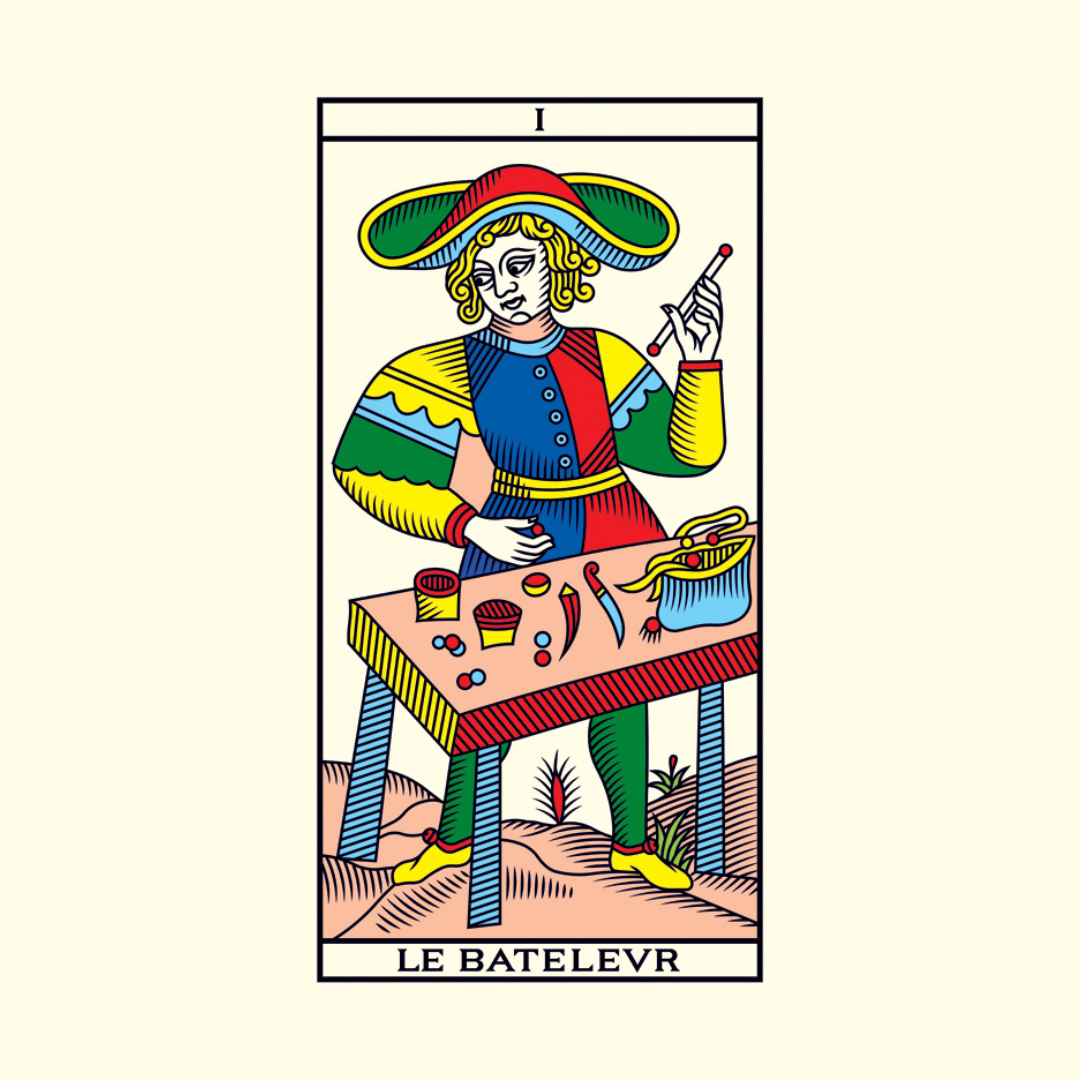

On the Bateleur’s table, everything seems ready, but nothing has yet been accomplished. The first numbered card shows an operator at the beginning of his art, with tools, know-how, and the ambiguity that accompanies every skill: the hand can build, persuade, or deceive. This tension between initiative and artifice belongs to the card’s history.
The Bateleur of the Tarot of Marseilles and the Magician of the deck designed by Arthur Edward Waite and illustrated by Pamela Colman Smith belong to the same iconographic family without being interchangeable. The former remains close to the sleight-of-hand performer and fairground entertainer. The latter becomes an officiant standing before the four emblems of the tarot suits. Reading the card accurately therefore requires identifying the deck being used before assigning it a Hebrew letter, a planet, or an element.
The Bateleur Before the Magician
In Renaissance Italian tarots, the ancestor of the card bears the name Bagatto or Bagatello. A Visconti-Sforza example held by the Morgan Library, dated to around 1450–1480, shows a man seated before a table bearing, among other things, a cup and a knife. The scene evokes less a master of invisible forces than a person of low status, an entertainer, or a man who works with his hands. Morgan Library, Visconti-Sforza Tarot, The Bagatto.
In Jean Noblet’s Parisian tarot, produced in the 17th century, the figure is already called the Bateleur. The word then referred to someone who performed feats of skill in a public square or at a fair. His narrow table, small objects, and wand belong to this world of entertainment. Nothing allows us to claim that every accessory in the old French tarots already represented a specific cosmic element. Bibliothèque nationale de France, Jean Noblet Tarot.
Iconographic reference. In a Tarot of Marseilles, the table and its objects first speak of available resources, learning, skill, and presentation. In the Waite-Smith, the cup, sword, wand, and pentacle are deliberately arranged as the four emblems of the suits. This difference belongs to the images themselves.
From the Cup-and-Ball Player to the Occult Practitioner
The transformation took shape at the end of the 18th century. In 1781, Antoine Court de Gébelin still described the card as the “Cup Player,” also called Pagad, and then gave it a role in an initiatory reading of the tarot. His hypothesis of an Egyptian origin is not supported by the documents known today; it nevertheless marks a decisive moment in the history of European occultism. A few years later, Etteilla created a divinatory tarot that he presented as restored according to the Book of Thoth as he imagined it. Antoine Court de Gébelin, Monde primitif, volume VIII, 1781.
In the 19th century, French occultist authors made the first arcana a figure of willpower and beginnings. Papus associated it with Aleph and wrote in his divinatory list that the Bateleur could represent the querent. Oswald Wirth continued along this line: his Bateleur combines initiative, discernment, presence of mind, and dexterity, but also chatter, cunning, lies, or charlatanism when his art deteriorates.
The Waite-Smith Magician, published in 1909, belongs to a different construction. Standing with one hand raised and the other turned toward the earth, he stands before the four emblems of the suits. The infinity sign above his head, the serpent-shaped belt, and the garden of roses and lilies establish an explicit initiatory image. This card does not replace the Marseille Bateleur: it offers an English rewriting of it, arising from a different esoteric milieu.
What the older authors attributed to it
Divinatory texts from the 19th and 20th centuries do not offer an identical definition, but a core idea emerges. Samuel Liddell MacGregor Mathers emphasizes willpower, the power to act, and dexterity; in an unfavorable position, he refers to weak will, cunning, and deception. Papus places the querent before us, as though the first card showed the person beginning the experience of the game. Wirth emphasizes initiative, autonomy, and skill, while keeping the figure of the charlatan in the background.
Waite associates the Magician with skill, diplomacy, subtlety, self-confidence, and willpower. His printed list also contains less flattering meanings than contemporary summaries suggest. The card is therefore not an abstract promise of success. It asks what the querent can actually do, what means are within reach, and to what end their talent will be employed.
The card’s historical thread. The Magician opens, tries, assembles, and sets things in motion. His shadow is found in the gap between demonstrated skill and actual ability: poorly prepared improvisation, scattered efforts, seductive speech, or mastery used to deceive.
Meaning in a spread
In a favorable reading
The Magician indicates that room for action exists. The consultant already possesses a first tool, ability, contact, or opportunity that makes it possible to begin. The card favors the inaugural gesture, learning through experience, speaking up, and the ability to bring scattered resources together. It guarantees neither the result nor the project’s maturity: it describes the moment when one must move from intention to concrete trial.
A good reading will look for the card’s verb. What needs to be undertaken, presented, repaired, negotiated, or learned? What object placed on the consultant’s “table” has not yet been put to use? The Magician acts with what is there, without waiting for every condition to become ideal.
In an unfavorable reading
The card may indicate scattered talent, premature action, or confidence exceeding experience. It may also signal a performance: polished speech, withheld information, skill directed toward manipulation. The point is not to suspect every person one speaks with, but to verify the facts, the stated means, and the consistency between words and actions.
Reversal is not required to read this aspect. Some readers work without reversed cards; an obstacle position or tense neighboring cards are enough to reveal clumsiness, cunning, or inconsistency. The chosen system must remain stable throughout the reading.
Love, work, and finances
The meaning of the card becomes clearer when the area provides a concrete setting. The following table does not deliver verdicts: each line connects the Magician’s initiative to a verifiable question.
| Area | Favorable interpretation | Shadow aspect | Question to ask |
|---|---|---|---|
| Love | First exchange, straightforward attraction, a relationship that calls for a clear gesture. | Role-playing, charm used to evade a commitment, words without follow-through. | Who takes the initiative, and do their actions confirm their words? |
| Work | New position, initial assignment, demonstration of expertise, growing autonomy. | Overestimated skill, a project launched without a framework, a colleague or service provider skilled at diverting attention. | What resources have been acquired, and which still need to be learned? |
| Finances | An opportunity to negotiate, create a resource, or make better use of an available asset. | An offer that is too tempting, a figure presented without proof, impulsive spending related to a new project. | Is the setup based on verifiable facts? |
| Project or creation | Prototype, first text, launch, public test, meeting between idea and technique. | Grandstanding, multiplying possibilities, refusing to finish what has been started. | What tangible first result can be produced now? |
| Study or ritual practice | Beginning an apprenticeship, discovering a symbolic language, regularly exercising attention. | Seeking power before study, imitating a master, confusing a symbol with a material fact. | Can the method be named, transmitted, and put to the test? |
How to read its associations
A card association works like a sentence, not like a fixed recipe. The Magician brings the operator, initiative, means, and art of presentation. The neighboring card indicates what this initiative encounters, becomes, or what limits it. The position in the spread remains the priority.
| Association | Possible dynamic | Point of attention |
|---|---|---|
| Magician + High Priestess | Action encounters reserved knowledge; one must read, listen, or train before moving forward. | Do not force information that is not yet mature. |
| Magician + Emperor | The initiative receives structure, a rule, or the support of an authority. | The framework can support the project or confine it. |
| Magician + Lovers | The beginning enters the realm of choice, alliance, or attraction. | Charm replaces neither decision nor consent. |
| Magician + Wheel of Fortune | Skill encounters a change in circumstances; one must seize the right moment and adapt. | Do not confuse flexibility with opportunism. |
| Magician + Devil | Technique, desire, and fascination grow stronger; the combination may speak of powerful persuasion. | Check power dynamics, hidden interests, and manipulation. The association is not automatically sexual. |
| Magician + Tower | An initial plan is disrupted; the error becomes visible and demands a rapid response. | Improvisation saves the situation or worsens an already fragile foundation. |
| Magician + World | The means of the beginning find their fulfillment, audience, or place within a coherent whole. | Do not announce completion before all the parts have been connected. |
Order further refines the phrase. High Priestess followed by Magician can show that withheld knowledge finally moves into action. Magician followed by High Priestess may ask action to pause in order to consult a document, keep silent, or learn. This syntax will give future association entries a shared coherence without creating an automatic verdict.
Correspondences according to the schools
A reliable correspondence table must show where each attribution comes from. The number I belongs to the card in numbered French tarots, but the Hebrew letter, planet, and element vary according to the schools. Bringing them together in a single line would suggest a historical agreement that does not exist.
| Reference point | Attribution | Historical scope |
|---|---|---|
| Family | Trump or Major Arcana | First numbered trump in the French series; the Fool remains unnumbered in many Tarot de Marseille decks. |
| Ancient Italian name | Bagatto, Bagatello | Name borne by the Italian ancestor of the card during the Renaissance. |
| Tarot of Marseille | The Magician, number I | Fairground performer or skilled player at his table. No planet, letter, stone, or plant is inscribed in the image. |
| Court de Gébelin, 1781 | Cup player, Pagad | A landmark stage in occultist reinterpretation. Its Egyptian narrative belongs to its theory, not to the tarot’s demonstrated origin. |
| French occultism | Aleph; beginning, will, initiative | Attribution found in Papus and Wirth. It belongs to their symbolic architecture. |
| Oswald Wirth | Influence of Mercury, favorable or deceptive | Mercury accounts for manual intelligence, speech, exchange, and cunning. |
| Golden Dawn and English lineage | Beth and Mercury | A distinct system from the French Aleph–Bateleur order. The two attributions must not be merged. |
| Waite-Smith | The Magician; cup, pentacle, sword, and wand | The four emblems are explicit, with the gesture connecting above and below. |
| Element | No universal element | Air appears in later systems, but is not a feature of the Tarot de Marseille. |
| Stone, plant, and season | No stable historical attribution | Citrine, lily of the valley, or spring may belong to a recent editorial system; they are not presented here as ancient legacies. |
| Reading keywords | Initiative, dexterity, learning, negotiation, beginning | The common core emerges from Mathers, Papus, Wirth, and Waite. |
| Shadow aspect | Distraction, clumsiness, boasting, cunning, manipulation | Skill may be lacking, remain unused, or be used to deceive. |
Sources and reference texts
For the history of the images: Morgan Library, Visconti-Sforza Tarot, The Bagatto; Bibliothèque nationale de France, Tarot de Jean Noblet; CNRTL, historical definition of “bateleur”.
For occultist and divinatory construction: Antoine Court de Gébelin, Monde primitif, volume VIII, 1781; Papus, Le Tarot des Bohémiens, 1889; S. L. MacGregor Mathers, The Tarot, 1888; Oswald Wirth, Le Tarot des imagiers du Moyen Âge, 1927; Arthur Edward Waite, The Pictorial Key to the Tarot, 1911.










