






























































































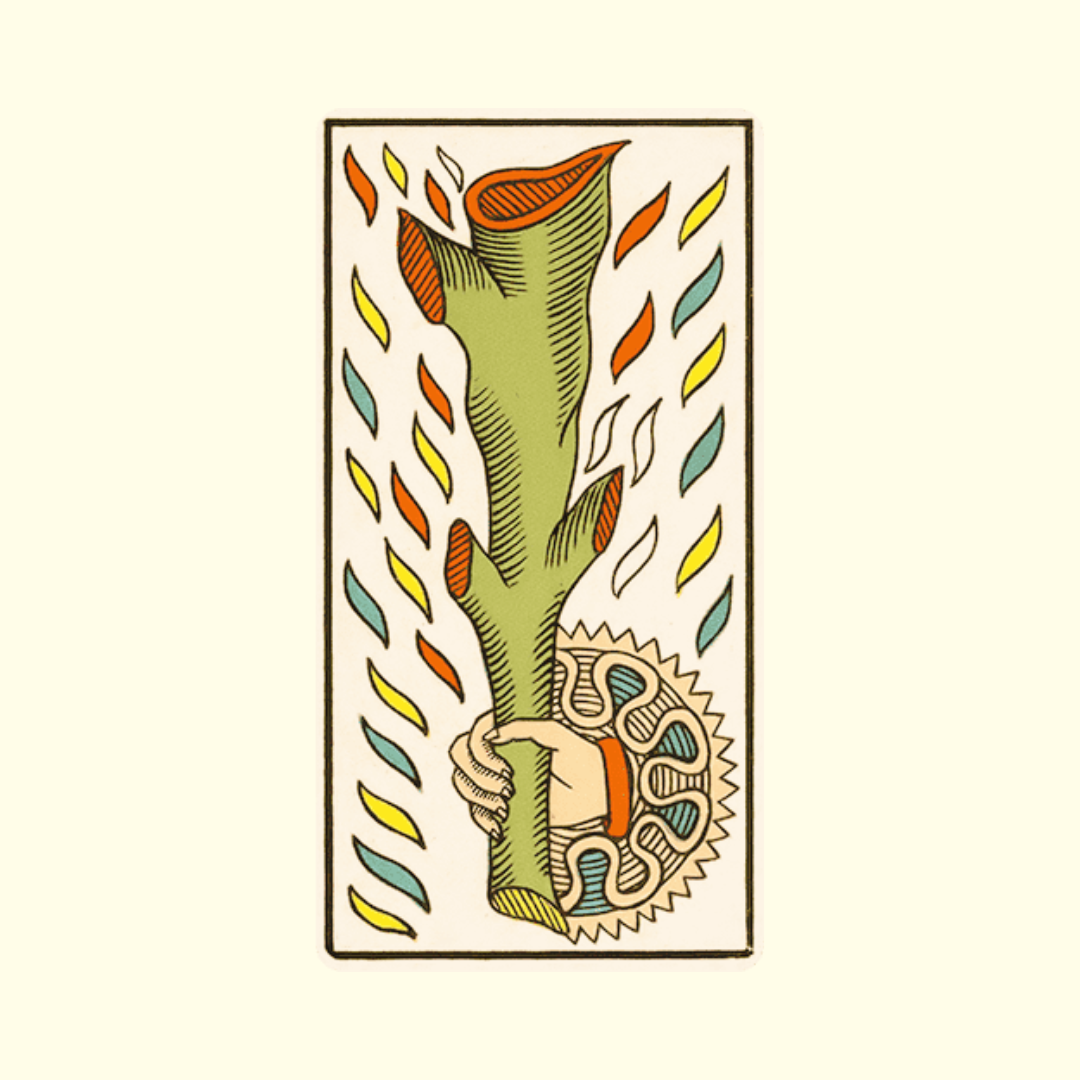

A hand grips a heavy staff. In the Tarot de Marseille, the emblem dominates the card and asserts the suit’s raw power. In the Waite-Smith, the wood bears young leaves above a landscape still far away. The Ace of Wands thus opens the realm of drive, enterprise, and available strength: a vigorous beginning, but one whose direction remains to be chosen.
The Ace gathers the character of Wands before it takes a precise form. It may indicate an initiative, a desire to act, a creative impulse, a vocation making itself known, or an opportunity to launch a project. The card does not promise final success. It shows a reserve of energy and the moment when that energy seeks a work, a decision, or a field.
Three layers must remain distinct. French tarots provide the staff, the hand, and the rank of Ace. In the 19th century, Mathers transmitted the ideas of birth, source, and beginning. The Golden Dawn made Wands the suit of Fire and named the Ace the “Root of the Powers of Fire.” Smith and Waite added the leaves, the landscape, and a developed reading of enterprise.
From the Marseille staff to the force that begins
In a Nicolas Conver-style Tarot de Marseille, a hand emerges from a sleeve and holds a large carved club, surrounded by small flames or colored leaves depending on the editions. The object is neither a royal scepter nor a slender wand. Its mass gives an impression of power in its raw state. The branch stubs recall that the wood comes from living matter, but the image does not yet tell any story of adventure.
Pamela Colman Smith retains the hand emerging from a cloud and replaces the monumental club with a straight branch that is budding. Leaves detach around it. In the distance are a fortress, hills, a river, and trees. The force now appears directed toward a world to be entered. Waite describes the card through creation, invention, enterprise, principle, origin, and starting point.
Iconographic reference. In a Marseille deck, the grasp of the hand and the weight of the staff point toward mastery of a force. In the Waite-Smith, the shoots and landscape add growth and the possibility of expansion. The flowering branch is therefore not a detail shared by all decks.
Divinatory transmission
In The Tarot, published in 1888, S. L. MacGregor Mathers attributes birth, beginning, origin, and source to the Ace of Wands. For the reversed card, his catalogue becomes severe: persecution, violence, vexation, cruelty, and tyranny. This contrast reminds us that the Ace’s power can serve either a foundation or a constraint.
The Golden Dawn material disseminated in Book T gives the card the title “Root of the Powers of Fire.” The wand becomes a great branching torch surrounded by twenty-two flames. The text speaks of force, vigor, energy, and impetus, then distinguishes this natural power from the invoked force associated with the Ace of Swords. This construction belongs to late-19th-century English occultism.
Waite retains the ideas of beginning and enterprise, adding creation, invention, family, origin, fortune, or inheritance depending on the methods used. Reversed, the card takes on meanings of downfall, decline, ruin, and obscured joy. These lists do not describe a simple “yes.” They ask what is being born, who holds the handle, and whether the energy already has a viable direction.
Meaning in a spread
In a favorable reading
The Ace of Wands signals the moment when action becomes possible. An idea ceases to be a daydream, a decision gathers the available forces, or an opportunity demands a rapid response. The card supports launching, boldness, the desire to create, and the ability to mobilize others around a first gesture.
Its best expression unites vigor and direction. It is not enough to feel the desire: the project must be named, the first action chosen, and the energy of the beginning protected. With cards of construction or continuity, the Ace can announce an undertaking that finds the means to succeed. In isolation, it remains a powerful but new impulse.
In a tension reading
The force can scatter in every direction, burn out too quickly, or become domination. The card then shows haste, desire without structure, anger turned into a decision, brutal competition, or a project launched before its resources have been assessed. It can also indicate blocked energy: the will exists, but fear, fatigue, or an external order holds back the first step.
Reversal is not necessary to read this aspect. An obstacle position, a Ten of Wands, a Devil, or a series of conflictual Swords can reveal overload, control, or misdirected action. The useful question becomes: what form allows this force to act without consuming me or crushing others?
Love, work, and finances
The Ace introduces a driving force into the area being asked about. It certifies neither commercial success, nor a lasting encounter, nor financial gain. The neighboring cards show what the querent can actually build with this energy.
| Area | Favorable reading | Tension aspect | Question to ask |
|---|---|---|---|
| Love | Strong attraction, initiative, a relationship that moves beyond waiting, desire expressed clearly. | Infatuation, conquest for its own sake, a power struggle, or desire mistaken for commitment. | Does the momentum respect the other person’s pace and freedom? |
| Work | Business creation, bold application, launched project, mobilizing authority. | Starting without a budget, unclear objective, rivalry or exhaustion from the earliest stages. | What first concrete result will prove that the project is moving forward? |
| Finances | Starting capital, purchase useful for an activity, possible new source of income. | Impulsive spending, a gamble guided by enthusiasm, overstated financial means. | Have the funding and timeline been calculated? |
| Creation | Fertile idea, inaugural gesture, desire to produce, style that declares itself. | Accumulation of beginnings, impatience with finishing work. | What form will this energy take today? |
| Decision | Ability to make a decision and take action. | Imposed decision, angry reaction, or need to prove one’s power. | Does the will serve the goal or only the ego? |
Reading associations
The Ace provides the initial force. The accompanying card clarifies whether this force encounters agreement, a plan, a structure, or resistance.
| Association | Possible dynamic | Point of vigilance |
|---|---|---|
| Ace of Wands + Two of Wands | The impulse receives a strategy, a territory, and a direction. | Do not confuse planning with absolute control. |
| Ace of Wands + Three of Wands | Launch focused on expansion, commerce, or a broader audience. | Results require time and reliable support. |
| Ace of Wands + Four of Wands | An initiative quickly finds a common framework or a first step to celebrate. | The celebration should not make one believe that everything is complete. |
| Ace of Wands + Magician | Highly active start, talent put to the test, tool finally put to use. | The multiplication of possibilities can scatter the effort. |
| Ace of Wands + Emperor | Disciplined energy, a project placed under solid authority or structure. | Watch for rigidity, domination, and lack of delegation. |
| Ace of Wands + Devil | Powerful desire, intense ambition, considerable ability to mobilize. | Constraint, dependence, or obsession can divert the momentum. |
Correspondences according to the schools
The great wand and the hand belong to the ancient images. Fire, the “root,” and the flaming torch come from the Golden Dawn. Tables that add a planet, a Hebrew letter, a stone, and a plant to the Ace combine systems without always saying so.
| Reference point | Attribution | Historical scope |
|---|---|---|
| Family | Minor arcana, suit of Wands, rank of Ace | First numbered card of the suit. |
| Tarot de Marseille | Hand holding a heavy club surrounded by ornaments | Image without a landscape or business scene. |
| Mathers, 1888 | Birth, beginning, origin, source | Reversed: violence, vexation, cruelty, tyranny. |
| Golden Dawn | Root of the Powers of Fire | Title of Book T. |
| Element | Fire | Attribution of the English occultist grid to the suit of Wands. |
| Decan and planet | None | Aces represent the root of their element; the decans concern the cards from Two to Ten. |
| Waite-Smith | Hand in the cloud, leafy branch, leaves, castle, and river | Composition published in 1909, commented on by Waite in 1911. |
| Hebrew letter | No specific and stable attribution | The twenty-two letters are associated with the trumps in the cited system. |
| Stone, plant, season | No common historical agreement | Modern lists should be recognized as editorial choices. |
| Reading keywords | Drive, initiative, creation, desire, beginning, power | Reading summary, with no guarantee of results. |
Reading advice
Begin by identifying the grip: who holds the force and for what purpose? Then look for the wand’s destination. A planning card will provide direction, a material card will provide the means, and a conflict card will show what diverts the energy. This method prevents reducing the Ace to vague encouragement.
In a love question, do not treat it as proof of commitment or pregnancy. In a professional question, do not read enthusiasm as an established outcome. Ask what action can be taken now, what boundary protects its duration, and what sign will indicate that the initial impulse is actually producing something.
Sources and reference texts
For the history of decks and suits: Victoria and Albert Museum, A History of Tarot Cards; British Museum, reproduction of Nicolas Conver’s Tarot de Marseille.
For divinatory and occult texts: S. L. MacGregor Mathers, The Tarot, 1888, card meanings; Liber LXXVIII, “The Root of the Powers of Fire,” publication of material from Book T; Arthur Edward Waite and Pamela Colman Smith, The Pictorial Key to the Tarot, Ace of Wands, 1911.