






























































































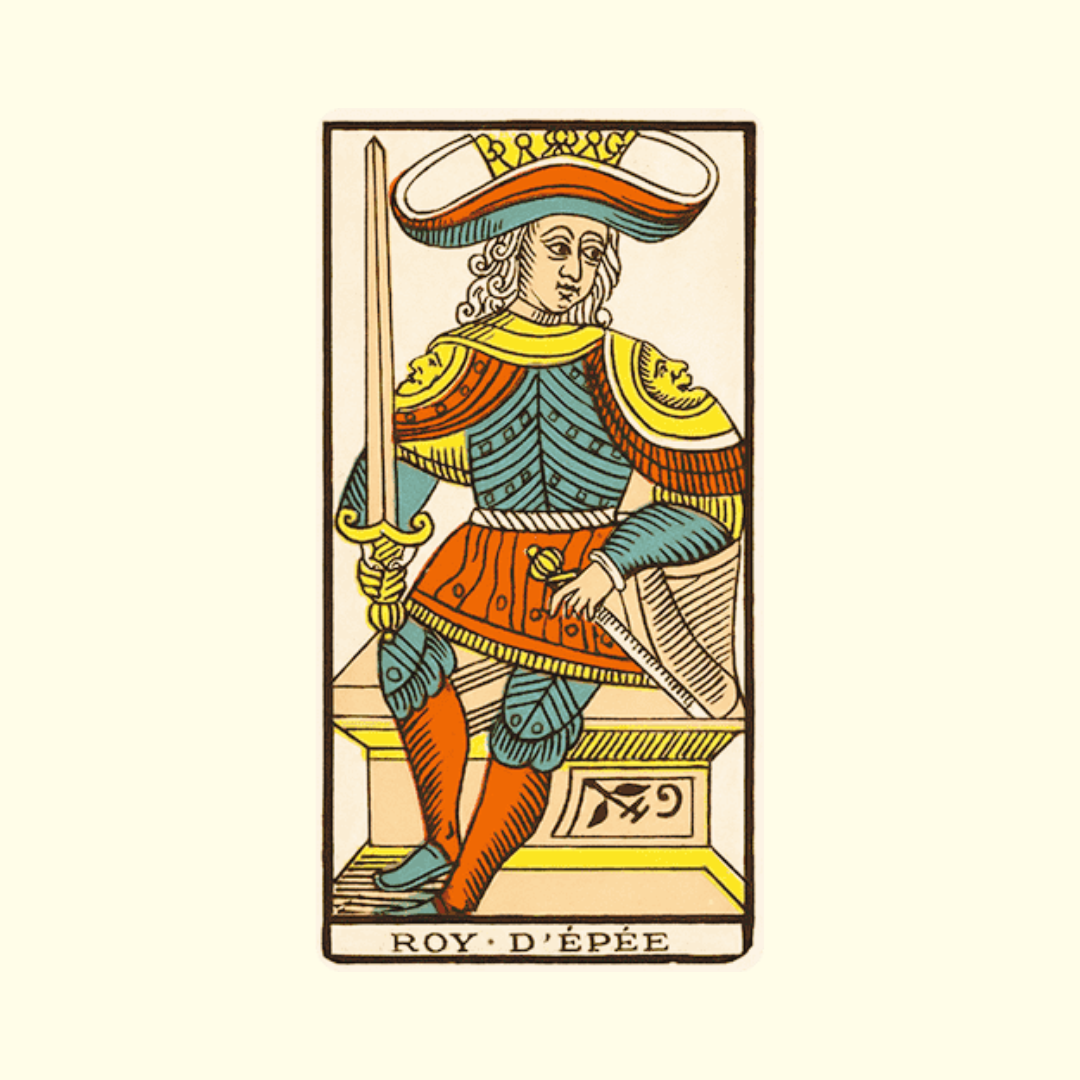

The King sits with his sword drawn. In the Tarot de Marseille, he carries the weapon as the emblem of his suit and as a sign of rank. In the Waite-Smith, he faces the reader, sword raised, in the posture of one who judges and holds office. The King of Swords represents authority given to thought, speech, and law: his decision can establish a fair framework, but that same power becomes cruelty, treachery, or domination when it escapes all contradiction.
The previous article presented an intelligent, calm, and self-possessed man. The sources describe a more demanding function. Mathers cites the legal professional, power, command, and authority. Waite speaks of judgment, law, the office of the Crown, and militant intelligence. The Golden Dawn adds an abundance of ideas, observation, slowness, distrust, and excessive caution.
The King may represent a person entrusted with a mandate: leader, arbitrator, legal professional, manager, expert, or spokesperson. It may also show the need to define a rule and take responsibility for one’s decision. The figure’s gender belongs to the historical language of the deck; the King’s function can be exercised by anyone.
From the armed sovereign to the judgment seat
In French tarot decks, the King is seated, crowned, and armed. His sword, clothing, and throne vary from one workshop to another. The card asserts a superior rank within the suit, but tells neither of a trial nor of a conviction. The idea of justice comes from the sovereign function and from later divinatory texts.
Smith places the King facing the reader, holding an upright sword. Trees and a cloudy sky unfold behind the throne, whose ornaments belong to the suit’s airy vocabulary. Waite writes that he sits in judgment and relates his posture to the conventional symbol of Justice among the major arcana. He nevertheless emphasizes the power attached to the office more than any guaranteed virtue.
Iconographic reference. The frontal pose, raised sword, and judgment seat belong to the construction of the Waite-Smith. The Marseilles King already bears the authority of his court, but no image guarantees that his verdict will be just. The weapon shows decision-making power; the neighboring cards reveal how it is used.
Divinatory transmission
In 1888, Mathers attributed the lawyer or legal man to the King of Swords, followed by power, command, superiority, and authority. Reversed, it indicates a bad man, sorrow, anxiety, distress, fear, and trouble. His catalog therefore clearly links the card to law and hierarchy, far beyond the simple portrait of a rational personality.
Book T calls its “King of Swords” the “Prince of the Chariot of the Winds.” This difference in titles comes from the classification specific to the Golden Dawn. The winged figure sits in a chariot and holds a sword and a sickle: with one, he governs; with the other, he cuts away. The text describes him as full of ideas, cautious, observant, slow, suspicious, and steadfast in friendship as in hostility. Poorly supported, he becomes harsh, malicious, scheming, obstinate, hesitant, and unreliable.
The Golden Dawn assigns him Air of Air and the area from the 20th degree of Capricorn to the 20th degree of Aquarius. Waite associates him with judgment, power, command, authority, militant intelligence, law, and royal offices. Reversed, the King becomes cruelty, perversity, barbarity, perfidy, and bad intentions. These terms show why authority can never be declared just solely because the card is present.
Meaning in a spread
In a favorable reading
The King of Swords favors a decision based on known rules, verified facts, and accepted responsibility. He may represent a competent opinion, an authority capable of explaining their reasoning, or the need to decide after hearing the parties concerned.
His strength lies in consistency. The same rule applies to everyone, the criteria come before the verdict, and the speaker is bound by their words. In a personal question, the card invites you to reclaim authority over your own narrative without turning your point of view into universal law.
In a tension reading
The King confuses power with truth. He uses the law, knowledge, or status to silence others, constructs a procedure whose rules only he knows, or fosters suspicion in order to retain control. Book T's excessive caution can also produce hesitation, surveillance, and constantly delayed decisions.
The card proves neither competence nor bad intentions. A title, uniform, or verbal fluency must be weighed against the actual mandate, the documents, and the avenues of appeal. For a legal, financial, or medical matter, the King may suggest consulting a qualified authority; he never replaces their advice.
Love, work, and finances
The King brings judgment, law, and command. The domain shows the scope of his office, while the neighboring cards indicate the facts heard, the limits of power, and the consequences of the verdict.
| Domain | Favorable reading | Tension aspect | Question to ask |
|---|---|---|---|
| Love | Clear agreement, responsible communication, and a decision made after listening to both people. | A relationship governed by unilateral rules, interrogation, and intellectual superiority. | Who defined the rule, and can the other person challenge it? |
| Work | Competent leadership, arbitration, strategy, responsibility assumed before the team. | Authoritarianism, opaque decision, expertise used to exclude dissent. | Are the mandate, criteria, and appeal process known? |
| Finances | Controlled contract, qualified counsel, budget governed by a stable rule. | Imposed clause, imbalanced power, decision delayed by excessive mistrust. | Which authority validates the document, and for how long? |
| Social life | Firm mediation, structured public discourse, protection of a common rule. | Condemnation without listening, exclusion, reputation destroyed by group authority. | Have the facts been heard separately from opinions? |
| Decision | Rational choice, clear-cut priorities, accepted responsibility. | Harshness, hostile calculation, hesitation masked by an accumulation of arguments. | What criterion makes it possible to decide now? |
Reading associations
The King gives authority to the card accompanying it. It shows the area of judgment, the rule invoked, or the force capable of limiting its power.
| Association | Possible dynamic | Point of caution |
|---|---|---|
| King of Swords + Justice | Legal decision, arbitration, rule applied with explicit responsibility. | Control the proportionality of the decision and the avenues of appeal. |
| King of Swords + Emperor | Institutional authority, structured command, executive power, and rules brought together. | The accumulation of powers can stifle all dissent. |
| King of Swords + Hierophant | Law, doctrine, counsel, or transmission confirmed by an institution. | Distinguish genuine competence, school tradition, and argument from authority. |
| King of Swords + Seven of Swords | Strategic investigation, power confronted with hidden information. | Mistrust alone is not enough to establish fraud. |
| King of Swords + Temperance | Measured arbitration, negotiated decision, authority capable of setting the pace. | Conciliation must not conceal an unequal power relationship. |
| King of Swords + Devil | Intellectual, contractual, or institutional power used to coerce. | Examine dependence, threat, abusive clause, and the real possibility of refusal. |
Correspondences according to the schools
The earlier table brought together Saturn, autumn, obsidian, cypress, and Zayin. These attributions do not form a common historical table. The Golden Dawn assigns the King Air of Air and a zodiacal zone from Capricorn to Aquarius, without assigning Saturn to him as an isolated planet.
| Reference | Attribution | Historical scope |
|---|---|---|
| Family | Minor Arcana, court figure, King of Swords | Sovereign rank of the French tarot. |
| Tarot of Marseilles | Crowned sovereign holding a sword | Court figure without a tribunal depicted. |
| Mathers, 1888 | Jurist, power, command, superiority, authority | Reversed: bad man, worry, sorrow, fear, and trouble. |
| Golden Dawn | Prince of the Chariot of the Winds, Air of Air | The text names the card “King of Swords” in its own classification. |
| Element | Air for the suit; Air of Air for the figure | English occult attributions. |
| Astrology | From the 20th degree of Capricorn to the 20th degree of Aquarius | Zodiacal domain of the figure in Book T. |
| Waite-Smith | King facing forward, raised sword, throne, and cloudy sky | Seated figure passing judgment, published in 1909. |
| Hebrew letter | No letter specific to the card | Zayin belongs to the Lovers in the Golden Dawn system. |
| Stone, plant, season | No common historical agreement | Obsidian, cypress, and autumn do not come from the cited sources. |
| Reading keywords | Judgment, law, command, expertise, authority, decision | The mandate and avenues of appeal distinguish a fair framework from domination. |
Reading advice
Write the King’s mandate in one sentence: what may he decide, for whom, and how far? Then list the evidence examined, the people heard, and the avenue of appeal. If any of these elements is missing, the card may signal incomplete authority or a premature verdict.
When the King represents the querent, replace “I am right” with a criterion that the other person can understand and discuss. When the card designates a third party, verify their title and area of expertise. The sword cuts; the fairness of the decision depends on the framework guiding the hand.
Sources and reference texts
For the history of decks and figures: Victoria and Albert Museum, A History of Tarot Cards; British Museum, reproduction of Nicolas Conver’s Tarot de Marseille.
For divinatory and occult texts: S. L. MacGregor Mathers, The Tarot, 1888, card meanings; Liber LXXVIII, “The Prince of the Chariot of the Winds,” publication of material from Book T; Arthur Edward Waite and Pamela Colman Smith, The Pictorial Key to the Tarot, King of Swords, 1911.