






























































































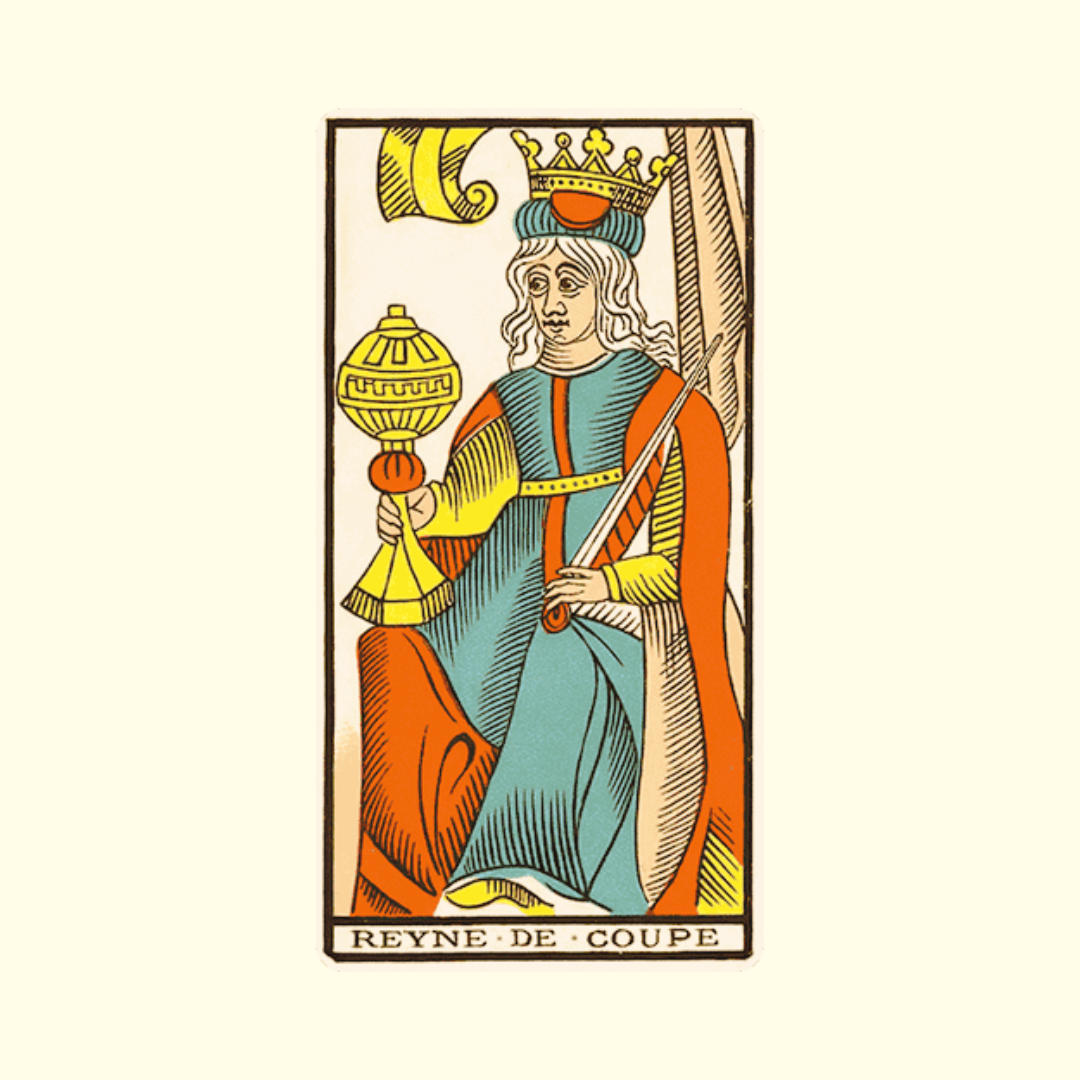

A crowned queen holds the cup before her. In the Tarot de Marseille, she presents the emblem of her suit with the gravity of a court figure. In the Waite-Smith, she contemplates a closed chalice, crafted like a small sanctuary, by the water. The Queen of Cups receives, observes, and gives form to what is said between the lines. Her power does not come from passive sensitivity: Waite reminds us that she sees, but also acts.
The Queen of Cups can represent an attentive person, an adviser, a creator, a mother, a partner, or a disposition capable of understanding feelings without confusing them with facts. She combines listening, imagination, kindness, relational discernment, and the ability to care for others. Her difficult side involves interference, dependence on the emotional climate, indirect seduction, or help that creates a debt.
Older portraits use gender, age, and hair color as selection criteria. A contemporary reading can retain the card's function without confining a person to these categories. The Queen describes a mode of authority: she governs through welcome, understanding, and sustained attention.
From the sovereign of the chalice to active listening
In a Nicolas Conver-style Tarot de Marseille, the Queen is seated and crowned. She holds a large cup close to her torso. The design of the headdress, throne, clothing, and vessel varies according to the workshops, but the figure remains stable and frontal. The cup is no longer received with the Valet's astonishment or carried along the road by the Cavalier: it now belongs to someone who assumes responsibility for guarding it.
Smith places the Queen on a stone seat by the sea. Aquatic figures adorn the throne, and pebbles cover the shore. The chalice has a lid, two handles, and ornamentation reminiscent of religious architecture. The Queen looks at it without drinking. Waite describes her as someone who sees images in the cup, then specifies that her activity nourishes her vision. The gaze comes before the act; it does not replace it.
Iconographic marker. The closed chalice, the shore, and the ornate throne belong to the Waite-Smith. The Queen of Marseille already holds the cup with authority, but without this maritime setting. In both decks, she protects something before deciding how to receive or transmit it.
Divinatory Transmission
Mathers assigns the Queen of Cups a fair woman, success, happiness, advantage, and pleasure. Reversed, she may represent a well-positioned woman who interferes in other people’s affairs and should be viewed with caution; success remains, accompanied by trouble. This catalog therefore unites benevolence and intrusion, joy and complication.
In Book T, the “Queen of the Thrones of the Waters” sits above running water and holds a cup from which a crayfish emerges. The ibis and the lotus complete her symbolism. The text describes her as imaginative, poetic, kind, and good-natured, but influenced by her surroundings and little inclined to make long efforts for others. She is assigned “Water of Water” and rules the area between the 20th degree of Gemini and the 20th degree of Cancer.
Waite describes an honest, devoted woman ready to be of service, a loving intelligence, the gift of vision, wisdom, virtue, success, and pleasure. He also adds the roles of wife and mother according to the standards of his era. These roles do not sum up the card. Its central point remains the meeting of perception and action: the Queen understands a situation, then responds with an appropriate gesture.
Meaning in a spread
In a favorable reading
The Queen of Cups encourages listening that does not immediately seek to correct or judge. She may show someone capable of receiving a confidence, identifying a need, and offering appropriate help. In a creative spread, she gives imagination a sustained form: the project gains an atmosphere, coherence, and attention to the audience’s reactions.
She also represents emotional maturity. An emotion can be heard without governing the entire decision. Kindness remains compatible with a boundary, a delay, and a clear refusal.
In a tension reading
The Queen may absorb the group’s atmosphere to the point of losing her own judgment. She then shows relational fatigue, interference, unsolicited advice, guilt used to hold someone back, a need to be indispensable, or a tendency to guess instead of listening.
Her difficult aspect can also describe a charming person whose help creates a hidden obligation. The querent benefits from distinguishing compassion, rescuing, and control. A healthy relationship allows one to give thanks, refuse, and leave without emotional punishment.
Love, work, and finances
The Queen brings understanding, acceptance, and continuity. The area shows what she protects, while the neighboring cards indicate whether her attention supports autonomy or fosters dependence.
| Area | Favorable reading | Tension aspect | Question to ask |
|---|---|---|---|
| Love | Reciprocal listening, mature affection, a partner capable of receiving sensitive communication. | Emotional sacrifice, guilt, overreading silences, the rescuer role. | Can everyone express their need without leaving the other person to guess it? |
| Work | Mediation, guidance, attentive management, coherent creative project. | Confusion of roles, favor granted according to affection, emotional overload. | Does benevolence rest on clear rules? |
| Finances | Measured assistance, decision that protects the household, thoughtful use of a resource. | Spending to console, financial support that maintains dependence, emotional debt. | Does the help have an amount, duration and limit? |
| Suit | Stable presence, confidence respected, care that lets everyone grow. | Interference, secret carried for the entire group, loyalty imposed in the name of love. | Who is actually asking for help, and in what form? |
| Creation | Disciplined imagination, right atmosphere, work attentive to human nuances. | Project absorbed by mood, difficulty finishing or receiving criticism. | What method makes it possible to preserve emotion without losing structure? |
Reading associations
The Queen brings welcome, listening and imagination. The associated card shows what she receives, the quality of her response and the necessary limit to her intervention.
| Association | Possible dynamic | Point of vigilance |
|---|---|---|
| Queen of Cups + Two of Cups | Attentive relationship, shared affection, dialogue capable of receiving a confidence. | Understanding must remain mutual. |
| Queen of Cups + Empress | Fertile creation, embodied speech, relational authority that produces a concrete form. | Do not carry all the project's responsibilities alone. |
| Queen of Cups + Justice | Listening combined with a measured decision, mediation or a clear boundary. | Feelings illuminate the choice without replacing the facts. |
| Queen of Cups + Devil | Powerful attachment, seduction, care mingled with desire or dependence. | Examine debt, control, secrecy and fear of losing the connection. |
| Queen of Cups + Moon | Intense imagination, fine perception of the atmosphere, dream or situation that is difficult to name. | Check impressions before making any accusation or promise. |
| Queen of Cups + Nine of Swords | Person who welcomes a worry or bears suffering that is not entirely theirs. | Seek qualified support and share the load. |
Correspondences according to the schools
Success and pleasure come from Mathers, Water of Water and the Golden Dawn's zodiacal domain, the closed cup and active vision from Smith and Waite. The Marseille Queen retains the throne, crown and chalice.
| Signifier | Attribution | Historical scope |
|---|---|---|
| Suit | Minor Arcana, court card of the Cups | Figure of the Queen between the Knight and the King. |
| Tarot de Marseille | Crowned and seated Queen holding a cup | The figure does not sit at the edge of the sea. |
| Mathers, 1888 | Fair woman, success, happiness, advantage, pleasure | Reversed: interference, mistrust, and success accompanied by turmoil. |
| Golden Dawn | Queen of the Thrones of the Waters | Title from Book T. |
| Rank element | Water of Water | Attribution of the Queen of Cups in the Golden Dawn. |
| Astrology | From the 20th degree of Gemini to the 20th degree of Cancer | Area attributed to the Queen of Cups by Book T. |
| Waite-Smith | Queen at the water’s edge, stone throne and closed chalice | Composition published in 1909. |
| Hebrew letter | No letter specific to this card | The letters are attributed to the trumps in this system. |
| Stone and plant | No historical consensus | Recent associations vary by author. |
| Reading words | Listening, imagination, kindness, discernment, interference | Context distinguishes welcome from emotional control. |
Reading advice
When the Queen represents a person, look for what she actually does. Does she listen, protect, advise, create, or decide? Then observe the limits of her role. Generosity becomes clearer when a beginning, an end, and a responsibility are clearly defined.
With a Waite-Smith deck, look at the cup’s lid: not everything should be opened or entrusted immediately. With a Marseille deck, observe how the figure holds the emblem. The cards placed before the Queen indicate what she contemplates; those that follow her show the response she is preparing.
Sources and reference texts
For the history of decks and figures: Victoria and Albert Museum, A History of Tarot Cards; British Museum, reproduction of Nicolas Conver’s Tarot de Marseille.
For divinatory and occult texts: S. L. MacGregor Mathers, The Tarot, 1888, card meanings; Liber LXXVIII, “The Queen of the Thrones of the Waters”, publication of material from Book T; Arthur Edward Waite and Pamela Colman Smith, The Pictorial Key to the Tarot, Queen of Cups, 1911.