






























































































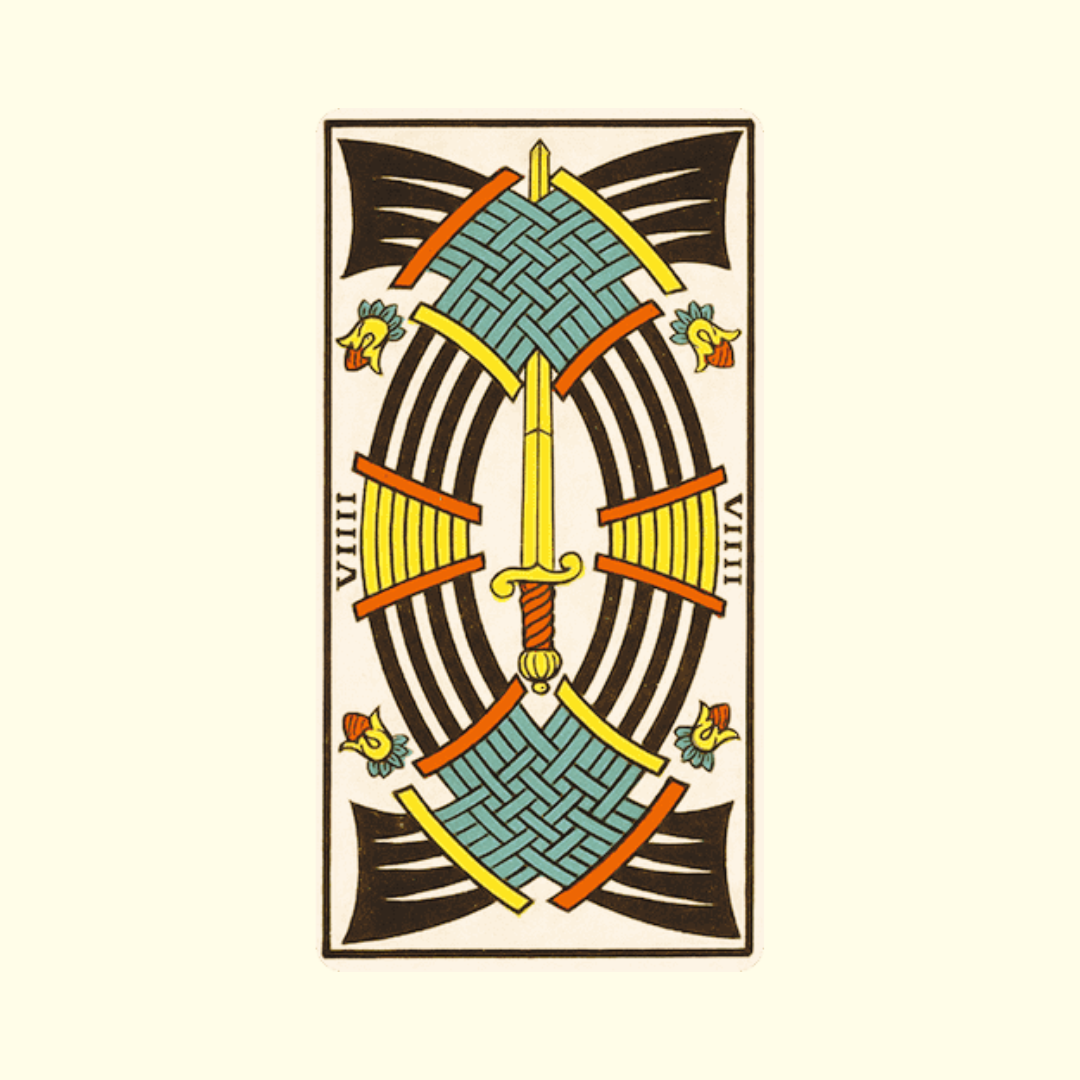

A ninth sword cuts across the arrangement of the other eight. In the Tarot of Marseille, it rises at the center of a framework of curved blades. In the Waite-Smith, a person sits upright in bed, face covered by the hands, beneath nine swords aligned in the darkness. The Nine of Swords puts the conscience to the test: fear, remorse, sorrow, or suspicion may occupy the entire night, without the card yet allowing us to confuse what is feared with what is established.
This card has become the emblem of anxiety in contemporary commentary. Smith's image supports this reading, but the older record is broader. Mathers places the priest, conscience, probity, good faith, and integrity in the foreground. The Golden Dawn adds despair, cruelty, suffering, oppression, and slander. Waite retains failure, delay, disappointment, and despair.
The Nine thus describes a thought that judges, accuses, regrets, or anticipates. It may arise from a real act, a hurtful word, a neglected duty, a reasonable fear, or a scenario without evidence. The reading must distinguish between these causes. Repeating that “everything is in your head” denies concrete difficulties; announcing certain misfortune gives the symbol an authority it does not possess.
From the ninth blade to the painful vigil
In French tarots, eight curved blades form a symmetrical enclosure around a straight sword. Vegetal motifs fill the spaces left open. No bed, night, or person appears. The card creates a tense structure in which the central axis may express an insistent idea, a decision, or a word cutting through the established order.
Smith shows a person sitting on a bed, hands held before the face. Nine swords hang horizontally against a black background. The bedspread bears roses and astrological signs, while a carved relief appears on the bed's wood. Waite describes a lamentation and extreme desolation. He mentions neither nightmares nor insomnia: these notions come from observing the scene and from later commentary.
Iconographic marker. The bedroom, the nighttime awakening, and the nine horizontal blades belong to the Waite-Smith. The Marseille shows a central sword in the middle of an abstract construction. With the English deck, suffering is given a face; with the French deck, the ninth blade forces us to seek the idea running through the entire spread.
Divinatory transmission
In Mathers’s 1888 The Tarot, the Nine of Swords represents the priest, conscience, integrity, good faith, and honesty. Reversed, it indicates wise distrust, suspicion, fear, doubt, and questionable character. He adds that the next card shows the person or thing one should beware of. His text therefore does not reduce the Nine to psychological suffering: it also questions moral judgment and reliability.
Book T calls it the “Lord of Despair and Cruelty” and assigns it Mars in Gemini. Eight swords part beneath the blow of a ninth central blade, without a rose. The text mentions despair, harshness, malice, suffering, lack, loss, oppression, lies, and slander. Depending on the card’s position, it also retains obedience, fidelity, patience, and selflessness. This ambivalence rules out a uniform reading.
Waite describes total desolation, then lists death, failure, a failed enterprise, delay, deception, disappointment, and despair. Reversed, the card receives imprisonment, suspicion, doubt, reasonable fear, and shame. These severe words belong to a divinatory list from the early 20th century. They neither allow one to predict a death, announce a pregnancy loss, nor make a diagnosis.
Meaning in a spread
In a favorable reading
The Nine can mark the moment when awareness refuses denial. A wrongdoing is acknowledged, a concern finally receives words, or a suspicion is submitted for verification. The person stops struggling against an inchoate thought and seeks to determine what concerns a fact, a responsibility, a wound, or an anticipation.
The integrity cited by Mathers offers a constructive path: tell the truth, repair what can be repaired, ask for an explanation, and act according to a clear rule. The card does not promise immediate relief. It favors moving from solitary rumination toward an approach that can be examined and shared.
In a tension reading
Thought turns against itself. Shame, fear, guilt, suspicion, or cruel words take up all the space. A mistake becomes a general condemnation, a delay is experienced as a definitive failure, or the person replays a conversation until they can no longer distinguish the words that were spoken from those they imagine.
The Nine establishes neither deception nor wrongdoing. Check the facts before making accusations, and seek real support when distress prevents sleep, work, or a sense of safety. Tarot can open a conversation; it must never trap someone in a dark prediction.
Love, work, and finances
The Nine shows a concern that calls for a specific object. The chart distinguishes useful awareness, well-founded fear, and thought that grows in the absence of evidence or support.
| Area | Favorable reading | Tension aspect | Question to ask |
|---|---|---|---|
| Love | A difficult word spoken openly, remorse followed by amends, concern expressed without accusation. | Jealousy without evidence, shame, fear of abandonment, conversation replayed throughout the night. | What fact supports the fear, and what words are still missing? |
| Work | Mistake acknowledged, inspection before delivery, responsibility taken with integrity. | Constant fear of failure, internalized criticism, delay experienced as a catastrophe. | What action can be taken right now, and who can review the file? |
| Finances | Accounts finally reviewed, debt named, advice sought before the situation worsens. | Diffuse fear of not having enough, avoided figures, shame that prevents seeking help. | What amount, date, and document need to be verified? |
| Social life | Awareness after harsh words, clarification of a rumor. | Slander, suspicion, feared damage to one’s reputation, isolation under the presumed gaze of others. | Who actually said what, and in front of whom? |
| Decision | Self-examination, time set aside to verify a real risk. | Paralysis, repeated scenarios, decision dictated by shame or fear. | What new element would make it possible to break out of the loop? |
Read the associations
The Nine intensifies thought, judgment, and pain. The associated card shows whether this vigilance leads to proof, reparation, confinement, or help.
| Association | Possible dynamic | Point of caution |
|---|---|---|
| Nine of Swords + Justice | Conscience confronted with the facts, reparation, decision or procedure that clarifies responsibility. | Felt guilt does not amount to legal acknowledgment of wrongdoing. |
| Nine of Swords + Moon | Nighttime fear, uncertain information, imagination fed by silence. | Postpone any accusation until verifiable evidence is obtained. |
| Nine of Swords + Three of Swords | Acknowledged pain, hurtful words that continue to echo. | Do not turn pain into proof of malicious intent. |
| Nine of Swords + Four of Swords | Need for rest, withdrawal after a period of mental tension. | Rest alone does not resolve the material cause of the worry. |
| Nine of Swords + Hierophant | Moral examination, confession, advice received from an authority or a framework of values. | Choose a competent person who respects confidentiality. |
| Nine of Swords + Star | Entrusted pain, sober hope, renewed connection with the future. | Calming requires real actions and time. |
Correspondences according to the schools
The former chart brought together Mars, autumn, onyx, water lily, and Yod. Only Mars in Gemini belongs to the Golden Dawn table. The season, stone, plant, and letter do not form a common historical system with it.
| Reference | Attribution | Historical scope |
|---|---|---|
| Family | Minor Arcana, Nine of Swords | Ninth numbered card of the suit. |
| Marseille Tarot | Eight curved blades around a central sword and ornaments | Court card without suit symbols, room, or character. |
| Mathers, 1888 | Priest, awareness, probity, good faith, integrity | Reversed: prudent mistrust, suspicion, fear, doubt. |
| Golden Dawn | Lord of Despair and Cruelty | Title from Book T. |
| Element | Air | Occult attribution to the suit of Swords. |
| Astrology | Mars in Gemini | Second decan of Gemini in the Golden Dawn framework. |
| Waite-Smith | Seated person on a bed, face covered, nine horizontal swords | Scene published in 1909. |
| Hebrew letter | No letter specific to the card | Yod belongs to the Hermit in the Golden Dawn system. |
| Stone, plant, season | No common historical consensus | Onyx, water lily, and autumn belong to more recent editorial lists. |
| Reading keywords | Awareness, remorse, worry, suspicion, sorrow, integrity | Facts distinguish responsibility, well-founded fear, and anticipation. |
Reading advice
Give the ninth sword a name. Is it a fault, a debt, a delay, a word, a danger, a loss, or a feared gaze? Then write two columns: known facts and added scenarios. This separation does not deny the pain; it shows where action becomes possible.
If reparation is necessary, choose a measurable action and an appropriate person to contact. If no evidence supports the suspicion, suspend the accusation. If the suffering becomes overwhelming, seek human and professional support instead of multiplying readings. Repeatedly asking the same question feeds the loop that the card represents.
Sources and reference texts
For the history of decks and suits: Victoria and Albert Museum, A History of Tarot Cards; British Museum, reproduction of Nicolas Conver’s Tarot of Marseille.
For divinatory and occult texts: S. L. MacGregor Mathers, The Tarot, 1888, card meanings; Liber LXXVIII, “The Lord of Despair and Cruelty,” publication of the Book T material; Arthur Edward Waite and Pamela Colman Smith, The Pictorial Key to the Tarot, Nine of Swords, 1911.