




























































































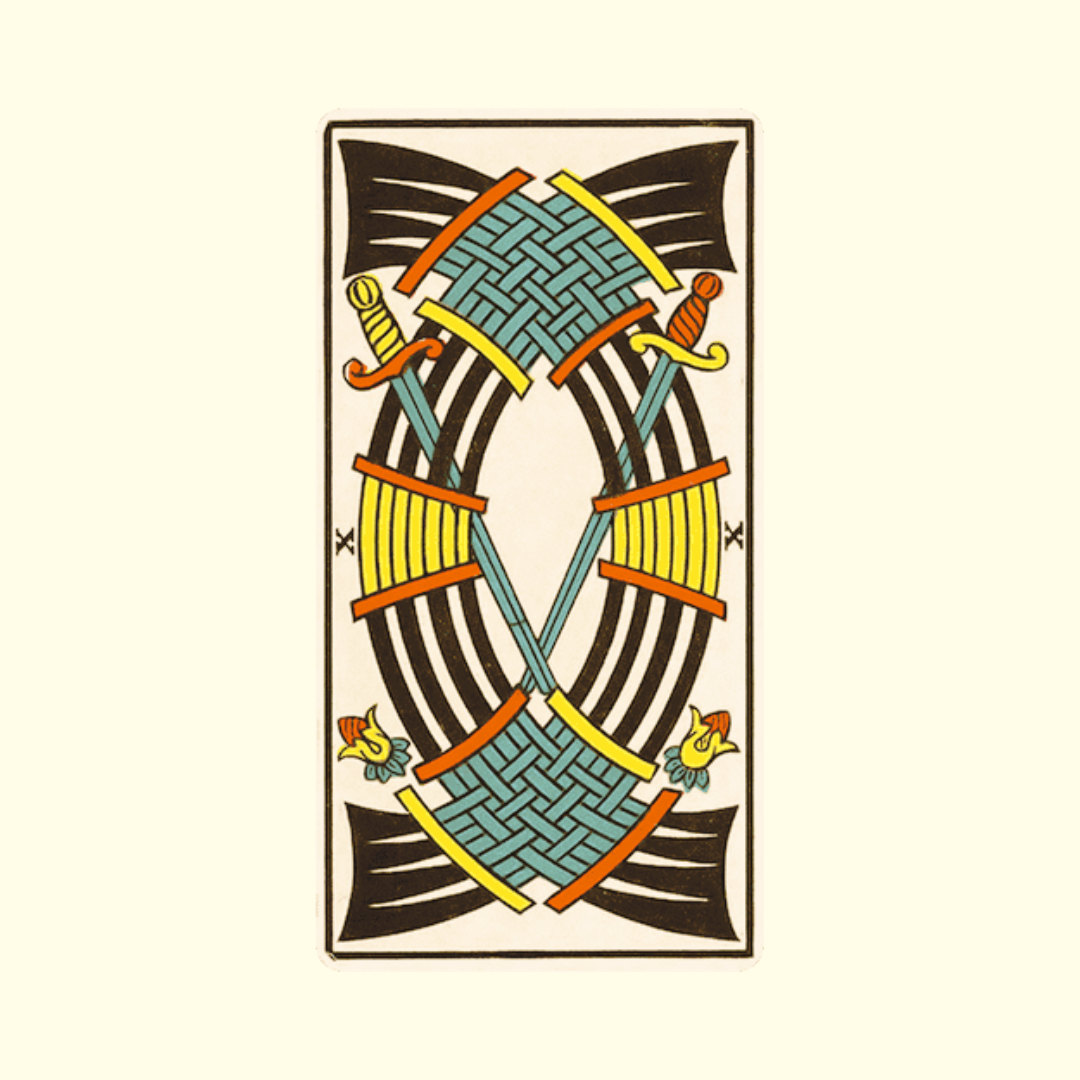

Ten swords close the numbered sequence. In the Tarot de Marseille, they form a regular, dense framework, without a victim or landscape. In the Waite-Smith, a body lies beneath ten blades while brightness appears on the horizon, beyond calm water. The Ten of Swords marks the breakdown of a plan, conflict, or discourse that has reached its point of defeat; it expresses the pain of an ending without authorizing the announcement of death, betrayal, or irreversible ruin.
Smith’s scene is so powerful that it absorbs almost all modern interpretations. The pierced figure has become an image of final catastrophe, followed by the clear sky as an automatic promise of rebirth. Waite remains more restrained: he cites pain, affliction, tears, sadness, and desolation, specifies that the card does not specifically indicate a violent death, and does not comment on the sunrise.
Nineteenth- and early-twentieth-century sources also link the Ten to speech that destroys, a disjointed plan, and short-lived success. The card may show an exhausted project, a conflict that can no longer continue in its current form, or a painful conclusion. The word “end” requires clarification: the end of what, decided by whom, with what consequences and what resources are still available?
From ten blades to a scene of desolation
In French tarot decks, ten curved blades are arranged in symmetrical bands and fill almost the entire space. Botanical ornaments punctuate the composition. No body, blood, or dawn appears. The Ten completes the structure of the suit: the swords are numerous, orderly, and leave no central space comparable to that of the odd-numbered cards.
Smith places in the foreground a figure lying face down, covered by a red cloak. Ten swords are planted in their back. The black sky occupies the upper part, but a yellow band illuminates the horizon behind the water and the hills. One hand remains visible in a position that may suggest a blessing gesture. Waite merely describes the fallen figure and refers to the meanings suggested by the drawing.
Iconographic reference. The victim, the red cloak, the landscape, and the brightness of the horizon belong to the Waite-Smith. The Marseille depicts no assault. Sunrise may support a contemporary reading of the post-crisis period, but it is not a promise made by Waite.
Divinatory transmission
In 1888, Mathers attributed tears, affliction, grief, and sadness to the Ten of Swords. Reversed, it indicates fleeting success and momentary advantage. His list does not mention betrayal. That latter idea may arise from context or association, but it should not be imposed on every appearance of the Ten.
Book T calls it the “Lord of Ruin” and assigns it the Sun in Gemini. Two crossed swords seem to separate the other eight; no rose remains. The text describes an undisciplined force at war with itself, complete rupture, failure, and the ruin of plans. It also adds disdain, insolence, useless speech, and a taste for repeating what causes harm, while acknowledging intelligence and eloquence depending on the card’s position.
Waite associates the Ten with pain, affliction, tears, sadness, and desolation. He explicitly writes that the card is not specifically one of violent death. Reversed, it brings advantage, profit, success, and favor, but without lasting, as well as power and authority. The reversal therefore does not guarantee complete healing: it may show only a respite or a temporary benefit.
Meaning in a reading
In a favorable reading
The constructive side of the Ten comes from the clarity of the assessment. A plan no longer works, a debate is exhausted, a strategy has caused all the damage it can, or words can no longer be taken back. Admitting this limit makes it possible to stop adding an eleventh sword to a situation that is already closed.
The card may still mark a conclusion that protects the future: stopping a loss-making project, ending a sterile quarrel, withdrawing from a poorly initiated procedure, or publicly correcting false information. The pain remains real, but it ceases to serve as an excuse for continuing the same mechanism.
In a tension reading
The Ten shows collapse, humiliation, a catastrophic narrative, or words that destroy more than they resolve. A person believes they are completely defeated, when only a method, an alliance, or a stage has failed. Conversely, they may deny an ending that is nevertheless visible and maintain a conflict out of pride, repetition, or a need to have the last word.
The card does not allow you to announce death, suicide, bankruptcy, dismissal, or a breakup. If the question concerns safety, health, or material loss, seek the facts and qualified people to consult. A dramatic image must never become a sentence.
Love, work, and finances
The Ten asks you to name what is genuinely coming to an end. It distinguishes the end of a system from the destruction of every possibility.
| Area | Favorable reading | Tension aspect | Question to ask |
|---|---|---|---|
| Love | The end of a repetitive conflict, an acknowledged truth, a decision that brings a harmful relationship to an end. | A rupture experienced as annihilation, cruel words, a desire to humiliate or have the last word. | What is ending: the connection, a form of the connection, or a quarrel? |
| Work | A project halted before costing more, a clear-eyed assessment, a method abandoned after failure. | Public failure, a divided team, communication that destroys cooperation. | What skills, data, or relationships remain after the halt? |
| Finances | Closing out an expense, exiting a loss-making commitment, a contained loss. | Catastrophizing, a decision made in shock, a provisional advantage mistaken for lasting recovery. | What is the true amount of the loss, and which obligation continues? |
| Social life | End of a rumor or confrontation, withdrawal from a hostile group. | Humiliation, repeated remarks, exclusion, a verbal victory that leaves everyone losing. | Which statement must stop circulating? |
| Decision | A sudden halt to a ruined plan, acceptance of a conclusion, and preparation for what comes next. | Persistence out of pride, a feeling that every path is destroyed. | Which part of the project is dead, and which part can be taken up differently? |
Reading associations
The Ten closes the sentence of the Swords. The neighboring card specifies what falls, what remains, and whether the aftermath begins with a decision, rest, or new material.
| Association | Possible dynamic | Point of caution |
|---|---|---|
| Ten of Swords + Ace of Swords | A decisive conclusion, truth that ends a narrative, or a new rule after failure. | Avoid restarting the same conflict under another name. |
| Ten of Swords + Tower | Rupture of the plan and the framework that supported it. | Secure people and property before any symbolic interpretation. |
| Ten of Swords + Four of Swords | A halt followed by a period of withdrawal and recovery. | Do not decide what comes next during the shock alone. |
| Ten of Swords + Judgement | Assessment, announcement, decision rendered, or matter recalled to be concluded. | A second reading of the facts may alter the responsibilities. |
| Ten of Swords + Six of Pentacles | Concrete help after a loss, distribution of what remains. | Check the conditions attached to the assistance offered. |
| Ten of Swords + Sun | An ending made visible, a clarified situation, a return to shareable facts. | Clarity does not erase the consequences of the rupture. |
Correspondences according to the schools
The old table associated the Sun, winter, obsidian, birch, and Yod. The Sun in Gemini does indeed come from the Golden Dawn. The other additions do not belong to the same transmission and cannot be presented as an ancient set.
| Reference | Attribution | Historical scope |
|---|---|---|
| Family | Minor Arcana, Ten of Swords | Last numbered card of the suit. |
| Tarot of Marseille | Ten curved blades in a symmetrical framework with ornaments | Suit card without a person or landscape. |
| Mathers, 1888 | Tears, affliction, grief, sadness | Reversed: passing success, momentary advantage. |
| Golden Dawn | Lord of Ruin | Title from Book T. |
| Element | Air | Occult attribution to the suit of Swords. |
| Astrology | Sun in Gemini | Third decan of Gemini in the Golden Dawn grid. |
| Waite-Smith | Body beneath ten swords, black sky, water, and illuminated horizon | Scene published in 1909. |
| Hebrew letter | No letter specific to the card | Yod belongs to the Hermit in the Golden Dawn system. |
| Stone, plant, season | No common historical agreement | Obsidian, birch, and winter belong to more recent tables. |
| Reading keywords | Conclusion, breakdown of the plan, desolation, destructive words, stoppage | The card describes a specific ending, not the end of everything. |
Reading advice
Complete the sentence “what is over is…” without using a general word. Name the project, agreement, method, deadline, or conflict concerned. Then take stock of what has not been destroyed: skills, documents, income, allies, remedies, housing, health, time, or freedom of decision.
Do not try to make the card positive at all costs. A loss may call for mourning, rest, and repair. Also refuse to turn it into an absolute condemnation. The Ten reaches the end of a series; it invites you to stop the repetition, assess the consequences, and prepare the first decision that will no longer belong to the conflict that has ended.
Reference sources and texts
For the history of decks and suits: Victoria and Albert Museum, A History of Tarot Cards; British Museum, reproduction of Nicolas Conver’s Tarot de Marseille.
For divinatory and occult texts: S. L. MacGregor Mathers, The Tarot, 1888, card meanings; Liber LXXVIII, “The Lord of Ruin,” publication of the material from Book T; Arthur Edward Waite and Pamela Colman Smith, The Pictorial Key to the Tarot, Ten of Swords, 1911.