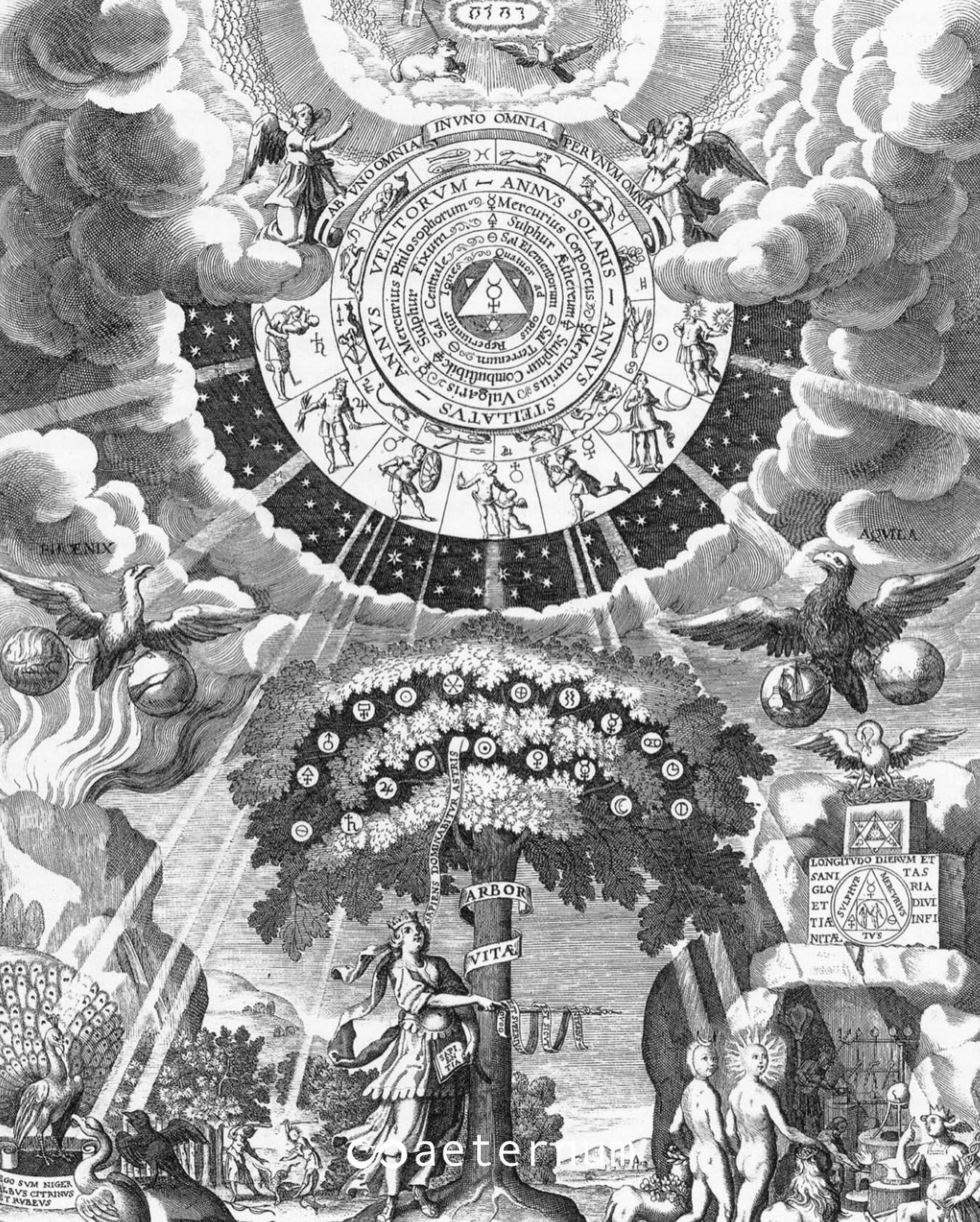






























































































The design composed of a circle, a square, a triangle, and a second circle is now presented everywhere as “the symbol of the philosopher’s stone.” This formula needs to be corrected: the figure has a precise historical source, emblem XXI of Michael Maier’s Atalanta Fugiens, published in Oppenheim in 1618. It is a major emblem of the alchemical quest, but the philosopher’s stone has received many representations over the centuries. Understanding this origin allows the geometry to be read as a process rather than as a timeless logo.
| Famous figure | Outer circle, triangle, square, and inner circle |
|---|---|
| Source | Michael Maier, Atalanta Fugiens, emblem XXI |
| Date | 1618 for the edition held by the Science History Institute |
| Purpose of the stone | Transmutation of base metals into noble metals in a large part of the tradition |
| Essential point | Maier’s figure is a major historical emblem, not a universal glyph used by all alchemists |
What was the philosopher’s stone for alchemists?
The philosopher’s stone belongs among the most famous goals of Western alchemy. Texts present it as a substance or preparation capable of achieving the transmutation of metals, particularly transforming metals of lesser value into gold or silver. The Science History Institute notes that this research occupied experimenters in the 16th and 17th centuries and formed part of a theory of matter in which transmutation appeared possible.
The stone is not necessarily reduced to a rock in the ordinary sense. The word may refer to the completed product of the Work, a powder, a tincture, or a prepared substance whose descriptions vary according to the author. This flexibility explains the richness of its iconography.
Accounts also attribute medicinal properties to it or associate it with the elixir of life. These themes may overlap, but they should not be merged without examining the source. One author may emphasize metallic transmutation, another medicine, and yet another a philosophical theory of the perfection of matter.
The search for the stone also produced genuine laboratory practices: calcination, distillation, sublimation, separation of metals, and the preparation of salts. The history of alchemy is therefore reduced neither to a fantastical quest nor to poorly formulated modern chemistry. It combines a theory of matter, experimentation, medicine, metallurgy, and emblematic language.
Where does the famous circle, square, and triangle come from?
The clearest source of the modern figure is emblem XXI of Michael Maier’s Atalanta Fugiens. The Science History Institute holds the engraving published in Oppenheim in 1618. Its Latin title can be summarized as follows: from the male and female, make a circle; from that circle, a square; from the square, a triangle; then once again a circle, and the philosophers’ stone will be obtained.
The image shows a man and a woman integrated into a geometric demonstration. A figure traces the shapes with a compass, transforming an alchemical instruction into a geometric problem. The stone thus appears as the result of a succession of constructions, not as a simple pictogram placed beside a word.
Utpictura18, a database of Aix-Marseille University, preserves a notice devoted to this “Geometry of the Philosopher’s Stone” and precisely connects the image to Maier and the Atalanta Fugiens. This point helps dismiss modern legends that present the drawing as a very ancient character transmitted without change.
The cover of this guide should therefore remain faithful to the emblem’s structure: circle, square, triangle, and circle. Adding runes, planets, or alphabets unrelated to the engraving would diminish the motif’s historical force.
How should Michael Maier’s construction be read?
The first thing to retain is the movement. The man and woman form an initial duality; geometry leads them toward totality. The circle, square, and triangle are not simply three “meanings” to be added together. They constitute the stages of a transformation described by the emblem.
The square can naturally evoke the four and therefore the four elements. The triangle can open onto alchemical or philosophical triads. The circle can express wholeness and fulfillment. But the reading must remain connected to Maier’s text: the author primarily gives an instruction for moving from one form to another in order to arrive at the stone.
This caution avoids a frequent flaw in modern explanations, which assign each shape a complete dictionary without a source. The emblem functions as a global composition. Its strength comes from the articulation between sex, number, geometry, and transmutation.
The context of the Atalanta Fugiens reinforces this reading. The book associates fifty emblems with texts and musical fugues. Alchemy is staged there through several media: image, motto, epigram, discourse, and music. Isolating emblem XXI from this architecture helps identify its design, but its historical meaning belongs to the work as a whole.
Is there a single historical symbol for the stone?
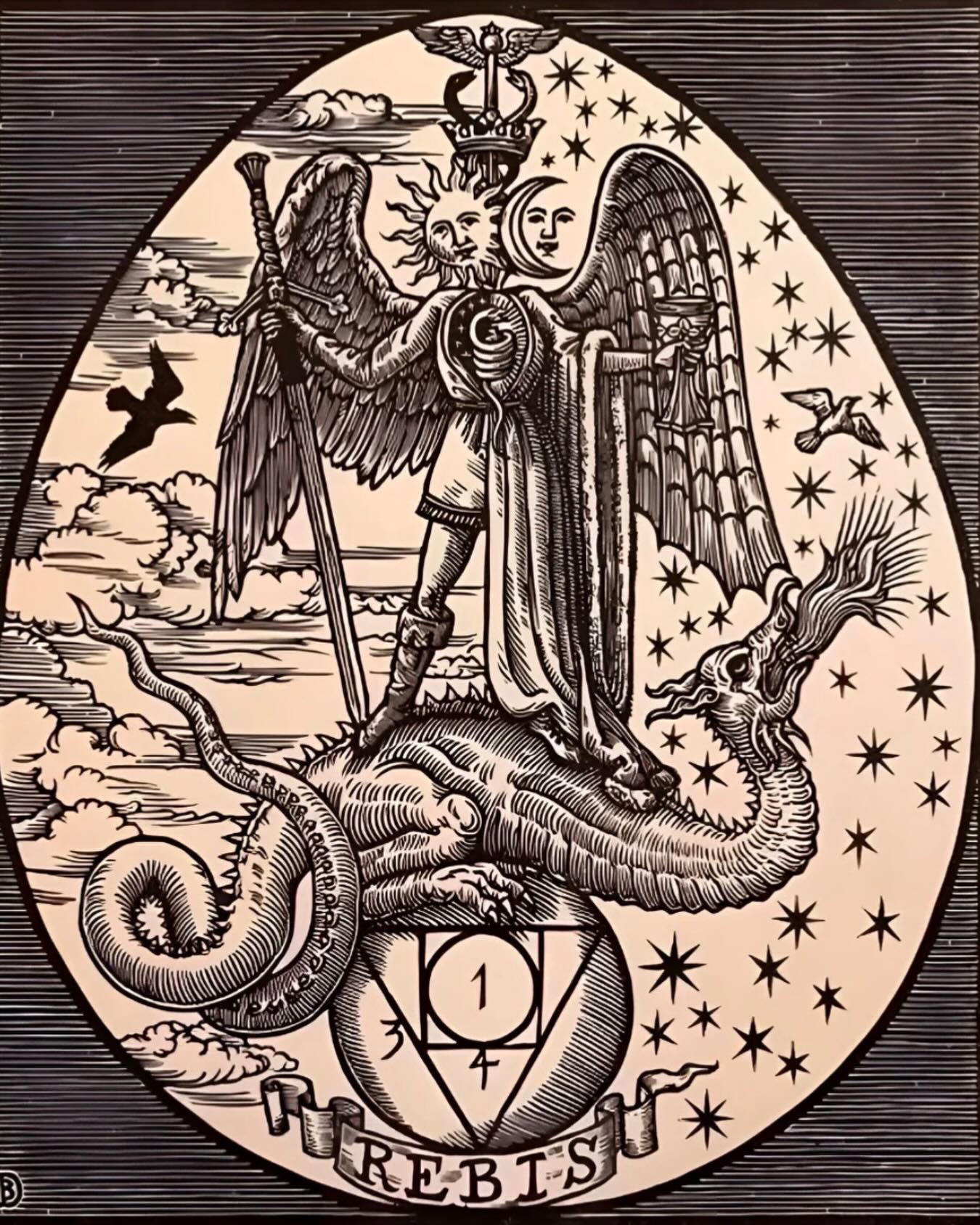
No. The philosopher’s stone has been depicted through very different images: a stone, king, child, royal body, red or white substance, tree, sun, couple, animal figures, or geometric compositions. The texts do not possess a standardized alphabet in which one glyph would designate the stone everywhere in the same way.
The fame of Maier’s construction lies in its legibility and graphic power. Modern reuses have transformed it into an almost official emblem. It is therefore legitimate to present it as the best-known symbol today, provided that its origin is specified.
This distinction is important for any research into historical iconography. Finding a circle, square, and triangle in a manuscript does not automatically identify the stone; conversely, an image of the stone may contain none of these shapes. The caption, neighboring text, and provenance should guide the interpretation.
What is its connection with the Ouroboros, elements, and Tria Prima?
The Ouroboros offers another image of totality: the serpent joins its own tail and transforms the line into a living circle. In Greek and later European alchemy, it can represent the unity of matter and its return to itself. Maier’s geometry and the Ouroboros are not the same figure, but they allow two ways of representing fulfillment and transformation to be compared.
The four elements - Fire, Water, Air, and Earth - form a quaternary that can illuminate the presence of the square in alchemical readings. The three principles - Sulfur, Mercury, and Salt - offer another system of three.
Nevertheless, the square should not automatically be turned into the “four elements” and the triangle into the “Tria Prima,” as though Maier had provided this modern caption. The comparison is useful for understanding the alchemical vocabulary of number and form, but it must remain a connection, not a forced translation.
This is the method that gives the symbol of the stone its value: begin with the 1618 engraving, follow Maier’s text, then compare the figure with the other systems in the Grimoire without inventing a universal origin.
Sources and historical reference points
The Science History Institute holds emblem XXI of the 1618 Atalanta Fugiens and its motto devoted to the philosophers’ stone. The Utpictura18 database of Aix-Marseille University analyzes the same engraving. For the historical role of the stone in metallic transmutation and 17th-century experimentation, see “Dr. Butler and the Quest for the Philosophers’ Stone”.