
















































































































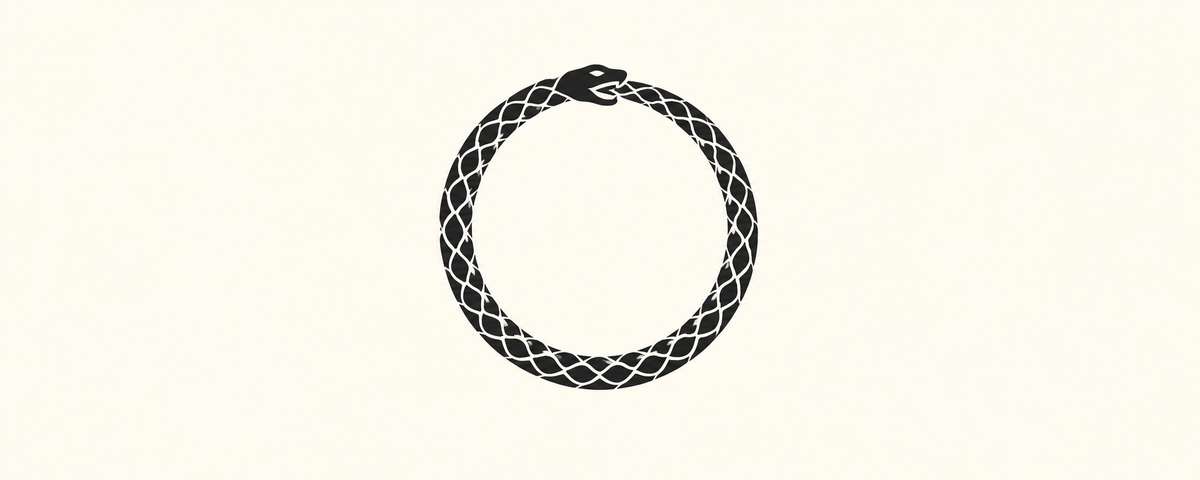
The ouroboros represents a serpent or dragon whose mouth meets its own tail. The animal circle seems to unite beginning and end in a single movement, which has encouraged interpretations linked to the cycle, return, and unity. Yet the symbol’s history requires greater precision: the “tail-in-mouth” serpents of pharaonic Egypt do not necessarily carry the meaning of “eternity” that Europe would later give them, while Greek and then European alchemy makes the ouroboros a major image of matter transforming and returning to itself.
| Form | Serpent or dragon curved until it places its tail in its mouth |
|---|---|
| Ancient references | Egyptian funerary iconography, followed by the Greco-Egyptian world and Late Antiquity |
| Name | From the Greek ouroboros, “tail-devouring” |
| Major alchemical reference | Ouroboros accompanied by the Greek formula hen to pan, “One is the All” |
| Interpretation to qualify | The automatic association with “eternity” does not describe every ancient context |
What really defines an ouroboros?
The sign is recognized by a precise gesture: the animal reaches its own extremity. The body forms a circle or loop, and the head grasps, bites, or receives the tail. The drawing may be very spare or filled with details: scales, wings, two colors, inscriptions, planetary signs, or figures enclosed at the center. The fundamental structure remains that of a living being that becomes its own boundary.
This characteristic distinguishes the ouroboros from a simple circular serpent. In historical study, the position of the head and tail, the text accompanying the image, and what lies inside the circle matter as much as the overall impression. Artists may use the loop to encircle a deity, delimit a protective space, or express a cosmological principle.
The form explains its visual power. A geometric line has a beginning and an end; the ouroboros makes them coincide within the body of an animal. It thus becomes an ideal image for thinking about a process that returns to its origin. This interpretation is especially strong in alchemy, but it should not erase the older functions of the circular serpent.
What do the first “tail-in-mouth” serpents mean?
Ancient Egypt provides very early depictions of serpents folded back upon themselves. In the funerary iconography of the New Kingdom, serpents associated with the underworld surround or protect divine figures. The motif then participates in a conception of the sun’s nocturnal passage, protection, boundaries, and regeneration.
The modern interpretation that immediately translates the Egyptian ouroboros as “eternity” nevertheless calls for restraint. An academic study devoted to the Egyptian ouroboros shows that several meanings that became standard in Europe were retrospectively projected onto pharaonic images. The idea of a serpent directly representing eternal time largely belongs to the later reception of the motif.
This nuance does not diminish Egypt’s importance; it makes it more interesting. A “tail-in-mouth” serpent may define a protected space or participate in solar transformation without being an abstract pictogram of infinity. The British Museum notably preserves an Egyptian amulet of Bes whose base bears an ouroboros serpent accompanied by dangerous animals: the image functions within a specific protective context.
It is therefore best to avoid the overly quick statement “the Egyptians used the ouroboros to symbolize eternity.” The iconographic reality is richer: protective serpent, boundary, underworld, solar cycle, and renewal combine differently depending on the objects and texts.
Why does “One is the All” become a central formula?
In the Greek alchemy of Egypt, the ouroboros receives a formulation that shaped its entire later history. A famous drawing transmitted in alchemical manuscripts attributed to Cleopatra the Alchemist shows a circular serpent associated with the Greek expression hen to pan, generally rendered as “One is the All” or “The All is One.” The image no longer speaks only of a circle: it formulates a conception of the unity of matter.
The serpent may be divided into light and dark parts, reinforcing the idea of a unity capable of containing opposing states. Alchemy works precisely on this tension: separating, purifying, dissolving, uniting, and recomposing. The ouroboros becomes an especially effective sign for representing matter that transforms without leaving the same whole.
This logic illuminates the connection with the three alchemical principles of Sulfur, Mercury, and Salt. These principles were not invented by the ouroboros and belong to a later history, but they extend the same ambition: to think about matter through qualities that separate and reunite during the Work.
How does the ouroboros accompany the Great Work?
In European alchemy, the motif continues to circulate in manuscripts, emblems, and illustrated collections. It may surround a composition, enclose a scene, or become the principal subject itself. The Science History Institute preserves three 15th-century alchemical miniatures from the tradition of the Buch der heiligen Dreifaltigkeit, in which the ouroboros appears within an elaborate alchemical iconography.
The serpent that consumes and sustains itself at the same time provides a powerful image for the repeated operations of the Work. Matter is heated, dissolved, separated, and reassembled; what seemed destroyed returns in a new form. The serpent’s loop can then express circulation and return, without needing to assign it a rigid translation valid for every manuscript.
The connection with the symbol of the philosopher’s stone is particularly fruitful. For Michael Maier, the stone is expressed through a construction of circle, square, triangle, and then circle; in the ouroboros, wholeness takes the form of an animal closing in on itself. Both images speak of fulfillment through transformation, but they do so with different visual languages.
The ouroboros can also function as a boundary. When it encircles a group of figures, it turns the outline into an active element: what lies inside belongs to a closed cycle. The serpent does not merely decorate the scene; it defines the space in which transformation is conceived.
Cycle, eternity, regeneration: what can we really say about it?
The safest meaning is that of returning to oneself: the end meets the beginning. From this structure arise ideas of cycle, continuity, renewal, and wholeness. Eternity becomes an important interpretation in Renaissance Europe and the centuries that followed, but it should not be automatically projected onto every ancient representation.
Regeneration fits many alchemical and funerary contexts, provided that the specific document is examined. The serpent may express matter renewing itself, the solar journey, or a protected space. The image also combines a harsher dimension: the animal feeds on itself. Creation and destruction are therefore brought together in the same gesture.
This is precisely what distinguishes the ouroboros from a simple symbol of infinity. Its loop is not abstract: it is made of flesh, jaws, and tail. The sign speaks of a living whole that maintains itself through its own transformation. This tension explains its longevity in alchemy, art, and contemporary esotericism.
Sources and historical references
For the caution required when approaching modern interpretations of the Egyptian ouroboros, see Dana Michael Reemes, The Egyptian Ouroboros: An Iconological and Theological Study, University of California, 2015. The British Museum preserves an Egyptian amulet decorated with an ouroboros serpent. For its presence in medieval European alchemy, see the alchemical miniatures of the Science History Institute.










