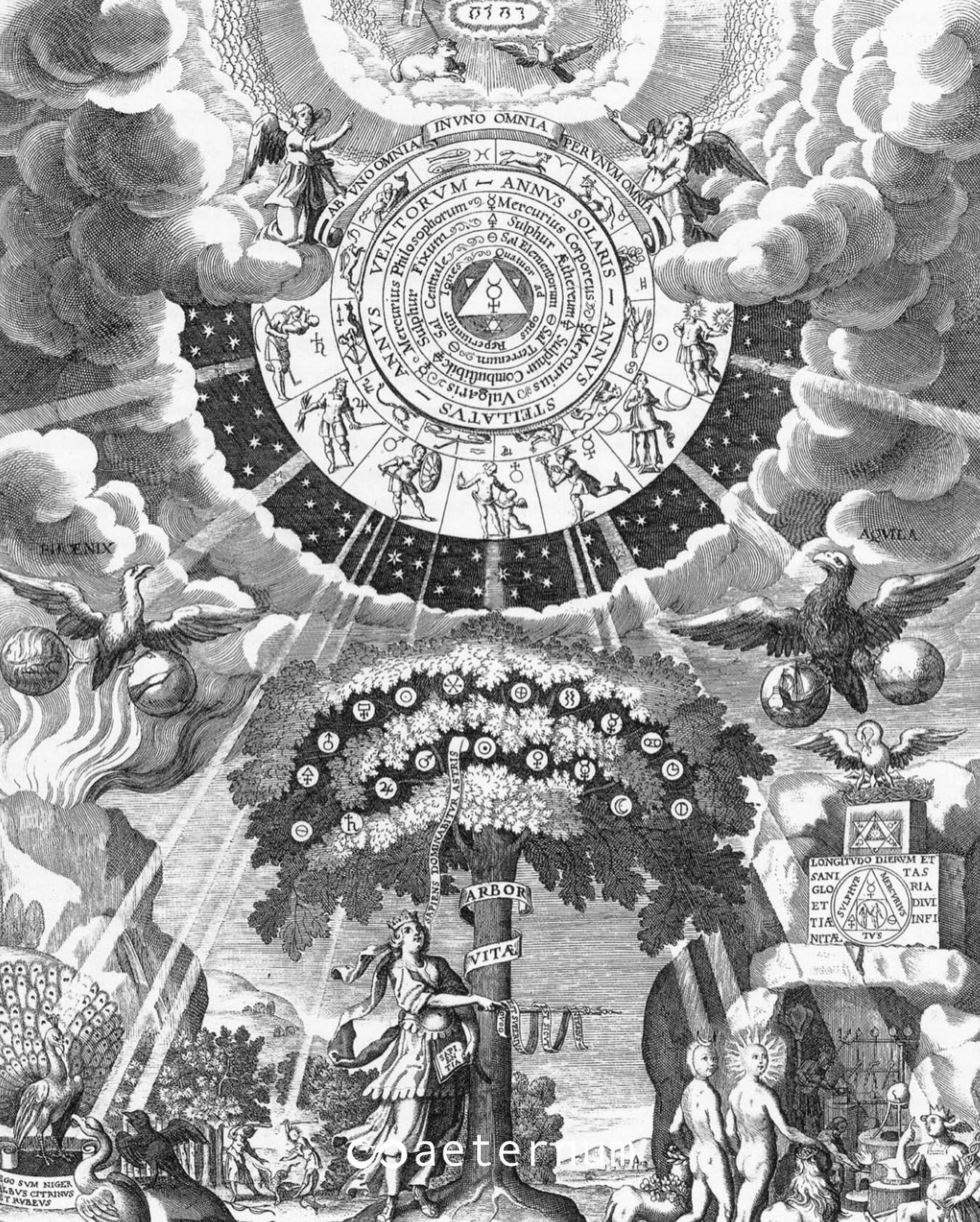































































































The alchemical symbol for Salt, 🜔, is a circle crossed by a horizontal line. Its form may appear simpler than that of Sulfur or Mercury, but its historical role is significant: Paracelsus added Salt to the ancient Sulfur-Mercury pair and developed a triad intended to explain the properties of matter. In the Tria Prima, Salt corresponds to what remains, resists volatilization, and is found in the residue after the action of fire.
| Glyph | Circle crossed horizontally — 🜔 |
|---|---|
| Name | Salt, Sal |
| Major system | Tria Prima of the Paracelsian tradition |
| Paracelsian property | Fixity, non-volatility, residue after combustion |
| To distinguish from | The principle of Salt, material salts, and modern sodium chloride |
How can you recognize the alchemical symbol for Salt?
The character 🜔 consists of a circle crossed by a horizontal bar. Unicode classifies it among the alchemical symbols for salt, vitriol, and nitre, and also distinguishes several characters for rock salt or other salts. This plurality reminds us that ancient chymical notation had a much richer vocabulary than the handful of glyphs that have become famous today.
In a manuscript, the bar may extend slightly beyond the circle or remain enclosed within it. Modern typography provides a regular version; ancient sources show freer forms of writing. Identification therefore depends on the overall structure and the context.
The sign should not be confused with the barred triangle of Earth. The two may be associated through themes of stability and fixity, but they belong to two distinct systems.
Why does Salt become the third principle?
Medieval theories of metallic matter largely rested on a Sulfur-Mercury pair. At the beginning of the 16th century, Paracelsus added Salt and formulated a theory based on three principles. Histories of science describe this development as an extension of the earlier model: the Tria Prima were then used to account for the composition of metals, and more broadly for matter.
The change is important because it adds a category for what remains. Sulfur accounts for what burns; Mercury for what smokes, volatilizes, or appears fluid; Salt for the fixed part that resists and is found in the ashes.
This theory is therefore based on a simple experience of separation by fire. It transforms a laboratory observation into a general model of matter. It is precisely this transition from technical action to principle that gives the three terms their force in Paracelsian alchemy.
What is the connection between Salt, ash, fixation, and residue?
When organic material burns, part of it disappears as smoke or vapor, part fuels the flame, and part remains as ash. For Paracelsus, this decomposition could serve as a model for distinguishing the three principles. Salt corresponds to the fraction that remains, to what does not fly away and resists the action of fire more strongly.
This fixity does not mean absolute immobility. Material salts can be dissolved, crystallized, calcined, or recombined. The principle of Salt instead describes a pole of stability and corporeality within a theory of separation.
The connection with Earth becomes understandable here. The element Earth represents cold and dry in the classical quaternary; Salt represents the fixed part in the Paracelsian triad. Later authors may establish correspondences between the two, but the resemblance does not erase their historical difference.
This notion of fixation also occupies an important place in the vocabulary of the Work. To “fix” a volatile substance means giving it a new stability. In this language, Salt can become an image of the form retained after transformation.
Is the Salt of the philosophers table salt?
No. Sodium chloride is a salt in the sense of modern chemistry and could obviously have been known and used as a material, but the Salt of the Tria Prima does not simply refer to this ingredient. It constitutes a theoretical principle applied to what remains fixed and non-volatile.
Ancient vocabulary also requires particular attention, because the word “salt” covers a very broad family of substances: rock salt, nitre, sal ammoniac, metallic salts, or products obtained through calcination and leaching. Alchemical characters distinguish several of these materials.
Reading 🜔 as “table salt” in every context would therefore be just as mistaken as reading ☿ solely as a planet or 🜍 solely as chemical sulfur. The passage, the operations described, and the other signs provide the correct scale of interpretation.
How should Salt, Sulfur, and Mercury be read together?
The Tria Prima form a system. Taken in isolation, each principle loses part of its meaning. Sulfur shows combustibility; Mercury, volatility and fluidity; Salt, fixity. Together, they make it possible to describe what a body reveals when subjected to separation operations.
Philosophical interpretations later associated this triad with the body, soul, and spirit. These readings played a major role in the history of alchemy and occultism, but they do not constitute an absolutely stable table. Authors change the correspondences or emphasize other properties.
The best guide therefore remains the material behavior described by the Paracelsian tradition. This foundation then makes it possible to understand the symbolic elaborations without reversing the historical order.
The triad also sheds light on the philosopher's stone, since many authors seek to unite, purify, or recompose the principles of matter. No glyph of the Tria Prima by itself constitutes “the symbol of the stone”; rather, they belong to the language used to consider its preparation.
Sources and historical references
Unicode lists 🜔 as the alchemical symbol for Salt and distinguishes several characters for other salts. For Paracelsus's addition of Salt to the Sulfur-Mercury pair and the formation of the Tria Prima, see the historical study “Rusticall chymistry” and the article devoted to Paracelsus.