




































































































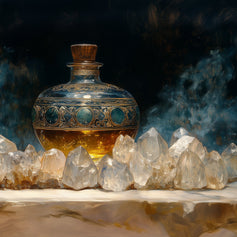














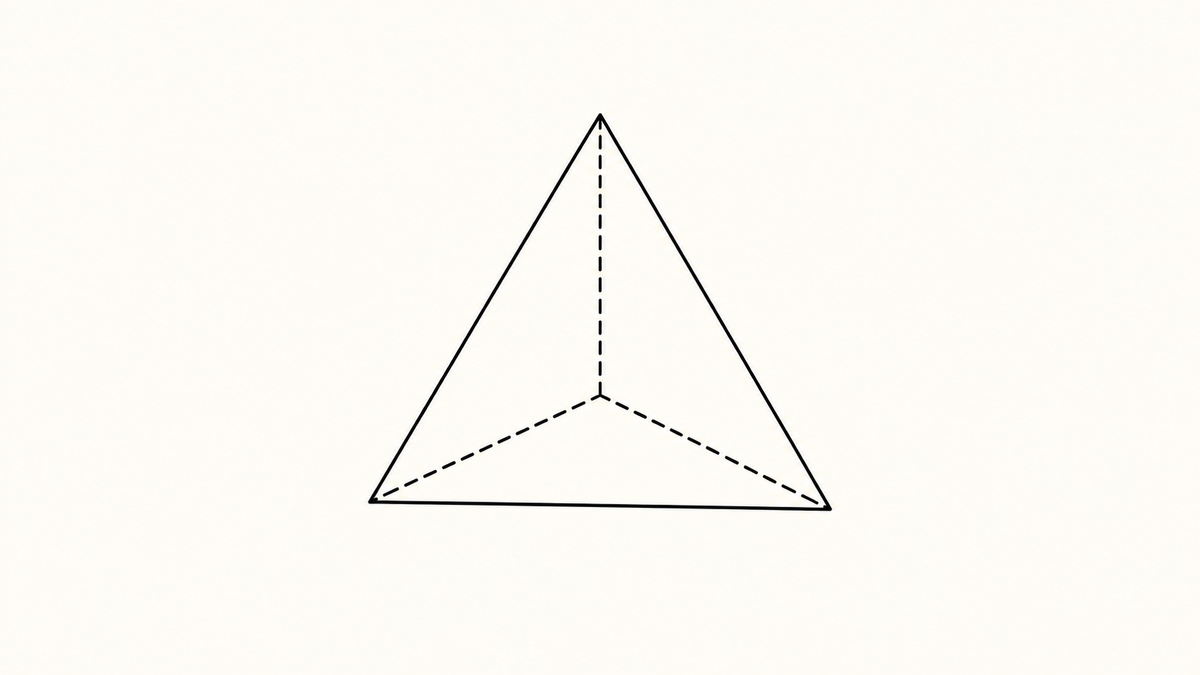
The tetrahedron is the simplest of the five convex regular solids. Its four faces are equilateral triangles, and three faces meet at each vertex. In the Timaeus, Plato associates this solid with fire, whose mobility and power of division seem to him to correspond to the sharpest form. Renaissance Hermetic authors and contemporary schools of sacred geometry take up this association, which belongs to the history of natural philosophy rather than to the actual physical composition of flames.
| Faces | 4 equilateral triangles |
|---|---|
| Edges | 6 |
| Vertices | 4 |
| Duality | Self-dual |
| Element according to Plato | Fire |
How can you recognize and construct a regular tetrahedron?
Four equal equilateral triangles assemble into a closed volume in which three faces meet at each vertex. The six edges all have the same length.
This structure is the smallest possible for enclosing a volume using flat triangular faces. It can be obtained by folding the net of four connected triangles.
Why is the tetrahedron associated with fire?
In the Timaeus, Plato associates the tetrahedron with fire, the octahedron with air, the icosahedron with water, and the cube with earth. He describes the small triangular bodies as particularly mobile and penetrating.
The association is a proposition from Greek natural philosophy: it does not mean that fire is actually composed of tetrahedral molecules in the sense of modern science.
What makes its symmetry remarkable?
The tetrahedron can be rotated around several axes while retaining an indistinguishable shape. Its self-duality means that the polyhedron obtained by connecting the centers of its faces once again has the shape of a tetrahedron.
This geometric self-similarity contributes to its interest in harmony diagrams and nested solid constructions.
How is it connected to the Merkaba?
Two regular tetrahedra arranged in opposite orientations form the stella octangula, a figure widely known by the modern name Merkaba.
The assembly contains two complete tetrahedra, while their common intersection forms an octahedron. The distinction between an isolated solid and a compound of two solids helps explain modern three-dimensional drawings.
Why does the tetrahedron appear in contemporary occultism?
Sacred geometry schools draw on Plato’s correspondences to connect the five solids with a cosmology of the elements. Tetrahedra may then appear on diagrams or talismans as an image of fire.
The historical genealogy is fairly clear: Greek philosophical speculation, polyhedral geometry, Hermetic reception, and then modern reinterpretations. The periods should not be conflated.
Sources and historical reference points
Plato, Timaeus, 53c–55c, translation available through the Internet Classics Archive. Euclid, Elements, Book XIII details the constructions of the regular solids; Wolfram MathWorld, “Platonic Solid” provides their mathematical characteristics.










