
















































































































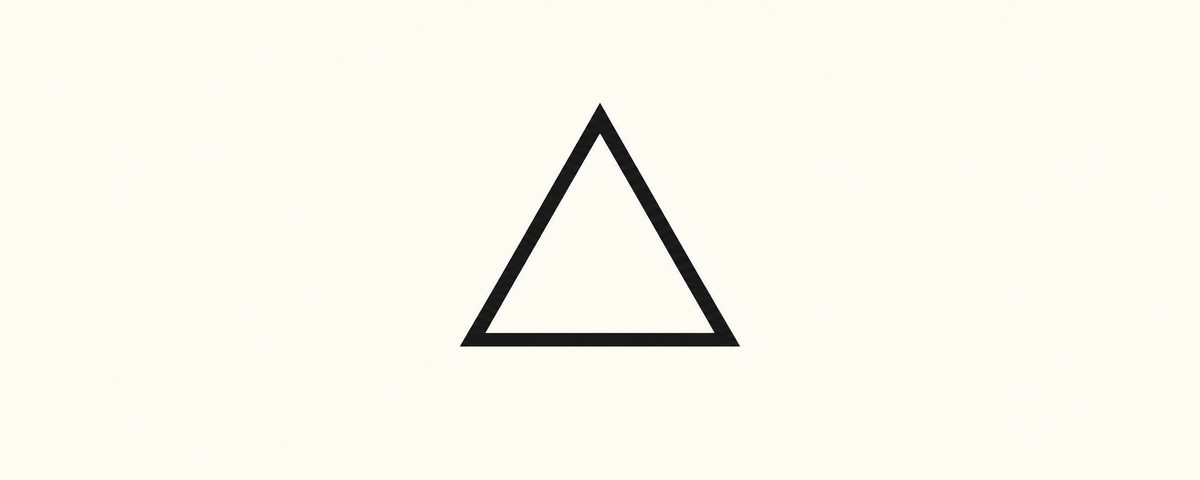
The alchemical symbol for fire is an upward-pointing triangle, now immediately recognizable in charts of Western elements. Yet two histories must be distinguished: that of the Fire element, inherited from Greek philosophy and transmitted to the Arabic and then Latin worlds, and that of the triangular glyph, which belongs to a later alchemical notation. The sign thus condenses an ancient theory of matter and a graphic language developed by European chymical traditions.
| Glyph | Triangle pointing upward — 🜂 |
|---|---|
| Element | Fire |
| Classical qualities | Hot and dry |
| Opposing element | Water, cold and moist |
| Historical reference | Ancient elemental theory; triangular notation attested in European alchemical traditions |
Why is fire represented by an upward-pointing triangle?
In modern alchemical repertories and tables of chymical characters, fire is represented by a triangle with its point facing upward. Unicode preserves this character today under the name “Alchemical Symbol for Fire,” establishing its contemporary typographic form without claiming that it dates back unchanged to antiquity.
The upward orientation lends itself to an obvious visual reading: the flame rises, heat lifts air and vapors, and fire transforms matter by producing smoke, ash, and volatile substances. This graphic correspondence helps memorize the sign, but it is not enough to recount its origin. The Greek philosophers who developed the theory of the four elements did not describe this triangle as the ancient character of fire.
The distinction is important for a historical reference sheet. Empedocles, Aristotle, and their successors provide a cosmology of the elements; alchemists and chymists of later centuries developed notation systems intended to abbreviate materials, operations, and principles. The triangle of fire belongs to this second layer.
What does a hot and dry element mean?
In the Aristotelian model transmitted to Arabic and then Latin alchemy, the four elements arise from combinations of qualities. Fire combines heat and dryness; air, heat and moisture; water, cold and moisture; earth, cold and dryness. This organization does not describe four pure substances observable in a flask, but a system for thinking about the constitution and transformation of bodies.
The Science History Institute summarizes this theory in its study devoted to Arabic-language alchemy: hot + dry leads to fire, hot + moist to air, cold + moist to water, and cold + dry to earth. A body is understood as a mixture of these qualities in varying proportions. Changing their balance makes it possible to conceive of a transformation of matter.
Fire therefore has a much broader theoretical role than the visible flame. It represents the hot and dry pole of the quaternary. In a diagram, it connects to air through heat and to earth through dryness; water is opposed to it because it combines the two contrary qualities.
Why is fire indispensable to alchemical work?
Alchemy is not merely a language of emblems. It also develops in workshops where people heat, melt, calcine, sublime, and distill. Mastery of heat is therefore an essential technical skill. A furnace that is too hot can destroy a volatile substance; insufficient heat can prevent a reaction or separation; prolonged heating gradually changes the material.
The texts distinguish several ways of heating: direct fire, a sand bath, a water bath, gentle heat, or more intense heat. Behind the images of “philosophical fire” lies a material world of furnaces, crucibles, retorts, and alembics. Reading fire exclusively as will, passion, or inner energy would erase this historical dimension.
This technical function also explains the close connection between fire and transformation. A solid substance melts, a liquid produces vapors, a compound calcines and leaves a residue. Alchemists see heat daily make visible what was contained within bodies. Fire thus becomes both a laboratory tool and a category for thinking about change.
In the quest for the philosopher’s stone, controlling heat plays a central role in many texts, even when the authors describe the operation through images and riddles. Fire is not the stone by itself, but it makes possible the work through which substances are transformed.
How does fire interact with water, air, and earth?
The four glyphs form a remarkably economical system. The symbol of water reverses the triangle and points it downward. Air takes up the ascending triangle of fire, adding a horizontal bar. Earth takes up the descending triangle of water with the same bar.
The geometry therefore reproduces relationships: fire and air rise; water and earth descend; air and earth bear a bar. The system of qualities adds another reading. Fire and air are hot, fire and earth dry, air and water moist, and water and earth cold. No element is isolated.
This framework also helps explain certain interpretations of the hexagram. In modern occultism, the superimposition of the fire triangle and the water triangle becomes an image of the union of opposites. This is an interpretation specific to certain systems, not an explanation of all historical hexagrams.
How is the fire triangle reinterpreted in modern magic?
The ceremonial traditions of the 19th and 20th centuries took up the alchemical triangle and incorporated it into tables of correspondences. Fire could then be linked to a direction, a color, a ritual weapon, divine names, and categories of spirits. It also acquired values of activity, expansion, purification, and will.
These correspondences extend certain traits of classical fire, notably heat and activity, but they constitute a more recent construction. A medieval natural philosophy treatise, a chymical laboratory manual, and a ceremonial magic ritual do not speak exactly the same language, even when they use the same triangle.
The symbol should therefore be read in successive layers: first, the hot and dry element of natural philosophy; then, the alchemical notation symbol; finally, the ritual correspondences developed by modern occultism. This chronology avoids attributing a fixed definition to the sign since antiquity.
Historical sources and reference points
The 🜂 character is listed by Unicode among the alchemical symbols for the Aristotelian elements. For the theory of the four qualities and its transmission in Arabic-language alchemy, see Gabriele Ferrario, “Al-Kimiya: Notes on Arabic Alchemy”, Science History Institute.










