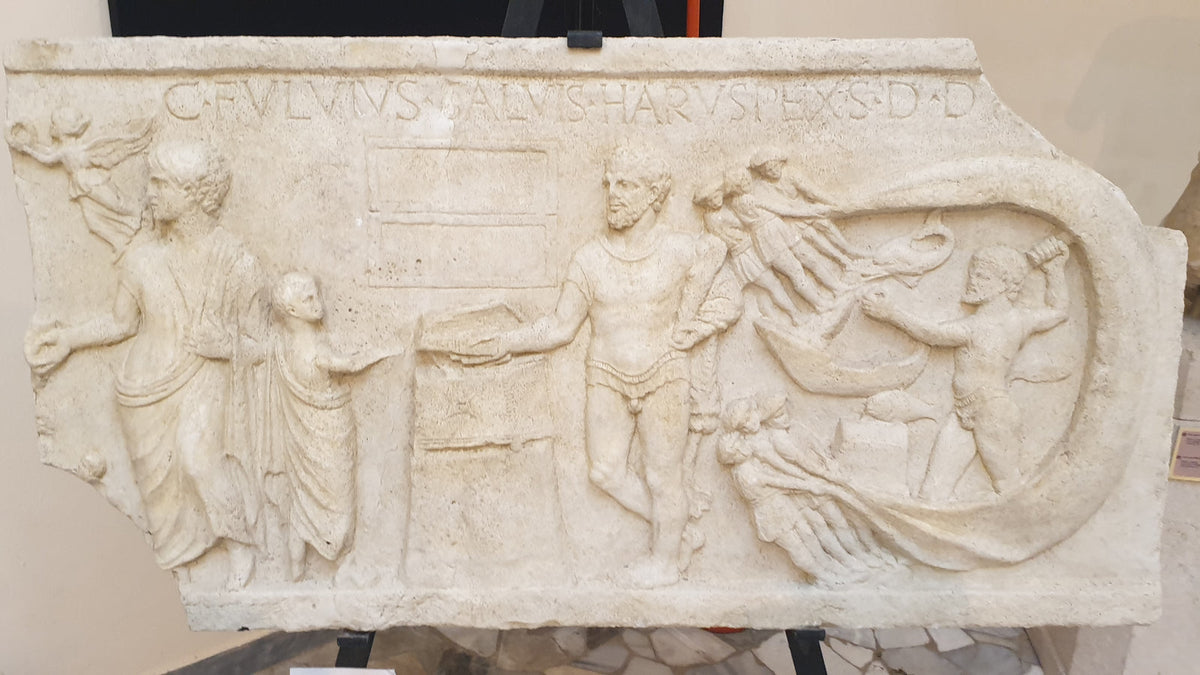
In ancient Italy, signs from the gods were not always sought above people’s heads. The sky, lightning, and birds had their language, but the entrails of animals offered to divine powers could also be understood as a surface on which destiny appeared. According to their inherited tradition, specialists recognized indications of the relationship between people and deities there. Romans called them haruspices. Their knowledge, associated primarily with the Etruscans, could concern an anxious family, a magistrate, or the Senate. An organ could thus become the starting point for a public pronouncement.
It would be reductive to view haruspicy as a sacrificial scene intended mainly as spectacle. For its practitioners, it was a discipline based on transmitted correspondences and interpretations. The liver held a special place, but haruspices also understood signs from lightning and prodigies—events believed to have religious significance. Roman institutions could ask them to interpret unsettling manifestations. This authority did not eliminate disagreements, political rivalries, or philosophers’ questions about the reliability of omens.
The surviving objects trace a remarkable journey from Mesopotamia to Italy’s sanctuaries. Inscribed clay livers were found in the palace of Mari. A small bronze model discovered near Piacenza in 1877 preserves the names of Etruscan deities. Engraved mirrors depict seers, while Cicero recounts political disputes prompted by the haruspices’ responses. These witnesses do not all concern exactly the same tradition, and substantial gaps remain. Together, however, they illuminate a central idea: the animal body could be regarded as an image of a greater sacred order.
The Liver as an Image of the World’s Invisible Order
The Latin term extispicium refers to divination from entrails, while the modern word hepatoscopy applies specifically to the liver. Haruspicy more precisely denotes the full range of skills of haruspices, experts in the Etruscan tradition. The distinction matters because antiquity never had one method of interpreting omens shared by all its peoples. A Roman augur, for example, had particular institutional duties concerning auspices, distinct from those of a haruspex. Signs involving birds and phenomena attributed to the gods could intersect in the city’s religious government, but their interpreters were not interchangeable. Precise vocabulary helps us understand a culture in which reading divine messages was recognized expertise.
Why the liver rather than another organ? Ancient societies gave this part of the body considerable importance within their ideas about life and bodily functions. In some traditions, its contours and variations could be interpreted through religious categories. The organ was conceived as a small-scale image of the universe, with regions corresponding to divine powers. An anatomical feature became a sign to read within a system transmitted by specialists. This was not a scientific property enabling the liver to predict the future: it was a historical doctrine that reveals how communities understood their relationships with the gods. That distinction does not diminish its symbolic coherence.
The earliest important material parallels come from Mesopotamia. Experts called bārû knew methods of interpreting omens involving animal organs. Cuneiform texts and clay models attest to complex teaching. Archaeology does not justify presenting Mesopotamia as a primitive stage leading inevitably to Rome. Near Eastern cultures had their own deities, languages, and institutions. Similarities between liver models invite comparison but do not, by themselves, prove direct transmission between schools. What we see first is the antiquity of a belief: an event within a living body could carry meaning for human affairs.
At the royal palace of Mari on the Middle Euphrates, thirty-two clay liver models were discovered during excavations led by André Parrot in the 1930s. The University of Hamburg presents them as major documents from the early 2nd millennium BCE. The Louvre holds example AO 19829, from the apartments of Zimri-Lim’s palace. Its cuneiform inscription mentions an omen of imprisonment. This detail links a material representation of the liver with the memory of a feared event. It also shows that interpretations could be written down, preserved, and compared rather than depend solely on individual inspiration. These objects reveal a religious practice tied to documentary knowledge.
The exact role of each Mesopotamian model must nevertheless be considered separately. Researchers suggest teaching, consultation, or the recording of noteworthy observations. Finding several pieces in a palace does not reveal the words spoken around each one. The British Museum also owns a clay liver model, inventory 92668, associated with this learned tradition. Another example, BM 50494, carries indications about the organ’s parts and their significance. The symbolic division into favorable and unfavorable areas belongs to ancient categories, rather than medical diagnosis. Archaeologists can describe objects, inscriptions, and provenances; they cannot turn this information into a fully recovered ceremony.
These pieces show how writing helped stabilize divinatory knowledge. A mark meant something only within a shared repertoire of correspondences. Surviving texts reveal an organization of responses, precedents, and categories. Knowledge could thus pass between generations in specialist circles. Liver models in Mesopotamia and Etruria make cultural contacts between the East and the Mediterranean especially intriguing. Yet chronological differences and the loss of many sources prevent a complete genealogy. Etruscan haruspicy must therefore be understood through its own remains while taking its place in a broader history of relationships among bodies, signs, and divine power.
The Etruscans Entrusted Haruspices with Reading Divine Signs
Etruscan civilization played an essential role in central Italy before its cities were incorporated into the Roman world. It had sanctuaries, a written language, and a religious life known to us largely through indirect evidence. Romans attributed to the Etruscans a body of knowledge called the disciplina Etrusca. It concerned the interpretation of entrails, lightning, and certain prodigies. Latin writers’ preservation of its name reflects the authority of this heritage. It also calls for care: the authors who inform us viewed Etruscan traditions from another culture and generations after their supposed formation. Their accounts must be compared with inscriptions and archaeology.
Ancient writers told of a figure named Tages who appeared in a plowed furrow near Tarquinia. He was said to have a child’s appearance and an old man’s wisdom. According to the myth, his words revealed divinatory teachings subsequently recorded and transmitted by the Etruscans. Cicero recounts the story in Book 2 of De divinatione. It gives the discipline a sacred beginning connected with the nourishing earth. It is not evidence that Tages existed historically. Rather, it explains why practitioners could present their knowledge as an inheritance received from divine power instead of a human invention. The contrast between a youthful face and ancient wisdom heightens that traditional authority.
The Etruscan specialist also appears in images. The Vatican Museums hold a celebrated bronze mirror from Vulci dated to the late 5th century BCE. Its reverse depicts an old man bent over a liver, identified by an inscription as Kalkhas, an adaptation of the Greek seer Calchas’s name. The figure has wings, an exceptional attribute emphasizing his role as intermediary between human and divine worlds. His foot rests on a stone, a detail the Vatican Museums interpret symbolically as contact with the earth. This scene should not become a literal illustration of every action performed by haruspices. It is a religious and artistic work in which Greek and Etruscan traditions meet.
A bronze mirror discovered at Tuscania and held by the National Archaeological Museum in Florence depicts another scene associated with knowledge of omens. Several figures, identified by inscriptions, gather around Pava Tarchies, associated in some scholarly interpretations with the transmission of the discipline. The image suggests the prestige of knowledge communicated before witnesses. Names, poses, and objects inform research into Etruscan narratives, but proposed identifications with figures known from Latin authors remain open to discussion. Treating the scene as an administrative document with every detail definitively explained would go too far. Its value lies precisely in its access to a culture that also expressed itself through images.
A haruspex was therefore not simply a figure withdrawn into a private relationship with the sacred. His authority could matter to groups awaiting an accepted interpretation. Within the doctrine, prodigies and natural signs were possible manifestations of a divine order. Someone claiming to understand them acted as intermediary and bore responsibility toward those seeking his words. His prestige depended both on the knowledge attributed to his tradition and on communities’ trust. This social dimension helps explain why Roman institutions, despite differing from Etruscan cities, continued to seek interpretations attributed to this ancient religious expertise.
Etruscan ideas about lightning seem connected with an organized vision of the sky whose regions belonged to distinct powers. Examining organs could share the same ambition to make the cosmic order readable. Such comparisons do not reduce haruspicy to Renaissance astrology. They instead show the importance ancient cultures gave to correspondences between the visible world and divine order. Our article on the astrologers’ thirty-six decans explores another historical division of the sky. The traditions can be compared through their symbolic organization without assuming identical origins or exact correspondences between their categories.
The Liver of Piacenza Preserves Divine Names in Bronze
On September 26, 1877, near Gossolengo in the Italian region of Piacenza, a farmer discovered a small bronze object while working in the fields. Shaped like an animal liver, it bore Etruscan inscriptions. It is now held at the civic museum of Palazzo Farnese in Piacenza, among the archaeological collection’s major pieces. Information published by the city dates its manufacture between the 2nd and 1st centuries BCE. The bronze was donated to the museum in 1894. Its discovery matters because it was found outside its ancient context of use. We know its material, inscriptions, and general provenance, but not who used it.
The Liver of Piacenza measures about 12.6 by 7.6 centimeters, with a maximum height of roughly 6 centimeters. It reproduces the outline and some features of a sheep’s liver. Its upper surface is divided into areas bearing engraved names, while a series of compartments runs around the edge. The municipal record mentions approximately forty Etruscan inscriptions. Some correspond to divine names; others remain difficult to identify. The bronze is more than decoration. It materializes structured knowledge in which a sign’s position within an organ could relate to divine authority. This relationship among anatomy, inscription, and symbolic space makes it indispensable to the history of haruspicy.
The sixteen divisions around the edge have attracted researchers’ attention. They have been compared with ancient accounts dividing the Etruscan sky into sixteen regions. They may express a correspondence between an organ’s surface and a cosmic organization. Yet the exact interpretation of every compartment is not established. Etruscan is not wholly incomprehensible, but the loss of many religious texts deprives specialists of commentary that could connect each name with a precise doctrine. We must therefore distinguish what can be read on the metal from hypotheses explaining the whole system. Calling it a sacred map is illuminating, provided we do not arbitrarily project our own system of signs onto it.
Names associated with Tinia, Uni, and Nethuns, members of the Etruscan pantheon, are among those recognized in the inscriptions. Comparisons with certain Roman gods are possible, but automatic equivalence would erase Etruscan religion’s distinctive features. These names remind us that a part of the liver derived meaning from more than a number or shape. It belonged to relationships between divine powers. Names associated with the Sun and Moon have also been identified on another face, notably Usil and Tivs in epigraphic studies. These readings suggest the breadth of possible correspondences without allowing the entire Etruscan celestial world to be reconstructed from one object.
Archaeologists debate the bronze’s exact practical function. Its small size, orderly design, and inscriptions suggest a model for preserving or transmitting specialist knowledge. It may have aided learning, but no text associated with its discovery supplies ancient instructions. Presenting that hypothesis as certainty would fill the sources’ silence with imagination. Mesopotamian clay models offer a stimulating comparison: they show that the liver could become an object of study and a writing surface in several ancient societies. Yet that resemblance does not turn the Mari pieces into directly documented ancestors of the Piacenza bronze.
The museum thus preserves more than an unusual curiosity. One object brings together the memory of the Etruscan language, religious representations of the body, and the wish to classify the world’s powers. The bronze also belongs to a period when Etruria had already undergone major political changes under Roman influence. Its late manufacture shows that some categories of the discipline retained a cultural place even as Etruscan civilization’s structures changed. This small liver became central evidence because it gives concrete form to Latin writers’ allusions. Its engraved names help us approach an ancient system without reducing it to the judgments of outsiders.
The Responses of Haruspices Influenced Roman Power
The Roman Republic constantly considered the quality of its relations with the gods. A military victory, inauguration of an office, or extraordinary phenomenon could raise a religious question. Magistrates had different procedures and authorities depending on the sign involved. Haruspices, associated with the Etruscan heritage, were consulted particularly about entrails and prodigies. Their presence did not mean every political decision awaited consultation. Rather, it shows a society treating signs as part of public responsibility. Relations with the divine were not understood solely as an inward matter: they could concern the whole city and the stability of its institutions.
Prodigies were events to which a community attributed exceptional religious significance. Atmospheric phenomena, disturbing noises, or unusual occurrences could be reported to the authorities. The central question was not simply to predict a date or catastrophe. It concerned how the gods were believed to address the city and which interpretation should be accepted. In this setting, the specialist’s words carried particular weight. They could help identify a religious disturbance and give an event institutional meaning. This collective dimension distinguishes public haruspices from modern portraits of independent diviners predicting a client’s personal future.
Cicero’s speech De haruspicum responso illuminates these issues. Delivered to the Senate in 56 BCE, it belongs to his dispute with Publius Clodius. Haruspices had interpreted disturbing manifestations as signs of offenses against the gods. Clodius sought to connect responsibility with affairs surrounding Cicero’s house. The orator turned the accusation against his opponent. This is a political and polemical speech, not an impartial investigation of signs. Yet its very intensity proves that the response attributed to religious experts held authority that participants in Republican debates might try to appropriate.
Mary Beard analyzed the episode in an article published in 2012 in the Journal of Roman Studies. She emphasizes the relationship between prodigies’ audible manifestations and the human voice claiming to convey their meaning. A divine message did not necessarily appear as an immediately comprehensible sentence. It had to be made to speak within a religious and political framework. Cicero’s dispute shows how contested this translation could be. The Roman world was therefore not a place where a sign automatically imposed a unanimous decision. Institutions, personal rivalries, and interpretive traditions together shaped its reception.
In military affairs, omens could also influence leaders’ expectations. Ancient historians associate signs with campaigns, defeats, and successes, but their narratives were composed after events and served literary purposes. Treating every announcement as a proven prophecy would be unwarranted. These episodes do show, however, that divine favor concerned those commanding armies. Haruspices did not monopolize omens: auspices, oracles, and interpretations of prodigies belonged to neighboring fields. This variety of religious authorities reveals a world where political uncertainty and trust in the gods met through several forms of consultation.
The votive relief of Gaius Fulvius Salvis, held at the museum in Ostia and chosen to illustrate this article, offers another view of a haruspex’s status. An inscription identifies him, while scenes depict an oracular response connected with Hercules. The work comes from the surroundings of the Temple of Hercules at Ostia and dates to the late Republic. It does not directly depict the examination of a liver: a tablet and the figure of Victory belong to its imagery. This clarification avoids attributing to it a scene it does not show. Above all, it reveals the visible presence of a man bearing the title haruspex in a religious world where several ways of obtaining divine responses coexisted.
The Memory of Haruspices Outlives a Lost Religious Discipline
Today we can bring together objects ancient people would never have seen assembled: the Mari models at the Louvre, Mesopotamian collections at the British Museum, the Calchas mirror at the Vatican Museums, and the Liver of Piacenza in its municipal museum. This intellectual gathering results from centuries of excavation, collecting, and philological research. It enables comparison but carries a danger: erasing the distances between societies. Similarity of form does not prove continuous transmission. Each object must first recover its date, language, and context. The history of divinatory knowledge benefits from these distinctions because they show how different cultures organized their relationships with signs.
Roman authors did not share a single opinion about divination. In Book 2 of De divinatione, Cicero presents philosophical objections to the story of Tages and to certain techniques’ claims to know the future. The same Cicero intervened publicly in discussions prompted by a response from haruspices. We should not flatten that difference by assuming he always spoke in the same capacity. A philosophical text and a speech to the Senate serve different purposes. Ancient controversy reminds us that a religious tradition could be respected as an institution while questioned as an explanation of the world. Such tensions already belonged to Roman thought.
Haruspicy should also be distinguished from the other divinatory arts explored in the Aeternum Notebooks. Geomancy’s sixteen figures use a language of signs transmitted in different historical contexts. Knucklebones in the Greco-Roman world could refer to responses recorded in oracular inscriptions. Haruspices, by contrast, were linked to Etruscan doctrines concerning the liver, entrails, and prodigies. Their common ground is the idea that a visible form can be received as a message. The objects, categories, and institutions giving that message meaning differ. Historical comparison does not require inventing a common origin for every method.
The loss of Etruscan religious texts leaves questions open. We do not know the complete teachings attributed to the disciplina Etrusca. The Piacenza bronze’s surviving inscriptions supply names but no full commentary on their relationships. Mirror images attest to seers’ importance without preserving their words. Latin authors transmit narratives and judgments shaped by their own times. These gaps do not diminish the tradition’s interest; they encourage precise reading. Respect for ancient knowledge also means refusing to present a recent reconstruction as an attested practice. Authentic evidence does not need amplification through invented details.
The place of sacrifice in these societies should likewise be acknowledged without turning it into an invitation to reproduce ancient customs. Texts and remains belong to religious traditions whose social conditions differ from those of the contemporary world. What history can convey here is the symbolic logic that made an organ represent divine regions and human events. A haruspex’s knowledge depended on his place in the community and on recognition of his interpretation. It was neither simple anatomical observation nor medical diagnosis. Studying this tradition means studying a religious language, its authorities, and its political development.
The small bronze liver found near Piacenza remains the most eloquent image of this heritage. Its surfaces still bear the names of powers the Etruscans assigned a place in the world’s order. It reminds us that a civilization could see living matter as the reflection of a cosmos inhabited by gods. Around it emerge specialists, institutions, debates, and human fears about the future. Haruspices are therefore more than picturesque figures from a vanished antiquity: they show how societies entrusted some of their decisions to the reading of signs. Their religious discipline cannot be recovered in full, but its traces still illuminate the meeting of destiny, power, and sacred knowledge.

Par Olivier of Aeternum
Passionate about esoteric traditions and the history of the occult from the earliest civilizations to the 18th century, I share articles exploring these subjects. I am also a co-founder of Aeternum, the online esoteric store.