



















































































































At Conques, pilgrims from several provinces entered the abbey church to approach a golden figure seated on a throne. Its glass eyes seemed to meet the visitors’ gaze. Behind the metal plates and colored stones lay what they had come to seek: a relic attributed to Saint Faith. Elsewhere in Europe, the same desire for closeness led the faithful to stand before a silver arm raised in blessing, a shrine covered in enamel, or a casket whose crystal revealed a fragment of bone. A reliquary was not merely a beautiful box. It brought a material remnant into the living relationship between the faithful and their saints.
This tradition long predates the masterpieces of Gothic goldsmithing. The first Christians kept the memory of martyrs alive around their burial places. As shrines and pilgrimages developed, holy remains were placed in containers that could be transported, venerated, or displayed. The presence of a relic brought prestige to a monastery, enhanced a church’s reputation, and attracted travelers seeking intercession. A fragment might be very modest in material terms, but its history linked it to someone regarded as close to God.
The reliquary therefore served several distinct purposes. It protected the preserved matter, conveyed its name, marked its importance, and made it accessible to the eye, or at least to memory. The works preserved in church treasuries and museums help us understand this thinking without inventing ceremonies that have disappeared. They show the role of goldsmiths, builders, and donors; the communities’ hopes for protection; and the efforts made over the centuries to identify the remains and pass on their provenance.
From the First Martyrs to the Great Christian Shrines
At the beginning of this story lies the tomb. For the Christian communities of the Roman Empire, a martyr’s burial place was no ordinary location. It recalled a fidelity to Christ maintained until death and a hope of resurrection. The faithful could gather on the anniversary of the death, understood as the martyr’s entry into heavenly life. This attention to the body did not imply worship of the remains. It expressed the conviction that the human body had shared in a holy life and remained bound to its story. L’funerary space became a place of memory and collective prayer.
The Martyrdom of Polycarp, a Christian account of the death of the bishop of Smyrna in the 2nd century, offers valuable testimony. Chapter 18 explains that members of the community collected Polycarp’s bones after his execution and placed them in an honored location so that they could commemorate his martyrdom there every year. The text declares them more precious than gems and gold. This hierarchy of values is fundamental: the small remains of a man faithful to Christ could be worth more than a luxury object. This passage does not yet describe medieval reliquaries, but it sets out the principle that would give their ornaments meaning.
In Christian Rome, basilicas developed near martyrs’ tombs, and burial sites became part of a geography of devotion. Visitors did not come to view a collection; they sought a place associated with a venerated person. Inscriptions, architecture, celebrations, and the location of the altar could signal the presence of the remains. Some relics remained inaccessible beneath the stone, which did not prevent their reputation from spreading. It would be inaccurate to imagine that all early shrines had a precious casket displayed to the public. The visibility of relics and the forms used to house them changed over the centuries.
An episode in Milan, dated to 386, helps us understand this development. Ambrose, bishop of Milan, had the bodies attributed to the martyrs Gervasius and Protasius sought out, then had them moved to a new basilica. Augustine, who was living in Milan at the time, recounts the events in Book 9 of his Confessions. He describes the enthusiasm of the population and reports a healing attributed to contact with a cloth that had touched the remains. This last claim belongs to Augustine’s religious testimony: it documents how his contemporaries understood the event, but does not constitute independent medical verification. Above all, the account reveals the importance that the presence of the martyrs had acquired in the city’s public life.
The transfer of a relic from one place to another is called translation in ecclesiastical terminology. The word refers to much more than the transport of an object. A translation could be accompanied by a procession, singing, and gatherings. On some occasions, it transformed the status of a building, making it the center of a new devotion. Communities could make the saint whose remains they received their particular protector. The transported material made it possible to link two places in a shared history, while lending additional significance to the receiving sanctuary. The reliquary would become a favored instrument of this circulation.
Body fragments were not the only materials invested with religious value. Fabrics or objects that had come into contact with a tomb or a relic could be preserved as witnesses to this proximity. Historians use the term contact relics for some of these objects. Their function differs from that of a bone or body part, and present-day classifications should not be applied uncritically to every period. Augustine’s account of a cloth associated with the martyrs of Milan nevertheless shows that indirect contact could matter as much in accounts of devotion as seeing the remains themselves. This logic explains the development of containers designed to protect very small materials.
Christian theology makes an essential distinction here. L’adoration is reserved for God, while the veneration of saints is based on their role as intercessors. According to this doctrine, the metal, crystal, or material of a relic is not presented as divine. The faithful come to ask a saint to carry their prayer, and the reliquary gives them a visible meeting point for this relationship. Medieval accounts attribute protective interventions to saints; these accounts express experiences and transmitted traditions, not results that historians can guarantee. Understanding reliquaries requires respecting both this spiritual logic and the limits of the documentary record.
L’the growth of sanctuaries thus gave rise to a very practical problem: how could the remains be kept with honor, without leaving them exposed to accidents or dispersal, while still allowing visitors to feel close to the holy person? There were many answers. Some relics remained in tombs, others were placed in altars, and still others were given portable containers. Medieval reliquaries did not replace all these forms; they added an artistic language to the preservation of sacred materials.
Reliquaries, silver arms, and busts gave the sacred a face
The variety of medieval reliquaries is remarkable. The Metropolitan Museum of Art holds caskets, architectural objects, arms, and representations of the human body. Some are made around a wooden core covered with metal; others use ivory, silver, gilded copper, colored stones, or enamel. Their richness proclaims the importance of a material that may be almost invisible inside. This deliberate disproportion expresses a central idea of devotion: a relic of small size can have a dignity greater than that of a precious metal. L’object does not invent this dignity; it makes it manifest.
One of the most recognizable forms is the reliquary casket, a box whose shape recalls a miniature church, with a pitched roof. This reduced architecture gives the relic its own sanctuary. Images on the sides may depict the martyrdom, represent Christ, or evoke the presence of angels. The reliquary casket may remain near an altar, be displayed during a feast, or join a procession. The sacred contents should be distinguished from the visible narrative: a reliquary casket whose decoration depicts the Crucifixion does not necessarily contain a relic of the Passion. The decoration expresses the Christian context in which the fragment is venerated.
The workshops of Limoges brought these objects European renown, particularly between the 12th and 13th centuries. Champlevé enamel allows colored material to fill cavities made in the metal. On a gilded copper base, blues, greens, and reds catch the light and define the figures. The Cleveland Museum of Art holds a reliquary made around 1225–1250 on an oak core, decorated with images of Christ and angels. The museum notes that this type of object was displayed on altars during certain major feast days. Its entry shows how closely artisanal technique and religious function complement one another.
The British Museum also holds a reliquary of Saint Valérie, dating to around 1170. Its enamel plaques depict, in keeping with the hagiographic tradition of Limoges, the saint’s death and the episode in which she carries her head to Saint Martial. This story belongs to the language of religious legend and is not a historical scene that archaeology could verify. The images, however, really do exist on the metal and testify to the program intended by the artists. They allowed the faithful to recognize the saint and understand the value assigned to her remains. The reliquary thus became an instrument of memory, even for those who could not read Latin.
Some goldsmiths chose to shape the container like a part of the body. Arm reliquaries, head reliquaries, and busts make the identity of the saint immediately palpable. The Metropolitan Museum displays a French arm reliquary from the 13th century, with additions from the 15th century, associated with Saint Fiacre. An inscription at the wrist and a piece of parchment behind the crystal identify this attribution. L’object stands in a gesture of blessing and could be carried among the faithful. Its original provenance, however, has not been established with certainty, reminding us that the quality of the work does not resolve every gap in the historical record.
In another gallery at the Metropolitan Museum is an arm reliquary made around 1230 in the Meuse Valley. It has windows once fitted with crystal, behind which the remains could be seen. L’object simultaneously displayed a symbolic human limb and a fragment of sacred material. Specialists use the term “speaking” reliquaries when their shape evokes the person or body part associated with the relic. L’expression does not mean that the object produced a voice. It refers to its figurative language. It is also worth bearing in mind that an arm reliquary could contain fragments that did not necessarily come from an arm.
A saint’s face could be represented as a bust with a cavity holding some of their remains. These works offered the faithful an almost personal encounter with a revered figure. Their appearance did not always claim to reproduce the deceased’s historical features. It could convey an ideal of dignity, youth, or religious authority. The differences between statues, busts, and caskets are therefore not merely technical: they reveal different ways of understanding how to approach the saint. The reliquary could invite viewers to gaze at an image, consider a painted story, or glimpse the relic itself through a small opening.
Behind each work are the artisans and patrons who made it possible. A community could pool donations to have a reliquary made; a bishop, an abbey, or a prince could fund a particularly costly piece. In some cases, inscriptions and coats of arms help identify these patrons. Reliquaries also circulated between religious institutions and could be altered generations after they were made. Precious metal therefore guarantees neither that an object was made all at once nor that its original purpose remained unchanged. Their history is one of additions, repairs, and transfers. It is over time that these objects acquire some of their significance.
Conques and the Majesty of Saint Foy attracted pilgrims
Among the sanctuaries that help us understand the relationship between relics and pilgrimage, Conques holds a particularly important place. L’abbey church in Aveyron preserves a treasury of goldsmiths’ work that includes the Majesty of Saint Faith. This seated, crowned statue, covered with gold plaques and adorned with precious stones, is generally dated to the 9th and 10th centuries, with later modifications. It contains a relic believed to come from the top of the young martyr’s skull. The abbey’s tradition places the secret transfer of her remains from Agen in 866. This account of the transfer helps explain why possessing a relic could transform the fate of a monastic community.
The statue is striking for its proportions. Its head seems large, its hands and feet draw the eye, and its blue eyes give it a solemn expression. L’tourism office of Conques-Marcillac explains that the structure rests on yew wood covered with precious metals. Elements were added over several centuries: the plaques, borders, stones, and parts of the throne do not all date from the same period. The gilded head may have incorporated an ancient element, although the exact nature of this possible reuse remains disputed. This is essential to note: the statue as it stands today is the result of a long history, not the product of a workshop creating an immutable work at a single date.
L’Gold and stones are not mere accessories meant to impress. Each gift could express a person’s or family’s connection to the sanctuary. The gradual enrichment of the L’Majesty made generations of devotion and gratitude visible. Pilgrims who came before her did not necessarily have the means to commission a precious object; their presence nevertheless contributed to the site’s renown. The reliquary was both a sign of the saint’s reputation and a vessel that made that reputation present within the church. It thus belonged to a devotional economy far broader than the value of its materials.
The monk and scholar Bernard of Angers attested to Saint Foy’s reputation in the early 11th century. He recounted stories of miracles and pondered how to view a statue so richly adorned. The question was a sensitive one in a religion that had condemned the worship of pagan images. Bernard distinguished the material statue from the saint honored through it: the object could help the faithful direct their prayers toward an intercessor without itself being worshipped as a deity. His testimony is valuable for understanding the debates and emotions of a medieval cleric. The wonders he recounts remain religious traditions and should be presented as such.
The Conques treasury is not limited to the Majesty. L’institution preserves several objects whose inscriptions make it possible to trace patrons, transfers, and forms of goldsmithing. A reliquary commissioned by Abbot Begon III at the end of the 11th or beginning of the 12th century testifies to the abbey’s artistic ambition. An inscription on another object mentions relics sent from Rome by Pope Paschal II in 1100. Such references are important because they situate the movement of relics within a network of religious institutions and ecclesiastical authorities. On occasion, researchers can reconstruct provenance from a few letters engraved in metal.
Conques’s place on pilgrimage routes enhanced its reputation. Travelers could make their way to the abbey to seek Saint Foy’s intercession before continuing on their journey. L’hospitality, the accounts of aid, and the sanctuary’s works all contributed to the experience. The statue was not an object admired solely for its aesthetic qualities. It received religious attention, as part of an encounter between the place, the martyr’s memory, and the expectations of the visitor. Pilgrimage thus enabled a local community to make its saint known far beyond its territory.
This story has endured difficult times. At the end of 1793, during the French Revolution, residents hid pieces of the treasury to protect them from confiscation and melting down. L’tourist office recalls that the reliquaries were concealed in homes and gardens and then returned. Their survival was not a given: the value of their materials could make them vulnerable in times of crisis. The residents’ actions therefore played a part in passing these works down. They also illustrate a population’s attachment to objects that represented far more than a collection of precious metals.
Conques remains a place where heritage preservation and religious tradition meet. The Majesté of Saint Foy is a work studied by art historians, but it still forms part of the sanctuary’s identity. A single reliquary can therefore be included in a museum inventory while remaining associated with a festival or procession. These aspects should not be conflated, but together they explain its place in collective memory. Through the statue, we can see how the fragment attributed to a martyr became part of the enduring history of human relationships, journeys, and religious commitments.
Processions, royal treasures, and the protection of communities
Reliquaries did not always remain behind church doors. During certain festivals or in times of collective danger, reliquary shrines were carried through the streets. The inhabitants could thus see their patron saint symbolically leave the sanctuary and enter the space of the village or city. Accounts of processions mention the singing, clergy, crowds, and routes taken around inhabited areas. This visible presence expressed a plea for protection and intercession. This religious intent should not be mistaken for proof that the objects actually changed the course of an epidemic or conflict. The documents show what communities sought to obtain and how they organized their hopes.
The procession of a reliquary physically connected the sanctuary with its inhabitants. The route crossed squares, passed along houses, and followed paths used in everyday life. A saint’s protection thus took on a territorial dimension. A city could identify with the relics kept in its principal church, while a monastery saw its identity strengthened by the name of its protector. These practices were not uniform throughout Europe. They varied according to the period, institutions, festivals, and local authorities. What they had in common was the belief that a religious relationship could be made public by moving an object.
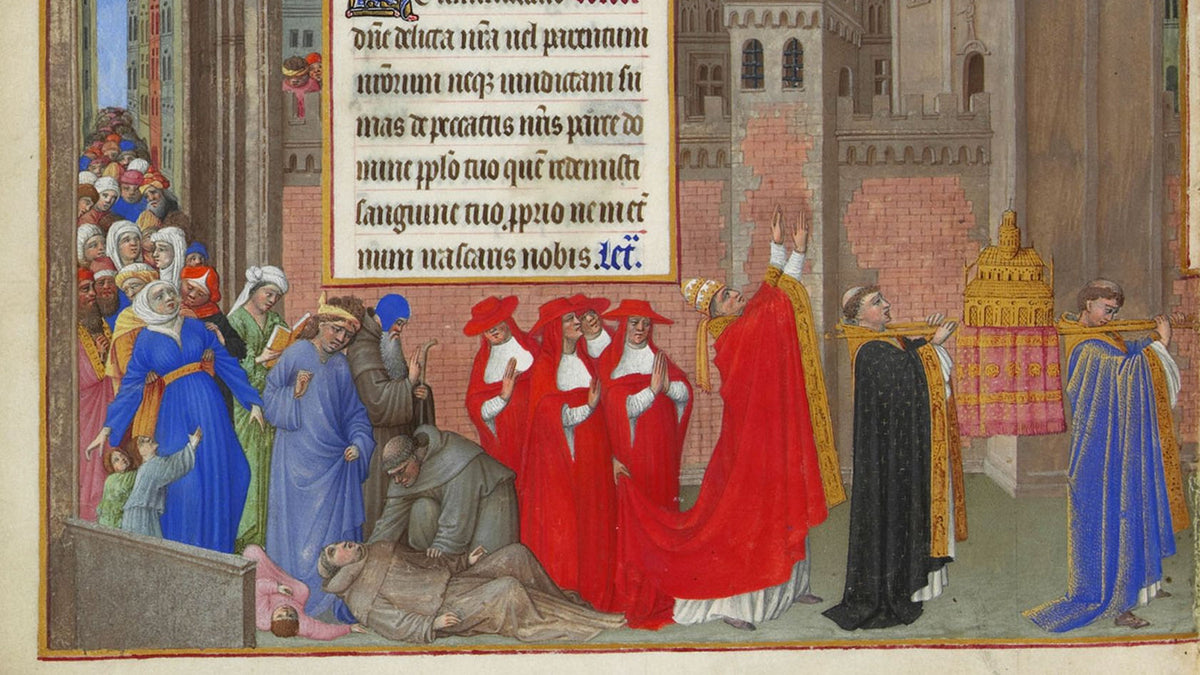
A miniature from the Très Riches Heures of the Duke of Berry, made by the Limbourg brothers in the early 15th century, illustrates this idea. It depicts a procession associated with Saint Gregory the Great: religious figures carry a reliquary while an angel appears above Rome. L’image evokes a tradition according to which a procession accompanied the end of an epidemic during Gregory’s time. The scene dates from the 15th century and depicts a story set in the late 6th century. It is therefore not a contemporary account of the events. Rather, it shows how medieval artists imagined the symbolic efficacy of a procession and the visible place of a sacred object among the people.
Relics could also become the centerpiece of monumental projects. In 1239, Louis IX acquired the Crown of Thorns from Baldwin II, Latin Emperor of Constantinople. The Centre des monuments nationaux highlights the importance of this acquisition for the king. He had the Sainte-Chapelle built in the heart of the royal palace in Paris to house the Crown and other relics of the Passion. Consecrated in 1248, the building can be understood as an immense architectural jewel case. Its stained-glass windows and proportions gave the safekeeping of a physical object considerable political and spiritual significance. The relic served to express the sovereign’s piety and the dignity of his kingdom.
Documents relating to the acquisition of 1239 must be distinguished from the question of the ancient origin of each fragment of the Passion. The documents make it possible to trace what a ruler and his entourage considered an authentic relic, as well as the decisions they made to honor it. They do not, by themselves, reconstruct all the events between Christ’s Passion and the 13th century. This historical caution does not erase the reality of royal devotion. On the contrary, it helps us understand the power of a decision: to build an exceptional structure for a tiny object whose value was above all religious.
Around 1400, a reliquary of the Holy Thorn was made in Paris for John, Duke of Berry. Now held at the British Museum, it brings together gold, enamels, pearls, sapphires, and rubies. A crystal allowed viewers to see the thorn attributed to Christ’s Crown, surrounded by angels and scenes connected to the Passion and the Resurrection. The duke’s coat of arms identifies the patron. This work shows another scale of princely devotion: a small fragment could become the centerpiece of an extremely elaborate piece of goldsmithing. The reliquary offered a sacred tableau intended to give visible form to something that, according to tradition, had touched Christ’s body.
Collective protection did not come only through the circulation of relics. In the countryside, blessed bells against storms offered another way of marking shared space as religious. Their history is distinct from that of reliquaries: the bell uses sound, while the reliquary makes visible a presence associated with the saint. Yet both traditions reveal the power of the same desire: for the village, its crops, and its people to remain under heavenly protection. These connections shed light on the landscape of popular religion without inventing a shared origin for objects that emerged in different contexts.
Beyond kings and bishops, ordinary pilgrims took part in this movement. Shrines welcomed people who came to pray, ask for help, or thank a saint. Some brought back souvenirs from their journey, helping spread the reputation of the place. Reliquaries thus became meeting points for people from far-flung regions. Their images circulated through travelers’ memories, while roads and places of lodging formed a network of human connections. A reliquary could remain in its cathedral and yet make its saint known to people who had never seen the object.
Authenticity, transformations, and the legacy of reliquaries
The fame of relics raised a difficult question very early on: how could one know who the preserved fragment really came from? An inscription, a monastic tradition, a document recording a translation, or a parchment label could provide clues, but these items did not all carry the same weight. A beautifully crafted reliquary did not guarantee the origin of its contents. Historians therefore distinguish an object’s material authenticity, its date of manufacture, and the religious attribution of the remains placed inside it. It is possible to know that a reliquary was made in Limoges in the 13th century while not knowing which shrine it originally belonged to. These gaps do not diminish its historical interest.
L’The medieval Church was aware of these difficulties. The Fourth Lateran Council, in 1215, devoted canon 62 to the question of relics. Among other things, it required that ancient relics not be displayed outside their reliquaries, condemned their sale, and required approval for the public veneration of newly discovered relics. The text denounces misleading stories and forged documents used to obtain money. This position is revealing: the authorities did not reject devotion to the saints, but sought to limit the abuses it could encourage. Protecting a sacred deposit also meant protecting the faithful from deception.
The small documents placed inside reliquaries play a valuable role for researchers today. Written strips, seals, or provenance notes may be found during restoration. They provide information about an attribution made at a particular date, the existence of a donor, or an earlier relocation. However, an old label alone cannot prove the biological identity of a fragment. L’studying the writing, wood, metal, and history of the collections allows researchers to go further, without always solving the entire mystery. This difficulty should not lead us to label all relics indiscriminately as fake or to accept all their attributions without scrutiny.
In the late Middle Ages and the Renaissance, artistic tastes brought changes in form. Reliquary busts took on features closer to human likeness, and some shrines were remodeled. The objects themselves also traveled: donations, inheritances, transfers between religious institutions, sales, and seizures could take them far from their place of origin. Their history therefore cannot be read from their style alone. An arm reliquary may bear an inscription naming a saint without it being known exactly which church it was in when it was made. Museums describe these uncertainties to distinguish confirmed findings from hypotheses.
The religious transformations of the 16th century also changed their fate. Some movements stemming from the Reformation challenged the veneration of relics, and church treasures were dispersed or destroyed in several regions. Political and financial circumstances also played a part: precious metal could be salvaged for other uses. Yet it would be too simplistic to reduce this entire history to an opposition between defenders and enemies of art. The debates concerned religious authority, images, intercession, and the meaning of material presence. Reliquaries became one of the visible settings in which these disagreements were expressed.
The Council of Trent, in its 25th session in December 1563, reaffirmed the legitimacy of venerating saints and their relics. The text emphasizes the saints’ intercession with God, while calling for abuses, profit-seeking, and distortions of religious practices to be corrected. This distinction between doctrine and contested practices is essential to history. It shows that a reliquary could be viewed both as a legitimate aid to devotion and as an object requiring scrutiny of its provenance and display. The decisions of a council provide information about ecclesiastical standards; they do not automatically describe the habits of every parish.
LModern times and revolutions continued this transformation. Some reliquaries left their churches and entered private or public collections. Others were melted down, restored, or saved by a town’s inhabitants. The treasury of Conques shows how much their material survival depended on human decisions. Today, museums study their manufacturing techniques, signs of repair, the provenance of their gemstones, and ancient inscriptions. This allows them to tell the story of the vessel even when its contents have disappeared. An artwork’s value then lies in everything it reveals about the society that produced it and the generations that preserved it.
Finally, it is important not to confuse reliquaries with other forms of material devotion. Agnus Dei disks of wax blessed by the popes belong to a different history, that of objects of blessing. Ex-votos left to the saints express promises and gratitude. A reliquary, by contrast, is intended to preserve and display material attributed to a holy person or a sacred event. Distinguishing these objects helps convey the richness of popular religion without telling the same story three times. Each has its own language and particular place in the sanctuary.
Reliquaries ultimately remind us that Christian Europe sought to make tangible a closeness between the living and those it considered saints. A fragment of bone could establish an abbey’s renown; a thorn could be enclosed in a jewel-studded case; a statue could carry a community’s memory for centuries. Historical research determines what can be dated, attributed, or documented. Religious tradition explains why these materials were honored and why their presence mattered. Between the two lies a heritage of art and devotion that is reducible neither to the value of gold nor to the curiosity of ancient objects.
Historical and museum sources
- Metropolitan Museum of Art — Barbara Drake Boehm, “Relics and Reliquaries in Medieval Christianity”
- Metropolitan Museum of Art — Wendy Alpern Stein, “Saints in Medieval Christian Art”
- Metropolitan Museum of Art — Arm reliquary of Saint Fiacre, France, 13th century
- Metropolitan Museum of Art — Arm reliquary from the Meuse Valley, c. 1230
- Cleveland Museum of Art — Limoges enamel reliquary shrine, c. 1225–1250
- British Museum — Reliquary shrine of Saint Valérie, c. 1170
- British Museum — Holy Thorn Reliquary, c. 1400
- Conques-Marcillac — The treasury and the Majesty of Saint Foy
- Centre des monuments nationaux — Saint Louis and the Sainte-Chapelle
- Martyrdom of Polycarp, chapter 18, ancient text
- Augustine, Confessions, book 9, chapter 7, account of Milan in 386
- Fourth Lateran Council, 1215, canon 62
- Council of Trent, session 25, 1563, text of the decree
- Aix-Marseille University — Miniature of the procession of Saint Gregory
Cover: Limbourg brothers, Procession of Saint Gregory, Très Riches Heures of the Duke of Berry, folio 71 verso, c. 1412–1416. Musée Condé, Chantilly. Historical public-domain illumination, Wikimedia Commons reproduction cropped to 16:9. It depicts a tradition associated with Gregory, not a contemporary account of events in the 6th century.

Par Olivier of Aeternum
Passionate about esoteric traditions and the history of the occult from the earliest civilizations to the 18th century, I share some articles on these topics. I am also co-creator of the online esoteric shop Aeternum.













